
TL;DR

Get coffee and tea gear delivered free with Prime
- Fast, free delivery on millions of items
- Prime Video, Amazon Music and more included
- Member-only deals all year
Espresso needs a better grinder because it relies on precise, repeatable grind size adjustments to control flow and extraction. Unlike drip coffee, which tolerates broader ranges, espresso’s short brew time and high pressure make grind uniformity and fine-tuning critical for perfect shots.
Ever notice how your espresso shot can go from deliciously smooth to bitter and sour with just a tiny tweak? That’s because espresso brewing is a delicate dance—tiny adjustments in grind size make a huge difference. Unlike drip coffee, which can forgive a bit of inconsistency, espresso demands precision.
In this guide, you’ll see why a high-quality, adjustable grinder isn’t just a luxury—it’s essential. We’ll explore how grind quality impacts flavor, consistency, and workflow, helping you understand what to look for in a grinder that can truly handle espresso’s demanding nature.
A high-quality espresso grinder offers fine, precise adjustments in tiny increments—crucial for dialing in shots.
Consistency in particle size is essential; uneven grounds lead to flavor imbalance and wasted beans.
A broad adjustment range makes it easier to adapt to different coffees, roasts, and machines.
Low-retention, easy-to-clean grinders support consistent dosing and workflow.
Drip coffee grinders often lack the fine-tuning and repeatability needed for espresso’s demanding process.
Why Espresso Needs a Better Grinder Than Drip Coffee
Espresso is a high-pressure, short-contact-time brew that lives or dies on grind precision. A shift of just 0.1 mm can swing a shot from bitter to sour—while drip coffee forgives far more. This guide breaks down exactly what a grinder must do to handle espresso’s demanding nature.
A slight change in grind size alters flow rate enough to turn a shot from bitter to sour—highlighting the need for highly precise, repeatable grinding tools.
Drip coffee tolerates a broad grind range with a long brew time. Espresso’s 9-bar pressure and short extraction make every micron count.
A quality espresso grinder isn’t a luxury—it’s essential equipment for consistent, balanced shots.
Finer, More Precise Settings Are Everything
Espresso works by resistance: pressurized water is forced through a compacted bed of fine coffee. Grind size controls how fast water passes. Too fine and it chokes; too coarse and it gushes. Like squeezing a thick straw versus a wide-open hose, the tight, uniform bed makes flow predictable.
A change of just 0.1 mm in grind size can shift a shot from over-extracted and bitter to under-extracted and sour. Your grinder must make tiny, repeatable steps—or you’ll chase extraction forever.
Particle Consistency Is Non-Negotiable
Imagine baking bread with wildly uneven flour: some parts over-rise, others stay dense. In espresso, small particles over-extract while large chunks under-extract—creating a shot that’s simultaneously burnt and sour.
Illustrative comparison: uniform grounds let water extract every particle evenly, giving harmonious flavor. Inconsistent grounds waste beans and make results unpredictable.
Why Drip Grinders Can’t Always Cut It
“Espresso grind” isn’t one universal setting—origin, roast, dose, basket, and machine pressure all shift the target. Like a dimmer switch, you need many small steps across a broad fine range. Drip grinders prioritize throughput and broad brew sizes over the fine-tuning espresso demands.
| Requirement | Espresso Grinder | Drip Grinder | Blade Grinder |
|---|---|---|---|
| Fine adjustment steps | ✓ Stepless / micro-steps | ✗ Too coarse for dialing in | ✗ No settings at all |
| Particle uniformity at fine range | ✓ Tight cluster around target | ~ Uneven at fine end | ✗ Highly irregular |
| Repeatability of a setting | ✓ Marked, replicable scale | ~ Broad, vague steps | ✗ Guesswork by timing |
| Low retention / single dosing | ✓ Low-retention chambers | ~ Often retains grounds | ✗ Full chamber, stale residue |
| Handles changing beans/roasts | ✓ 40–50 fine settings | ✗ Limited fine range | ✗ No control |
Note: high price alone doesn’t guarantee espresso suitability—burr design, alignment, adjustment mechanism, and build quality all matter. A good drip grinder still improves filter coffee without needing espresso-level precision.
Shopping Checklist & Recent Innovations
Modern grinders have embraced stepless adjustment, single-dose designs, low retention, clearer scales, quieter motors, and improved burr coatings—giving baristas unprecedented control.
Adjustment Precision
Stepless or very fine stepped mechanism; some now offer 0.01 mm micro-adjustments.
Burr Quality & Alignment
Conical or flat burrs with quality coatings; alignment matters as much as price.
Low Retention & Dosing
Single-dose capability and low-retention chambers keep doses accurate and fresh.
Ease of Use
Clear grind scales, easy cleaning, quiet operation—workflow consistency on every shot.
A home barista switching between light-roast filter and dark-roast espresso benefits most from a grinder that adjusts quickly and cleans easily—it’s the difference between a good shot and a great one.
The Five Things That Matter Most
Everything above distills into five essentials for any grinder that claims to handle espresso.
Fine, Tiny Increments
A quality espresso grinder offers very small adjustment steps—crucial for dialing in shots across beans and machines.
Consistent Particle Size
Uneven grounds mean uneven extraction, imbalanced flavor, and wasted beans. Uniformity is as vital as fineness.
Broad Fine-Setting Span
40–50 usable fine settings make it easy to adapt to different coffees, roasts, doses, and machines.
Low Retention & Easy Cleaning
Grounds stuck inside the grinder contaminate your next dose. Single-dosing keeps every shot precise and fresh.
Drip Grinders Fall Short
Most lack the fine-tuning and repeatability espresso demands—built for throughput, not precision at the fine end.
Drip Is Forgiving, Not Indifferent
Grind uniformity still improves drip coffee—but espresso leaves no margin for error.
Why Finer and More Precise Grind Settings Matter for Espresso
Espresso is a high-pressure, short-contact-time brew that relies on resistance—think of it as forcing water through a compacted bed of coffee. The grind size controls how quickly water passes. Too fine, and water struggles to flow; too coarse, and it rushes through.
Imagine trying to squeeze a thick straw versus a wide-open hose. The fine grind creates a tight, uniform bed, making flow rate predictable. This precision allows you to dial in the perfect extraction, balancing flavors and avoiding bitter or sour shots.
For example, a change of just 0.1mm in grind size can alter flow rate enough to shift a shot from over-extracted and bitter to under-extracted and sour. This sensitivity means your grinder must offer very fine, small-step adjustments that are easy to replicate.
Choosing a grinder that can’t make these tiny adjustments means you’ll struggle to consistently hit the ideal extraction point, leading to unpredictable results and wasted beans. The ability to fine-tune grind settings isn’t just convenience—it’s the key to mastering espresso’s delicate balance of flavors.
As an affiliate, we earn on qualifying purchases.
Why Consistency in Particle Size Is Non-Negotiable for Espresso
Imagine trying to bake bread with wildly uneven flour particles. Some parts would over-rise, others would stay dense. The same principle applies to espresso grounds. When particle sizes vary, extraction becomes uneven—smaller bits over-extract, larger chunks under-extract.
Inconsistent grounds lead to flavor imbalances where some parts of the shot taste burnt or bitter, while others are sour or weak. This inconsistency is not just a minor annoyance; it fundamentally undermines the quality of your espresso.
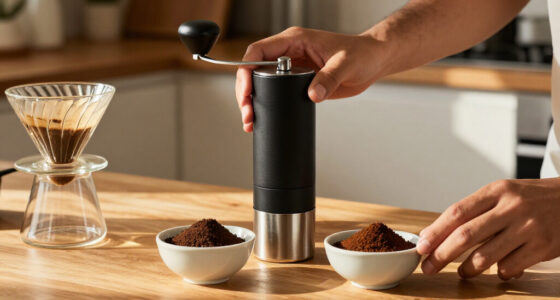
High-quality grinders produce a uniform particle size, clustering tightly around your target size. This uniformity ensures that water interacts evenly with all particles, leading to a balanced extraction where flavors develop harmoniously. The tradeoff is that inconsistent grounds force you to accept unpredictable results, wasting beans and time. Investing in a grinder that consistently produces evenly sized grounds reduces waste, improves flavor clarity, and makes your brewing process more reliable—core to espresso mastery.
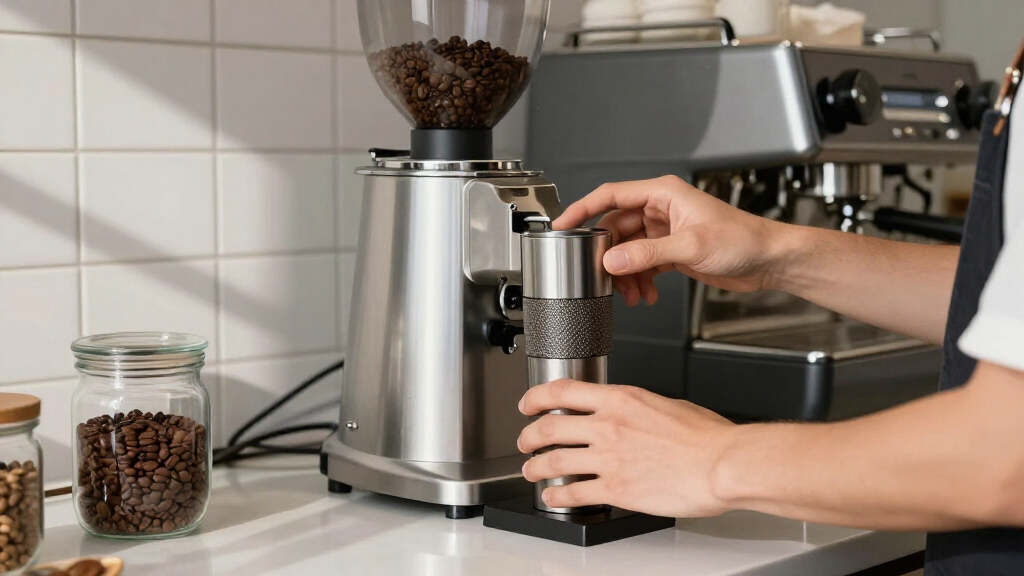
adjustable burr coffee grinder for espresso
As an affiliate, we earn on qualifying purchases.
As an affiliate, we earn on qualifying purchases.
The Range of Fine Settings: Why Your Grinder Should Do It All
Espresso brewing isn’t a one-size-fits-all process. Factors like coffee origin, roast level, dose, basket design, and machine pressure all influence the ideal grind setting. Your grinder must offer a broad, fine-tuned range to adapt quickly.
Think of it like adjusting a dimmer switch—small, precise tweaks make a big difference. A grinder with a limited adjustment range forces you to compromise, ending up with shots that are either too fast or too slow, which can lead to under- or over-extraction.
For example, a capable grinder might have 40-50 grind settings in the fine range, allowing you to find that perfect spot for different beans or machines. This flexibility isn’t just about convenience; it’s about being able to respond to subtle differences in coffee and equipment, ensuring you can consistently dial in optimal shots. Without this range, you’re left with guesswork, which diminishes your control over the final flavor profile and shot quality.
professional espresso coffee grinder
As an affiliate, we earn on qualifying purchases.
As an affiliate, we earn on qualifying purchases.
Why Workflow and Dosing Ease Matter When Choosing a Grinder
Imagine grinding coffee, only to find grounds stuck inside the machine, mixing with your next dose. Frustrating, right? A grinder designed for espresso should minimize retention and streamline dosing.
Features like single-dose capability, low retention chambers, and easy-to-read grind settings make a huge difference. They reduce the hassle of cleaning, help maintain freshness, and ensure that each shot is made with a precise amount of coffee.
For instance, a home barista switching between a light roast for filter and a dark roast for espresso benefits from a grinder that quickly adjusts and cleans easily. Efficient workflow isn’t just about speed; it’s about maintaining consistency and reducing waste, which ultimately affects shot quality and enjoyment.
As an affiliate, we earn on qualifying purchases.
Why Drip Coffee Grinders Can’t Always Cut It for Espresso
Drip coffee grinders are built to handle a wider range of brew sizes, often sacrificing fine-tuning precision. They tend to have larger, less consistent particles at the fine end, making espresso shots unpredictable and difficult to dial in accurately.
Many drip grinders lack the ability to make tiny, precise adjustments, and their coarse adjustments are often too broad for espresso’s delicate balance. This means that even if they can grind fine enough, they might not produce the consistent, uniform grounds necessary for a good shot.
Furthermore, their design prioritizes throughput over precision, which translates into less control over particle size and distribution. The result? Inconsistent extraction, wasted beans, and frustration—especially when trying to perfect your espresso shot. For serious espresso enthusiasts, investing in a dedicated espresso grinder is essential for achieving the desired flavor profile and shot consistency.
What to Look for in a Grinder to Make Better Espresso
When shopping for an espresso grinder, focus on adjustment precision, consistency, and ease of use. Look for grinders with stepless or very fine stepped adjustment mechanisms, and check if they offer a wide range of fine settings.
Pay attention to burr quality—conical or flat burrs with high-quality coatings tend to produce more even grounds. Also, consider features like low retention chambers, clear grind scales, and quiet operation.
For example, a home barista might prioritize a stepless grinder with a high-quality burr set and easy maintenance. It makes the difference between a good shot and a great one.
Recent Innovations Making Espresso Grinding Easier and Better
New grinder designs have focused on stepless adjustments, low retention, and user-friendly interfaces. Single-dose grinders are popular because they reduce stale grounds and simplify switching beans.
Manufacturers now promote features like quieter motors, clearer grind setting scales, and improved burr coatings. These innovations aim to give baristas and enthusiasts better control and consistency.
For instance, a grinder with micro-adjustments in 0.01mm steps allows for hyper-precise dialing, which can make all the difference in flavor balance and shot consistency.
Frequently Asked Questions
Why does espresso need a finer grind?
Espresso requires a finer grind because the high pressure and short brew time demand more resistance for proper extraction. A finer bed slows the water flow, allowing flavors to develop fully within seconds, unlike drip which can tolerate coarser settings.
Can I use my drip grinder for espresso?
Sometimes, but many drip grinders lack the fine, repeatable adjustments that espresso demands. Check if your grinder can produce a truly fine, consistent grind and make small incremental changes easily. Otherwise, you’ll struggle to dial in the shot accurately.
Does a more expensive grinder always make better espresso?
Not necessarily. A higher price often means better adjustment mechanisms, build quality, and durability, but the grinder must also suit your machine, coffee, and workflow. Quality and compatibility matter more than cost alone.
Is grind size the only thing that affects a shot?
No. Factors like dose, tamping, coffee freshness, water temperature, and machine pressure all influence the final shot. But grind size is the most immediate and adjustable variable for controlling flow and extraction.
Should I buy a stepped or stepless grinder?
Stepless grinders offer very fine, incremental adjustments, making it easier to find the perfect setting. Stepped grinders are simpler to repeat but might lack the necessary granularity for precise espresso dialing—consider your needs and experience level.
Conclusion
Choosing the right grinder isn’t just about price—it’s about matching the tool to espresso’s exacting needs. A grinder that offers fine, repeatable adjustments and consistent grounds transforms good espresso into great.
Remember, the smallest tweak in grind size can change your shot from bitter to sweet. Invest in a grinder that helps you control that tiny detail, and your espresso will thank you. Now, go perfect that grind—and enjoy shots that truly shine.
Halloween Picks
halloween
As an affiliate, we earn on qualifying purchases.