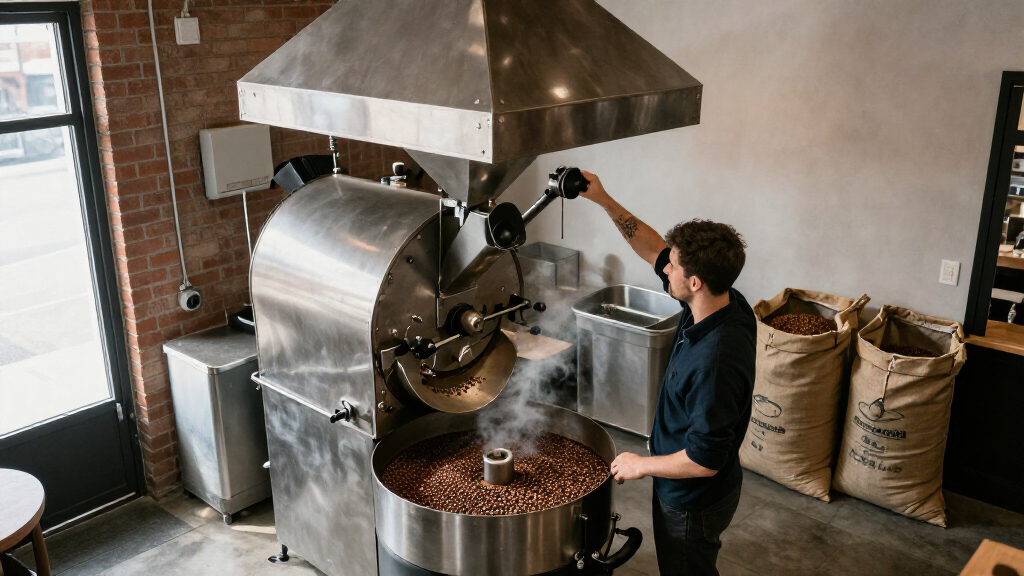

TL;DR
Coffee roasting produces smoke, odors, and fine particles, so a roaster needs an exhaust system that carries emissions safely out of the building. Smoke suppression equipment can reduce some smoke and odor, but it does not make exhaust disappear or remove the need for suitable venting, careful installation, and regular cleaning. Coordinate the roaster, fan, ductwork, treatment unit, and local requirements with the manufacturer and qualified local professionals.
A smoke suppressor can make the plume above a coffee roaster look cleaner, but the exhaust still has to go somewhere. Smoke reduction is not the same as ventilation, and confusing the two can leave a roastery smoky, uncomfortable, or poorly ventilated.

Get coffee and tea gear delivered free with Prime
- Fast, free delivery on millions of items
- Prime Video, Amazon Music and more included
- Member-only deals all year
As heat transforms sugars, oils, and other compounds in green coffee, coffee roasting produces smoke, odors, and fine particles. This guide explains what suppression equipment does, why a reliable exhaust route matters, and what to check before installation or maintenance. You’ll also see why visible smoke alone cannot tell you whether a system handles every emission safely.
Smoke suppression treats some exhaust emissions; it does not eliminate the need for a safe exhaust route.
The roaster, fan, ductwork, and treatment unit need to work together at the required airflow and operating conditions.
A lighter-looking plume does not prove that odor, gases, or fine particles have been eliminated.
Chaff and oily residue can restrict airflow and create hazards, so follow the manufacturer’s inspection and cleaning schedule.
Have installation and code questions checked against the roaster manual, local requirements, and qualified local professionals.
Smoke Suppression Still Needs Venting
Suppressors can reduce visible smoke and odor, but roasting exhaust still needs a safe route outside. The whole system must work together to protect people, equipment, and nearby spaces.
What venting protects
A clear exhaust route supports a safer, more comfortable roastery.
Indoor comfort
Smoke, odors, and fine particles can irritate eyes and airways or linger where staff and customers work.
Cleaner ductwork
Chaff and oily residue can restrict airflow and create hazards. Follow the manufacturer’s cleaning schedule.
Controlled airflow
Poor or altered exhaust can affect roaster operation and roast results.
Thoughtful outlet placement
Emissions can reach nearby homes, businesses, or outdoor seating if the outlet is poorly placed.
Treatment is one part of the route
Afterburners, oxidizers, and filters treat some emissions; they do not make exhaust disappear.
- Reduce visible smoke and odor
- Break down smoke-forming compounds or filter emissions
- Improve the plume when operated as designed
- A suitable exhaust path out of the building
- Airflow matched to the roaster and treatment unit
- Maintenance and safe discharge location
Match the full system
Sizing and installation depend on the machine, building, and operating conditions.
Record the roaster model, exhaust connection, installation requirements, and specified operating conditions.
Account for duct path, outlet location, clearances, building layout, and make-up air.
Have the manufacturer and a qualified local professional assess the roaster, fan, ductwork, and treatment unit as a set.
What appearance cannot tell you
A lighter-looking plume is only evidence of a visible change.
Why Proper Venting Keeps a Roastery Safer and More Comfortable
Venting carries roasting emissions out of the building and helps keep the work area comfortable. Coffee roasting produces smoke, odor, and fine particles as heat transforms compounds in green coffee, and those emissions can irritate eyes and airways. If exhaust is not captured and carried away, it can linger where people work, even when the roast itself is operating normally. A smoky room is unpleasant for a barista, a roaster operator, and a customer waiting at the counter.
Airflow also matters to the equipment itself. Roasters use controlled airflow to move heat and combustion byproducts; an exhaust system that is blocked, undersized, or altered can affect how the machine operates and may affect roast results. The practical implication is that exhaust changes can have effects beyond smoke at the outlet: they may change how air moves through the roaster. Think of the exhaust like a kitchen’s drain: treating a little of what passes through does not remove the need for a clear route out.
Fire precautions belong in the same conversation. Chaff and oily residue can collect in ducts and equipment, where deposits may restrict airflow and create hazards. Reduced airflow can make the system less effective while buildup remains hidden in parts of the route staff rarely see. For example, a small shop that roasts a few batches each morning can still build residue over time if nobody checks the duct route or follows the manufacturer’s cleaning schedule.
Venting also determines where emissions go after they leave the roaster. A well-functioning fan and duct still need an outlet placed with the building and surrounding area in mind; otherwise, emissions carried outside may return through an opening or reach nearby spaces. A poorly placed outlet may send odor toward an open window, a neighboring apartment, or the café’s outdoor seating. Why venting matters is practical: it protects indoor comfort, supports equipment airflow, helps limit fire risk, and reduces the chance that emissions become a neighborhood problem. These goals depend on the route as a whole, so improving one part of the system cannot automatically compensate for a problem elsewhere.
Products Worth Considering

Cuisinart 7-in-1 Air Fryer Toaster Oven, 1800W, TOA-55

De'Longhi Magnifica Duo Fully Automatic Espresso Machine with Hot and Cold Milk Frother

Instant Pot Pro 8 Qt 10-in-1 Electric Pressure Cooker, Black
As an affiliate, we earn on qualifying purchases.
What a Smoke Suppressor Can—and Cannot—Remove
Smoke suppression treats exhaust; it does not make exhaust disappear. An afterburner or oxidizer heats exhaust to break down smoke-forming compounds. Other equipment may use filtration or combine treatment methods. In each case, the treatment unit is only one part of the route: the treated air still needs a suitable path out of the roaster and building.
How well a unit works depends on its design, operating temperature, airflow, fuel, maintenance, and the emissions it is meant to treat. Those conditions matter because the unit has to receive exhaust at the conditions it was designed for; a mismatch can reduce treatment performance or interfere with airflow. That means a system that performs well with one roaster and installation may not deliver the same result with a different machine or duct layout. If a café owner adds a treatment unit but ignores the fan or duct sizing, the system may not move air as intended. A more capable treatment unit can also bring installation and maintenance demands, so owners need to weigh expected smoke and odor reduction against those practical requirements.
Visible smoke, odor, gases, and fine particles are different concerns. A plume that looks lighter does not prove that every pollutant has been removed or that the remaining emissions are harmless. Appearance is a limited observation: it can show a change in visible smoke, but it cannot establish what is present in the air or how the system performs across all operating conditions. Imagine a delivery driver seeing less haze at the outlet: that observation says something about visible smoke, but it cannot certify the system’s full emissions performance.
Smoke reduction and odor control are related goals, yet neither substitutes for safe exhaust ventilation. Ask the roaster manufacturer and treatment equipment supplier what the system is designed to handle, which operating conditions it requires, and what maintenance it needs. Keep performance claims specific to the equipment and conditions being discussed. That gives owners a clearer basis for comparing options and avoids treating a visible improvement as proof that every ventilation or emissions concern has been addressed.
How to Match the Roaster, Fan, Duct, and Treatment Unit
A roaster exhaust system works when its parts are sized and installed as a set. The roaster, ductwork, fan, and suppression unit all affect airflow. A treatment unit that restricts flow, a duct that is too small, or a fan that cannot meet the system’s needs may interfere with operation. The tradeoff is that adding equipment to reduce smoke can create new airflow demands; unless the whole path is assessed, an upgrade intended to improve emissions may leave the roaster with inadequate exhaust.
- Start with the roaster manual. Record the model, installation requirements, exhaust connection, and specified operating conditions. These details give the manufacturer and installer a baseline for assessing compatibility. For example, a roastery replacing a machine should not assume the new roaster can use the previous machine’s duct route unchanged.
- Map the building and exhaust route. Note the duct path, outlet location, clearances, building layout, and the supply of make-up air. A long route with multiple turns may create different demands than a short, direct run. Mapping the route helps show how the building—not just the roaster—shapes the system’s airflow and where emissions will discharge.
- Check the full system together. Have the manufacturer and a qualified ventilation professional account for the fan, duct, and treatment unit under the required operating conditions. Considering the components as a set can reveal a restriction or mismatch that would be missed by choosing each piece separately.
- Confirm local requirements. Ask the relevant local authorities and qualified fire-safety professionals about applicable installation, fire-protection, and emissions rules. Requirements and site conditions can differ, so a setup that works at one roastery is not proof that the same design is suitable at another.
- Set a maintenance plan before roasting. Identify who inspects and cleans the system, how often the manufacturer calls for service, and how to spot restricted airflow. This makes the ongoing cost and work part of the installation decision, rather than a surprise after buildup begins to affect performance.
Do not improvise exhaust changes. Adding a restrictive filter, reducing duct size, or redirecting a vent can affect airflow and create safety problems. A café that wants to avoid a visible plume should get the system assessed before adding parts; visual appearance alone is not a design specification. Any proposed change needs to account for what it does to airflow, treatment performance, and the discharge route together.
What to Check When Smoke or Odor Escapes Indoors
Smoke escaping indoors calls for an airflow and installation check. A suppressor cannot compensate for every problem upstream or downstream. The cause could involve a blocked or dirty duct, a fan or treatment unit that is not operating as intended, a mismatch between components, or an installation that does not suit the building. Because several parts can produce similar symptoms, changing one component based only on appearance may hide the clue without fixing the cause.
Start with a concrete observation rather than a guess. Note when smoke appears: during startup, throughout roasting, or only during a particular part of a batch. Record whether the exhaust outlet also shows a change, whether the smell is stronger near one connection, and whether the issue began after maintenance or a system modification. The timing can help narrow down which operating condition or recent change deserves attention.
For example, if a roaster ran cleanly for months and smoke began escaping after someone installed a filter, that timing is useful information for the manufacturer or ventilation contractor. It does not prove the filter caused the problem, but it gives them a specific change to inspect. A symptom log helps professionals diagnose the system without encouraging risky trial-and-error. It also helps distinguish an occasional event from a persistent change that may point to a developing restriction or equipment fault.
Follow the machine’s instructions and stop relying on the system if you suspect a serious ventilation or fire hazard; contact the manufacturer and qualified local professionals for guidance. Do not reduce duct size, block an outlet, or redirect a vent to hide a plume. Those shortcuts can worsen airflow or move the problem to another part of the building, while leaving the underlying cause unresolved.
How Regular Cleaning Protects Airflow and Fire Safety
Regular cleaning helps keep chaff and oily deposits from restricting exhaust airflow. Roasting sends chaff and residue through parts of the system, and deposits can accumulate in ducts and treatment equipment. As buildup grows, it can narrow the path that exhaust travels through, making airflow less reliable and creating a hazard that may not be visible from the roaster. A roastery’s cleaning needs depend on its equipment, use, and manufacturer instructions, so there is no universal interval that suits every setup.
Follow the manufacturer’s cleaning and inspection schedule for the roaster, ductwork, fan, and suppression unit. Make sure staff know who handles each task and where to report a visible change in airflow, a new odor, or smoke escaping around a connection. For instance, a shop roasting multiple batches each day should plan inspection and service around its actual operating schedule, not rely on a vague reminder to clean “when it looks dirty.” A schedule turns cleaning into a routine part of operating the equipment, rather than a response only after performance changes.
Keep a simple service record. Write down the date, the component inspected or cleaned, any unusual buildup, and whether the system needed repair. This record can help a technician spot recurring problems, such as one section of duct accumulating residue faster than the rest. That pattern may point to a place where airflow, layout, or service attention deserves a closer look.
Cleaning is one part of fire safety, not a substitute for a suitable installation or local fire precautions. If staff notice heavy buildup, damaged parts, or restricted airflow, they should follow the manufacturer’s instructions and bring in qualified help. Visible cleanliness at the roaster does not prove the entire exhaust route is clear; the duct and treatment equipment need attention too. Keeping those less visible sections in the maintenance plan matters because a clear-looking roaster can still be connected to a restricted or dirty exhaust path.
How to Reduce Neighbor Complaints Without Guesswork
Reducing neighborhood odor starts with a suitable exhaust route and treatment system. Outlet placement matters because a plume can travel toward nearby homes or businesses, especially when the building layout puts windows, doors, or outdoor seating close by. A suppressor may reduce visible smoke and odor, but results depend on the system and its operating conditions. That means a treatment unit and outlet need to be considered together: changing one without understanding the other may shift where the odor is noticed rather than resolve it.
Consider a roastery beside a small apartment building. Staff may see little smoke at the outlet yet still receive complaints when roasting begins early in the morning. The timing and location of the odor are useful clues; they do not, by themselves, establish whether emissions meet local requirements or whether the equipment is malfunctioning. The difference matters because the response to a routing issue may be different from the response to a maintenance or treatment problem.
Keep a practical record of batch times, reported odor locations, system maintenance, and any changes to equipment or airflow. Share it with the roaster manufacturer, ventilation professional, or relevant local authority when seeking advice. Measure and investigate where appropriate instead of judging performance only by what the plume looks like. The record can help connect reports to operating patterns and give professionals a clearer starting point for checking the system.
Local rules and building conditions vary, so have exhaust placement and treatment reviewed for the site. Ask neighbors or staff when and where the odor is strongest, then compare those reports with the roasting schedule. Specific observations make troubleshooting more useful and can help the right professional identify whether routing, maintenance, or system design needs attention. This approach is more useful than adding equipment based on a single complaint, since extra treatment may bring added maintenance needs without addressing an outlet-location problem.
What to Ask Before Choosing a Suppression Setup
Ask how the proposed system handles your roaster’s airflow and site conditions. A product label or a claim of reduced smoke cannot tell you whether a unit is appropriately sized, maintainable, or suitable for a particular building. The answers matter because a treatment system must fit the roaster and exhaust route, and its ongoing service needs affect how reliably it can perform. Use the questions below to get clear answers before committing to an installation.
| Ask about | What you need to learn | Example question |
|---|---|---|
| Compatibility | Whether the roaster, fan, duct, and treatment unit work together at required operating conditions. | “Is this setup suitable for my roaster model and its specified airflow?” |
| Emissions | Which emissions the equipment is designed to treat and what it does not remove. | “Does this reduce visible smoke, odor, or both—and what remains?” |
| Installation | How duct route, outlet location, clearances, make-up air, and building layout affect the design. | “Who will assess the full route and local requirements?” |
| Maintenance | Cleaning and inspection tasks, their schedule, and signs that airflow needs attention. | “What service does the manufacturer specify, and who can perform it?” |
| Approvals | Which local rules or fire precautions apply to the site. | “Which authority or qualified local professional should confirm the installation?” |
If you are comparing machines, the [guide to coffee roasters with smoke suppression](https://espressoguide.net/vetted/8-best-coffee-roasters-with-smoke-suppression-in-2027/) can help you understand what suppression features are available. Treat any feature as one part of the system. A properly designed installation still needs a safe exhaust path, suitable airflow, and a maintenance plan. Comparing the full requirements alongside the feature helps you weigh expected smoke reduction against installation fit and the work needed to keep the system operating.
Frequently Asked Questions
Does a coffee roaster need to be vented outdoors?
A roaster needs a suitable exhaust route designed for its equipment and building. Follow the manufacturer’s instructions and ask qualified local professionals and relevant authorities about the site’s installation requirements.
Will a smoke suppressor eliminate smoke and coffee odor?
It may reduce visible smoke and odor, depending on the system, operating conditions, and maintenance. It does not necessarily remove every pollutant, and treated exhaust still needs a suitable discharge route.
Is an afterburner required for every coffee roaster?
Requirements depend on the equipment, site, and local rules. Check with the roaster manufacturer, relevant local authorities, and qualified ventilation or fire-safety professionals rather than assuming every installation has the same requirements.
Can I connect a small roaster to an existing hood or chimney?
Do not assume an existing hood or chimney is suitable. The duct route, airflow, clearances, outlet location, and building conditions all matter. Have the setup checked against the roaster’s requirements by qualified professionals.
How often should I clean roaster ducts and suppression equipment?
Use the manufacturer’s cleaning and inspection schedule for your specific equipment. Chaff and oily residue can build up and restrict airflow, so keep service records and ask a qualified technician about unusual buildup or changes in operation.
Conclusion
Remember the distinction: suppression treats exhaust, while venting carries it safely out. Before changing or buying equipment, check the roaster’s requirements, the complete duct and fan setup, the outlet location, maintenance needs, and applicable local rules with qualified professionals.
A clean-looking plume is only one small window into a roastery’s air. Keep the exhaust route clear, the system maintained, and the people working nearby breathing comfortably.