
TL;DR

Get coffee and tea gear delivered free with Prime
- Fast, free delivery on millions of items
- Prime Video, Amazon Music and more included
- Member-only deals all year
Alkalinity measures how well water buffers coffee’s acids, while hardness mainly reflects calcium and magnesium. Too much buffering can make espresso taste muted; too little can make acidity seem sharp, though extraction and the coffee itself also matter. A moderate starting point often cited for coffee water is 30–50 mg/L as calcium carbonate, but test your water and follow your machine’s guidance rather than treating that range as a universal recipe.
A new bag of coffee can taste lively on Monday and strangely flat on Tuesday, even when you use the same grinder and recipe. Sometimes the quiet variable is the water: its alkalinity, or ability to buffer acids, can change how the coffee’s brightness comes through.
Espresso beginners often spend their attention on grind size, dose, and temperature. Those choices matter, but they cannot always correct a water profile that is pushing flavor in the wrong direction. This guide explains why alkalinity matters, how it differs from hardness and TDS, and what you can do when a shot tastes persistently sharp or dull.
You’ll also get a practical way to check your water and a sensible starting range. Think of water like the lighting in a kitchen: it doesn’t change the ingredients, but it can make their details look very different. Your goal is repeatable, good-tasting espresso and water that suits your machine.
Alkalinity measures acid-buffering capacity, mainly associated with bicarbonate; hardness mainly reflects calcium and magnesium.
High alkalinity can mute perceived brightness, while low alkalinity can make acidity seem sharper, but neither taste proves the cause.
A TDS meter cannot measure alkalinity; use a water report or alkalinity titration kit.
About 30–50 mg/L as calcium carbonate is a commonly cited starting range, not a universal espresso target.
Check filter specifications and machine water guidance; scale risk depends on hardness, temperature, alkalinity, and other water conditions.
Why Alkalinity Matters More Than Beginners Realize
Water’s buffering capacity can change how espresso acidity tastes, even when the coffee and recipe stay the same.
Know what each measure tells you
These water measures answer different questions, so one cannot stand in for another.
| Measure | What it tells you | Why check it |
|---|---|---|
| Alkalinity | Acid-buffering capacity | Helps explain muted or sharp acidity |
| Hardness | Mainly calcium and magnesium | Relevant to brewing and scale conditions |
| TDS | Total dissolved solids | Broad reading; does not measure alkalinity |
How buffering shifts flavor
Alkalinity can change the way coffee acids register, but taste alone does not prove water is the cause.
- Can mute brightness and make espresso seem flat or less distinct.
- May soften an aggressive edge while hiding delicate flavors.
- Offers less buffering, so acidity may seem sharp or unbalanced.
- Under-extraction and the coffee itself can create similar tastes.
Check water when flavor stays off
A persistent change across coffees makes water worth investigating alongside brewing variables.
Compare a reliable water report or use an alkalinity titration kit.
A TDS meter cannot tell you alkalinity, even when readings look similar.
Check filter specifications and manufacturer water recommendations; scale depends on several water conditions.
Understand what alkalinity tells you about espresso water
Alkalinity measures water’s capacity to neutralize acids, mainly through bicarbonate ions. In espresso, that buffering affects how vividly the coffee’s natural acidity comes across. When acids meet bicarbonate, some of their sharp impression is softened; the coffee’s compounds are still there, but their balance can register differently on your palate. That is why alkalinity can affect flavor without changing the beans or recipe.
Here’s a useful comparison: alkalinity is like a dimmer switch for acidity, while hardness is more like a separate ingredient in the water. Hardness mainly describes dissolved calcium and magnesium. The two measurements can vary independently, so water can have high hardness and low alkalinity, or the reverse. This distinction matters in practice: choosing water by hardness alone may address one brewing or equipment concern while leaving the flavor-buffering question unanswered.
Imagine you change a tap-water source and your usual espresso suddenly tastes rounder but less lively. You might first blame the grinder, yet a change in bicarbonate could have altered the way acids register. The same coffee and recipe can taste different in different water, even when neither water looks or smells unusual. If the shift persists across several coffees, water becomes a more plausible factor because it is the shared part of each brew.
A TDS meter won’t answer the alkalinity question. It measures total dissolved solids, not how much acid-neutralizing capacity the water has. Two samples can show similar TDS readings and still behave differently in the cup. A broad solids reading can be useful for tracking whether water changed, but it cannot tell you which dissolved substances changed or how strongly the water will buffer acids. That’s why alkalinity is one of the measurements to check when a flavor shift persists after you’ve ruled out obvious brewing changes.
Products Worth Considering

De'Longhi Classic Signature Espresso Machine with Adjustable Milk Frother

De’Longhi Classic Matte Black Espresso Machine with Milk Frother

De'Longhi La Specialista Arte Evo Espresso Machine with Grinder
As an affiliate, we earn on qualifying purchases.
See why high and low alkalinity change flavor
Alkalinity influences how much coffee acidity remains perceptible in the cup. Water with high alkalinity can buffer more of the acids, making espresso seem dull, muted, or less distinct. Very low alkalinity offers less buffering, so the same coffee may taste sharply acidic or unbalanced. The tradeoff is that buffering can smooth an aggressive edge, but too much can also hide the fruit or brightness that makes a coffee distinctive.
That doesn’t make every sour shot a water problem. Under-extraction, stale beans, or a coffee’s natural character can all produce a similar impression. Picture a new espresso drinker pulling a quick shot that tastes sour. If the shot runs fast, grind and extraction are likely suspects: changing water first could mask the symptom while leaving the uneven extraction unresolved. If the recipe is steady but a water change has made several coffees taste unusually flat, it makes sense to investigate alkalinity too.
Water is one part of the extraction recipe, much like the stage lighting in a play: it can bring certain details forward and soften others. It does not make a weak performance strong on its own. A delicate, high-acid coffee may lose some sparkle in highly alkaline water, while a coffee that already tastes bright could feel more balanced with moderate buffering. The best balance depends on what you want to preserve: a softer cup may be pleasant, but it can come at the cost of clarity.
These effects depend on the beans, roast, machine, and your own palate. If a shot tastes dull, don’t assume that raising the temperature will solve everything. A water profile may be part of the issue, but change one variable at a time so you can tell whether a new setting or new water actually helped. That also prevents one adjustment from compensating for another and making the underlying cause harder to identify.
Tell alkalinity apart from hardness, TDS, and scale risk
Alkalinity, hardness, and TDS answer different questions. Alkalinity indicates acid-buffering capacity; hardness mainly reflects calcium and magnesium; TDS reports the combined amount of dissolved material. A single number cannot stand in for all three, and no one measurement gives you the complete picture of your brewing water. These distinctions matter because a water choice has two jobs: it should support the flavor you want and stay within the conditions your machine can handle.
| Measurement | What it tells you | Why you might check it |
|---|---|---|
| Alkalinity | How much water can buffer acids | Helps explain muted or sharp acidity |
| Hardness | Mainly dissolved calcium and magnesium | Relevant to brewing and scale conditions |
| TDS | Total dissolved solids | Gives a broad reading, not alkalinity by itself |
For example, a home barista could see a familiar TDS reading after switching bottled water brands, then wonder why a favorite espresso tastes different. That reading does not confirm that the alkalinity stayed the same. Checking a water report or using an alkalinity titration kit can reveal a difference that the TDS meter misses. The extra measurement is useful because it helps distinguish a buffering change from a change in the overall amount of dissolved material.
Scale risk depends on more than alkalinity alone. Calcium and magnesium hardness, temperature, and the wider water composition also matter. A high alkalinity number by itself does not predict whether your machine will scale, and treating it as a complete scale test could give false confidence. Follow the manufacturer’s water recommendations, because equipment guidance is part of choosing water that works for both the cup and the machine.
Use 30–50 mg/L as a starting point, not a rule
A commonly cited starting range for coffee water is about 30–50 mg/L alkalinity as calcium carbonate. It offers a practical reference for beginners, not a universal target. The point of a starting range is to narrow your first comparison, not to guarantee a particular flavor: your coffee, machine, and taste preferences can all change what works best.
Units need care. Water reports may express alkalinity in mg/L as calcium carbonate or in degrees of carbonate hardness. Those units are related, but you shouldn’t compare their numbers directly without converting them. If your report says “degrees” and a recipe says “mg/L,” pause and check the units before changing your water. Otherwise, a number that looks similar could represent a substantially different level.
Suppose your bright washed coffee tastes too sharp with very low-alkalinity water. A moderate increase in buffering might round the cup without hiding all the fruit notes. A darker roast may call for a different balance, and one water recipe may not flatter every coffee in your cupboard. More buffering can reduce a harsh impression, but if you keep increasing it, you may trade that smoothness for a cup that feels less vivid.
Recipes are starting points, not guarantees. Specialty coffee advice increasingly treats water as an adjustable brewing ingredient, with published mineral recipes and concentrate-based mixing becoming more common. Even so, there is no single recipe that suits every espresso. Keep notes on the water, beans, and shot, then taste the result before deciding that a number is “right.” A small, controlled comparison lets you learn whether the change improved the cup you care about while keeping the machine’s requirements in view.
Check your water before chasing a better shot
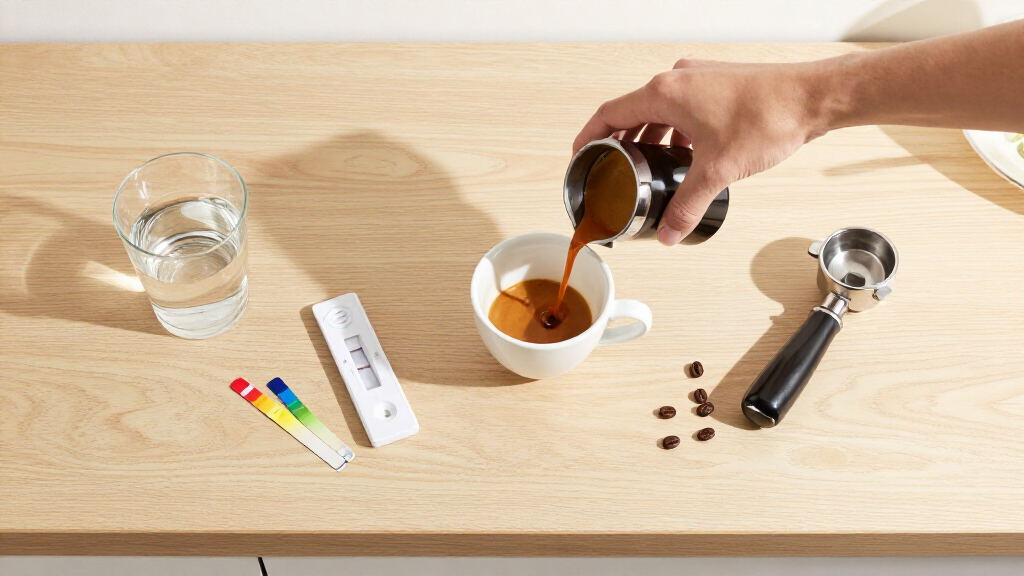
Test alkalinity when a water change or persistent flavor shift gives you a reason. You don’t need to turn every espresso session into a chemistry experiment. But if your water source is unknown, a filter has changed, or several coffees suddenly taste muted or overly sharp, a water report or alkalinity titration kit can give you useful evidence. Testing is most valuable when it answers a real comparison: it can help you decide whether a water change is worth trying before you spend time adjusting a stable recipe.
- Identify your water source. Look up the local water report, or find the analysis for your bottled water. Treat a label or a TDS reading as incomplete unless it provides alkalinity.
- Measure alkalinity directly. Use a water alkalinity titration kit or a reliable report. A basic TDS meter does not measure buffering capacity.
- Check the filter specifications. Filters vary: some reduce hardness, some reduce alkalinity, and some affect both. Check how performance changes with use and replace the filter on schedule.
- Change one thing and taste. Keep your dose and grinder setting steady while you compare water. That makes it easier to notice whether the water improved the cup.
For instance, if espresso gets flat just after you install a new filter, don’t immediately change the grind, temperature, and dose at once. Check whether that filter changes alkalinity, then compare a controlled shot. One change at a time makes the result easier to interpret. If the taste improves with a different known profile, you have a reason to keep exploring; if it does not, you can return attention to extraction or the beans.
If you mix water at home, use a measured recipe and clean containers. Follow your machine’s water guidance, especially if you’re uncertain about scale risk. The aim is a repeatable profile that tastes good and fits the equipment, not a complicated routine for its own sake. A useful water check should simplify your next decision, not add measurements without a purpose.
Use taste clues without mistaking them for proof
A sharp or flat taste can point you toward a water check, but it cannot diagnose alkalinity on its own. Very low buffering may make acidity stand out; high buffering may soften brightness. Yet grind size, extraction, roast, freshness, and brewing temperature can lead to similar impressions. Because these causes overlap in taste, treating a flavor description as a diagnosis can send you toward a water change that does not address the real problem.
Say your espresso tastes lemony and thin. If it also runs quickly, start by checking extraction and grind. If it tastes dull across several coffees despite a stable recipe, and you recently changed water or filters, alkalinity deserves a closer look. A real-world comparison helps: taste two coffees made with the same recipe and different known water profiles, keeping everything else steady. This comparison can show whether water is contributing, though it will not isolate alkalinity if the profiles differ in other ways too.
Think of flavor as a clue, not a lab test. Your palate can tell you that something changed; it cannot reliably identify bicarbonate concentration. This distinction keeps you from buying a test kit to “fix” what was actually a stale bag of beans or a shot that extracted unevenly. It also keeps expectations realistic: a water result is one piece of evidence to use alongside the recipe and the coffee.
When you make adjustments, write down the date, water source, filter age, coffee, and what you tasted. A simple note such as “new tap filter, same recipe, less brightness” is more useful a month later than a vague memory. Over time, you’ll learn whether your setup responds to water changes and when testing is worth the effort. That makes each experiment more informative and helps you avoid repeating changes that did not improve the cup.
Frequently Asked Questions
Is alkalinity the same as water hardness?
No. Alkalinity measures acid-buffering capacity, while hardness mainly reflects dissolved calcium and magnesium. Both can affect brewing and scale conditions, but they describe different properties.
Can high alkalinity make espresso taste sour?
High alkalinity more commonly mutes perceived acidity, making a cup seem flat or less distinct. Sourness often points to under-extraction, though coffee and water interact, so taste alone cannot identify the cause.
What alkalinity should I use for espresso?
A commonly cited starting range is 30–50 mg/L as calcium carbonate. Treat it as a reference, then account for your coffee, taste, machine guidance, and the rest of the water profile.
Can a TDS meter tell me my water’s alkalinity?
No. A TDS meter measures total dissolved solids, not acid-buffering capacity. Use a water report or an alkalinity titration kit to check alkalinity directly.
Will a filter fix high alkalinity?
It depends on the filter. Some filters reduce alkalinity, some reduce hardness, and some affect both; check the specifications and follow the replacement schedule.
Does alkalinity cause scale in an espresso machine?
Alkalinity can contribute to scale conditions, but it does not predict scale by itself. Hardness, temperature, and the full water composition also matter, so follow your machine manufacturer’s water recommendations.
Conclusion
When espresso flavor stays off despite a steady recipe, check the water before endlessly adjusting the grinder. Alkalinity affects how acidity comes through, while hardness, temperature, and the broader water profile matter for brewing and machine care. Start with a report or titration test, use a moderate range as a reference, and let your coffee and equipment guide the final choice.
Keep the test simple and change one variable at a time. A tiny difference in an invisible glass of water can decide whether your espresso’s bright notes ring clearly or disappear into the steam.