
TL;DR

Get coffee and tea gear delivered free with Prime
- Fast, free delivery on millions of items
- Prime Video, Amazon Music and more included
- Member-only deals all year
Hard water can leave mineral scale in boilers, thermoblocks, valves, and narrow passages, affecting flow, heating, and repair needs. Before you buy, test your tap water, check the exact machine’s water requirements and warranty, confirm approved treatment options, and price the routine you can maintain. No machine design or filter makes water care automatic.
Your espresso machine can look spotless on the counter while calcium and magnesium quietly build up inside its hottest, narrowest passages. That hidden deposit—scale—can slow water flow, interfere with heating, and turn a routine coffee habit into a service call.
Hard water and espresso machines call for a buying decision that starts with your tap, not a feature list. You’ll learn how to check your water, compare machine designs and treatment options, estimate ongoing costs, and protect your warranty. Think of water care as choosing the road your machine will travel every day: a great machine still needs a route its water system can handle.
Test the water at your tap; neighborhood averages may not reflect your supply.
Compare your reading with the exact machine’s stated water requirements.
Treat filters as model- and water-specific tools, not a guarantee against scale.
Price replacement supplies, suitable water, and service before you buy.
Follow the maker’s descaling and warranty instructions; no heating design is scale-proof.
BUYER’S FIELD GUIDE · WATER CARE
Hard Water and Espresso Machines: What to Solve Before Buying
Start with the water you will actually use. Test your tap, check the exact machine’s requirements, and choose a treatment routine you can maintain.
01 / KNOW YOUR INPUT
Read the water before the feature list
Hardness comes mainly from dissolved calcium and magnesium. A city-wide average is only a clue: supply can vary by neighborhood, building, or source.
Start with a report
Look up your local water report, then use a home test strip if you want a reading from the tap that fills your reservoir.
Keep hardness and alkalinity
They describe different parts of water chemistry. Save both figures when available and compare them with the exact model’s guidance.
Ask the maker
If you cannot get a reliable reading, ask what range the machine accepts and how to check your supply before committing.
Sequence shown as a decision path, not a hardness scale: establish your water, compare requirements, then choose a compatible treatment.
02 / FOLLOW THE WATER PATH
Scale can hide where the machine works hardest
Heating can leave mineral deposits in boilers, thermoblocks, thermocoils, valves, and narrow passages. A clean exterior cannot show what is collecting inside.
Hot, narrow parts
Boilers, thermoblocks, thermocoils, valves, and small passages can all be part of the water path.
Changes in use
Slower heating, restricted flow, uneven output, or temperature instability can have many causes; symptoms alone do not prove scale.
The model’s instructions
Maintenance may be based on measured hardness, shot volume, or a programmed reminder. Generic schedules may miss the mark.
03 / COMPARE THE REAL ROUTINE
Design changes the care details—not the need for care
Boiler, thermoblock, and thermocoil systems heat water differently. The design label alone cannot tell you how difficult maintenance will be or whether local service is available.
| Buying question | Why it matters | What to verify |
|---|---|---|
| Water-path design | Deposits may form in different parts of different systems. | Exact model guidance and maintenance steps |
| Home descaling | Instructions vary; incorrect care can create problems. | Whether the maker permits it and how to do it |
| Service access | Some repairs may require specialist work or shipping. | Nearby technicians, parts, and service options |
| Warranty terms | Water-related damage may be excluded outside stated limits or schedules. | Manual, water specification, and warranty wording |
04 / MATCH TREATMENT TO TEST RESULTS
“Filtered” and “soft” are not complete answers
Choose water that suits both the machine and the cup. Verify the product’s effect against your starting water and the manufacturer’s limits.
Check the fit
Confirm approval, stated hardness reduction, replacement interval, and compatibility with your machine. A reminder tracks replacement; it does not measure actual water hardness.
Check the chemistry
“Spring water” does not promise a consistent mineral profile. Verify the specific water source rather than relying on its label.
Check before filling
Very low-mineral water may be unsuitable for some machines or taste flat. Ask whether remineralization is required before use.
05 / THE PRE-ORDER TRACE
Seven checks before you place the order
Use this sequence to compare the machine’s water-care demands with your supply, budget, habits, and service access.
Use a report and, if useful, a home strip. Record hardness and alkalinity.
Check the exact model’s water limits and descaling instructions.
Verify approved filters, water sources, and any remineralization needs.
Estimate replacement supplies, suitable water, and maintenance frequency.
Review water-related terms and the required maintenance schedule.
Find out whether nearby technicians can service the model and source parts.
Select a machine whose care steps you can realistically keep doing.
Include filter replacements or purchased water in the real ownership cost.
Check frequency, clear instructions, parts access, and whether the routine fits your habits.
THE BUYING DECISION
Choose the water plan, then the machine
A practical path is to establish your water treatment first, then choose a machine that supports it and explains its maintenance clearly.
Prioritize a workable plan
A reliable treatment routine or a machine with manageable care may matter more than extra features. Confirm the routine meets the maker’s requirements.
Put the evidence together
Keep your tap reading beside the manual and warranty. Make sure the treatment, supply cost, maintenance steps, and service options all make sense together.
Find out what your tap water will ask of the machine
Hard water is water with more dissolved minerals, mainly calcium and magnesium, than softer water. Before you buy an espresso machine, test the water you plan to use and compare the result with that model’s stated requirements; a city-wide average may not describe your own kitchen tap.
Start with your local water report, then use a home test strip if you want a reading from your actual supply. Water can vary by neighborhood, building, or source. If your report also lists alkalinity, save that figure too: hardness and alkalinity describe different parts of water chemistry, and both can matter when you assess suitability.
For example, two friends in the same city might get water from different supplies. One may use a machine happily with tap water that meets its manual, while the other finds that a filter or different water source is needed. The address on the utility bill is a clue, not a substitute for checking the water that fills your reservoir.
Write down the result and keep it beside the manual as you compare machines. If you cannot get a reliable reading, treat that uncertainty as a buying question to solve—ask the manufacturer what range the machine accepts and how to check your supply. A clear answer gives you a useful baseline for cost, taste, and maintenance decisions.
As an affiliate, we earn on qualifying purchases.
See where scale forms and what it can change
Hard water and espresso machines are a concern because heating can leave mineral deposits in the water path. Scale may collect in boilers, thermoblocks, thermocoils, valves, and narrow passages, where it can restrict flow or interfere with heating and temperature stability.
Think of scale like limescale narrowing a kettle’s interior, except an espresso machine sends water through a more complex network of parts. A deposit in a small passage can matter even when the outside of the machine still shines. Over time, restricted flow or impaired heating may reduce performance and lead to repairs.
Imagine your morning espresso starts with a steady stream, then takes longer to heat and drips unevenly. Those symptoms can have several causes, so they do not prove that scale is the culprit. But if the machine has used hard water without a suitable maintenance routine, mineral buildup belongs on the list of possibilities.
Scale can shorten an espresso machine’s working life when it is allowed to accumulate and damage parts, but the speed and severity depend on the water, machine, and usage. Descaling instructions differ, too. The manual might use water hardness, shot volume, or a programmed reminder to guide maintenance; a generic calendar schedule can be too frequent for one setup and too infrequent for another.
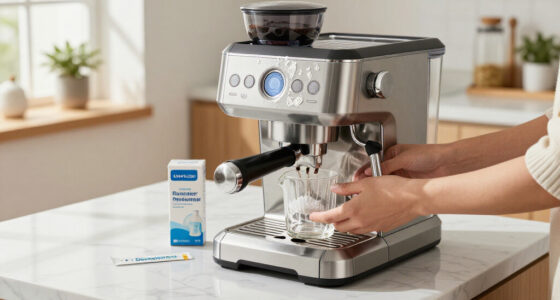
descaling solution for espresso machines
As an affiliate, we earn on qualifying purchases.
As an affiliate, we earn on qualifying purchases.
Compare machine designs by the care they actually require
Boiler, thermoblock, and thermocoil designs manage heating differently, but no design is automatically immune to scale. To compare them responsibly, check the exact model’s water-path guidance, maintenance steps, and service availability rather than assuming its heating system will solve your water problem.
A boiler stores heated water, while thermoblock and thermocoil systems heat water as it moves through a heated path. Those differences can affect where deposits form and how a manufacturer instructs you to care for the machine. The design label alone cannot tell you how difficult descaling will be or how a repair shop will handle the model.
Picture two buyers: one wants a machine they can maintain at home, while the other prefers a model with local service support. If their tap water is hard, both need to find out whether the maker permits home descaling and whether a nearby technician can service the machine. An elegant feature list matters less if the routine is unclear or a repair requires shipping the machine away.
If boiler material matters to your comparison, you can also review espresso machines with stainless steel boilers. Treat material as one part of the decision, alongside water requirements and maintenance directions. Ask what to solve before buying: where scale may collect, how the maker expects you to manage it, and whether you can get parts and service locally.
As an affiliate, we earn on qualifying purchases.
Choose a filter or water source that matches your test result
An in-tank filter can help reduce scale risk, but only if the filter is approved for the machine and suitable for your starting water. Check its stated effect, replacement schedule, and the manufacturer’s water guidance before treating “filter included” as proof that your tap is safe.
Filters are tools, not magic shields. Their results depend on the product and water, so one cartridge may work for a particular supply while another does not reduce hardness enough for a given machine’s requirements. Built-in filter reminders can help you remember a replacement, but a reminder does not measure your water’s actual hardness.
Softening or bottled water may be options, but each needs a chemistry check. “Spring water” does not specify a consistent mineral profile, and very low-mineral water from distillation or reverse osmosis may be unsuitable for some machines or make coffee taste flat. If a treatment system removes many minerals, check whether the machine maker requires remineralization before use.
For instance, a household that already uses a reverse-osmosis system might be tempted to fill the espresso reservoir straight from its drinking-water tap. Before doing that, the buyer should check the espresso manual and the treatment system’s output, then find out whether remineralization is needed. The goal is not simply the softest possible water; it is water that suits both the machine and the cup.
As an affiliate, we earn on qualifying purchases.
Run these seven checks before you place the order
Before buying, test your water, read the exact model’s manual and warranty, confirm approved treatment, and price a routine you can keep. This seven-step check makes the decision concrete: you can compare a machine’s care demands with your water, budget, and access to service before the box arrives.
- Test your tap. Check local reporting and use a home strip for your supply.
- Record hardness and alkalinity. Keep the readings for comparison with the manual.
- Read the machine’s water limits. Look for specific requirements in its manual.
- Check the descaling procedure. Confirm whether home descaling is allowed and what steps the maker specifies.
- Verify filter compatibility. Find out which filter is approved and how often it needs replacement.
- Estimate the annual routine. Add filter costs, treatment water, and any scheduled maintenance.
- Check repair access. Confirm that a local service shop can work on the model and obtain parts.
Then ask yourself whether you will follow the plan on a busy week. If a filter needs regular replacement and you know you tend to forget, decide how you’ll track it. If descaling requires a procedure you are not comfortable performing, check for authorized service. A plan you can follow beats a more elaborate plan that lives only in the manual.
For example, one buyer may find that their tap water meets a model’s requirements and that replacement filters are easy to buy locally. Another may discover the chosen machine needs a treatment method they cannot maintain consistently. That comparison can change the purchase before money is spent—and spare the second buyer a frustrating routine later.
Budget for upkeep and protect your warranty
Your real ownership cost includes more than the purchase price: filters, suitable water, descaling supplies where permitted, and possible service all belong in the estimate. Water-related damage may be excluded from warranty coverage if you operate outside the maker’s water specifications or maintenance schedule, so read both documents before you commit.
Compare how often a filter needs replacing, what it costs, and whether you can buy it nearby. Add the cost of treated or bottled water if that is your plan. A filter-equipped machine can still need descaling or other water-system maintenance, so do not treat the cartridge price as the whole budget.
Suppose a machine seems affordable, but its approved cartridges are hard to find where you live. If the replacement schedule slips, the water may no longer get the treatment the maker expects. A slightly less convenient purchase can become a recurring errand—and leave you unsure whether your routine still meets the manual.
Warranty details deserve the same attention as the feature list. Check the exact water specifications, whether the maker requires a particular filter, and how often you must perform maintenance. Keep notes or receipts if useful. A clear routine can support careful ownership, while an assumption such as “the machine has a reminder, so the water must be fine” leaves an important gap.
Make your water-care routine easy enough to repeat
The most useful water-care plan is one that fits your daily habits and follows the machine maker’s instructions. Set a reminder for filter replacement or maintenance if the manual calls for it, use the same approved water source consistently, and follow the model-specific descaling directions rather than guessing from a generic schedule.
Consistency helps you know what your machine has been drinking. If you switch between tap water, bottled water, and a filter without tracking the change, the maintenance reminder may no longer reflect your actual use. A small note on your phone with the test reading, filter date, and maintenance date can make the routine easier to follow.
Consider a household where one person makes coffee each morning and another refills the reservoir. A label inside the cupboard listing the approved water and filter replacement date prevents well-meant improvisation. That simple cue is especially useful when guests offer to refill the tank or someone reaches for a bottle labeled only “mineral water.”
Do not descale every machine the same way. Some makers specify a procedure or product, and some may restrict home descaling. Follow the manual; if it is unclear, ask the manufacturer or an authorized service provider. A reminder is a prompt to check, not a test of the water itself.
Frequently Asked Questions
How hard is too hard for an espresso machine?
There is no single safe hardness threshold for every model. Test your water and compare it with the exact machine’s stated requirements; ask the maker if its manual does not provide a clear limit.
Can I use tap water in an espresso machine?
Often, yes, if your tap water meets the machine’s specifications. Hardness and alkalinity can differ by supply, so check your own water rather than relying only on a city-wide figure.
Will an in-tank filter prevent scale?
A compatible filter may reduce scale risk, but its effect depends on the filter and your starting water. Follow the maker’s recommendations and replace it on schedule; a reminder does not test water hardness.
Can I use distilled or reverse-osmosis water?
Do not assume it suits your machine. Very low-mineral water can affect taste and may not meet some machines’ requirements, so check the manual and whether remineralization is needed.
How often should I descale my espresso machine?
Follow the manual, which may base maintenance on water hardness, use, or a programmed setting. A generic schedule can be too frequent for one setup and too infrequent for another.
Is a thermoblock espresso machine scale-proof?
No. Scale can still form in heated water paths and other components. The design affects where care is needed, but it does not remove the need to follow the machine’s water guidance.
Conclusion
Choose your water-care routine before you choose your espresso machine. Test the water, check the model’s limits and warranty, then confirm that its approved treatment and maintenance fit your real budget and habits.
A little homework now can keep the morning pour steady and the machine’s hidden passages cleaner. Let the water test guide the purchase, then make the care plan as dependable as your first shot of the day.
Halloween Picks
halloween
As an affiliate, we earn on qualifying purchases.