TL;DR

Get coffee and tea gear delivered free with Prime
- Fast, free delivery on millions of items
- Prime Video, Amazon Music and more included
- Member-only deals all year
Descaling removes mineral scale from inside your espresso machine’s boiler and water lines; backflushing removes coffee oils from the brew group and three-way valve. Descaling happens every 1–3 months depending on water hardness, while backflushing happens daily to weekly depending on use. Only machines with a three-way solenoid valve can be backflushed — attempting it on machines without one can cause damage.
Your espresso starts tasting like burnt cardboard. Then the shots start running slow. Then the pump starts laboring like it’s climbing a hill with a flat tire. One morning, nothing comes out at all.
Here’s the uncomfortable truth: that machine didn’t break. It was neglected — and probably in the wrong way. Most espresso machine problems come down to two cleaning jobs people either skip or confuse: descaling and backflushing. They sound similar. They fix completely different things.
By the end of this guide, you’ll know exactly which one your machine needs, how often, and the mistakes that turn a $15 maintenance routine into a $300 repair bill. No fluff — just what matters.
Descaling removes mineral scale from the boiler and water lines; backflushing removes rancid coffee oils from the brew group and three-way valve — they are not…
Backflush only if your machine has a three-way solenoid valve; machines without one can be permanently damaged by the process.
Backflush with detergent daily to weekly depending on use; descale every 1–3 months depending on water hardness.
Never use vinegar to descale — it damages seals and imparts flavor. Use citric acid or a purpose-made descaler instead.
Slow shots after descaling usually mean a coffee-clogged shower screen, which calls for backflushing, not more acid.
What Descaling Actually Does (And Why Your Boiler Depends on It)
Descaling is the process of dissolving mineral scale — calcium and limescale deposits — from the inside of your espresso machine: the boiler, water lines, and thermoblock. Water carries dissolved minerals. Heat those minerals over and over, and they fall out of solution and coat everything the water touches. Think of it like cholesterol for your machine — it builds up silently for months, then one day the “arteries” are too narrow for anything to get through.
Scale does three kinds of damage, and none of them announce themselves early. First, it restricts flow — that slow, dribbling shot you’ve been blaming on your grinder? Could be a scaled-up line. Second, it wraps around heating elements, forcing them to work harder until they burn out. Third, it causes temperature instability, because the sensor is reading a crust of rock instead of actual water temperature.
Here’s the number that should get your attention: scale buildup is a leading cause of machine failure, and manufacturers routinely void warranties over it. If you send in a dead machine and the technician opens it to find a boiler caked in white chalk, you’re paying for that repair yourself.
The descaler itself matters too. Use citric acid or a purpose-made commercial descaler. Never vinegar — most manufacturers explicitly warn against it because it degrades seals and can leave a flavor that haunts your espresso for weeks.
What Backflushing Cleans That Descaling Can’t Touch
Backflushing is the process of forcing water and espresso machine detergent backward through the brew group and three-way solenoid valve, flushing rancid coffee oils and trapped grounds into the drip tray. Where descaling deals with what’s in your water, backflushing deals with what’s in your coffee — the oily residue that coats the group head, the shower screen, and the valve passages after every single shot.
Coffee oil goes rancid. That’s the whole problem. Fresh oils give espresso its golden crema and rich mouthfeel; oils that have sat inside a warm group head for a week taste like stale nuts and bitterness. If your espresso has developed an off-flavor that survives even the best beans and a fresh grind, rancid oil is the prime suspect.
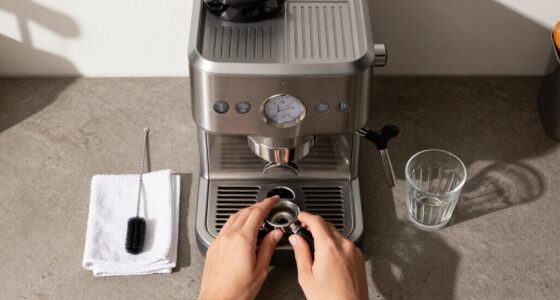
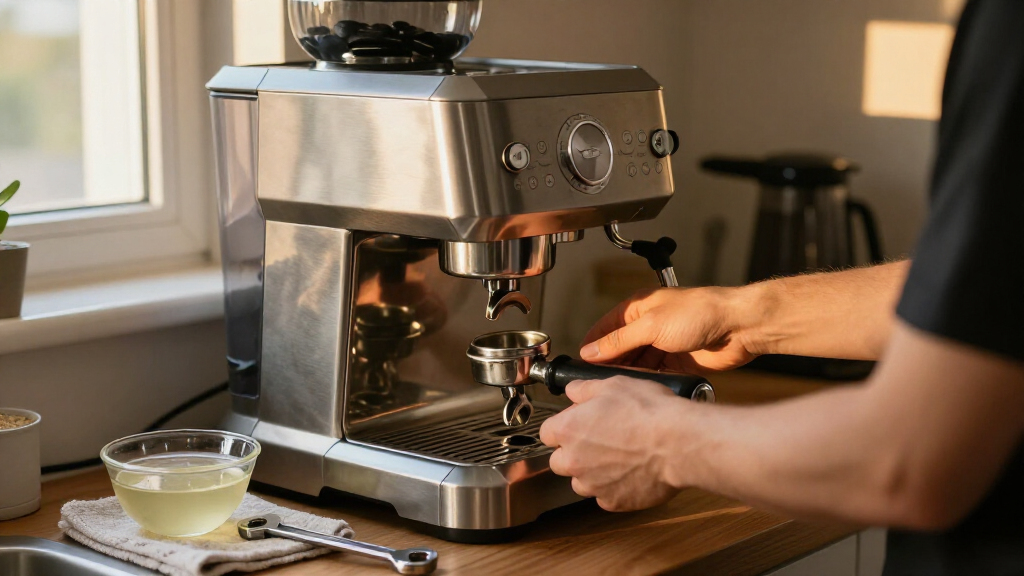
The mechanics are clever. A blanking disc — a portafilter basket with no holes — blocks the normal path. The pump builds pressure, the three-way valve opens its exhaust route in reverse, and detergent-laden water gets pushed through passages coffee normally only exits. Gunk dislodges, foams up, and lands in your drip tray as a brown, frothy mess that is genuinely satisfying to watch.
One critical caveat, and it’s the biggest safety point in this whole article:
Only machines with a three-way solenoid valve can be backflushed. Machines without one — including many entry-level home machines and all steam-only espresso makers — can be permanently damaged by backflushing. Check your manual before you try it.
Descaling vs Backflushing: The Side-by-Side Comparison
The fastest way to understand the difference is to see them next to each other. Descaling and backflushing differ in target, location, cleaning agent, frequency, and even which machines they apply to. Here’s the full breakdown:
| Aspect | Descaling | Backflushing |
|---|---|---|
| What it removes | Mineral scale (calcium/limescale) | Coffee oils and residue |
| Where it works | Boiler, internal plumbing, thermoblock | Group head, three-way solenoid valve |
| Cleaning agent | Citric acid or commercial descaler | Espresso machine detergent (e.g., Cafiza) |
| Frequency | Every 1–3 months (depends on water hardness) | Daily to weekly (depends on use) |
| Which machines | All machines | Only machines with a three-way valve |
Notice the frequency gap. Backflushing is a habit — like brushing your teeth. Descaling is a periodic deep clean — like a dental scaling. You can’t substitute one for the other any more than you can skip the dentist because you brush daily.
A real-world example: a home barista pulls two shots a day on hard tap water. Her group head needs a detergent backflush weekly. Her boiler needs descaling every 6–8 weeks. Same machine, same coffee, two completely different cleaning clocks. A café owner running the same model from open to close, meanwhile, might backflush every single night — which is exactly why cafés schedule “backflush at close” as part of shutdown — but still only descale on the same seasonal cadence, because scale depends on the water, not the shot count.
How Often Should You Actually Do Each One?
Frequency depends on two variables: water hardness for descaling, and shot volume for backflushing. Get these wrong in either direction and you either waste effort or damage your machine. Here’s a practical schedule that covers most home setups:
- Heavy use, hard water (4+ shots daily, unfiltered tap): backflush with detergent every 1–2 days; descale every 4–6 weeks.
- Moderate use, moderately hard water (2–3 shots daily): backflush weekly; descale every 2–3 months.
- Light use, filtered or softened water (1 shot daily): backflush weekly or biweekly; descale every 3–6 months.
- Custom water recipes (Third Wave Water, Barista Hustle-style profiles): descaling can stretch to 6 months or longer, because you’re preventing scale rather than treating it.
To make this concrete: imagine two identical Rancilio Silvias side by side. One lives in Phoenix on rock-hard tap water pulling four flat whites a day — its owner backflushes every other night and descales roughly every five weeks. The other lives in Seattle on filtered water pulling one morning shot — it gets a weekly backflush and a descale twice a year. Same machine, opposite schedules, both correctly maintained.
The smartest move you can make is to stop guessing and start watching your machine. If flow rate drops or your pump gets louder, that’s a descaling signal. If your espresso tastes rancid or bitter despite fresh beans, that’s a backflushing signal.
One trend worth knowing: newer prosumer machines now include cleaning indicator technology that automates these reminders. And note that manufacturer guidance is diverging — Breville/Sage advises caution with descaling certain models in favor of filter replacement, while De’Longhi sells proprietary descalers for theirs. When the manufacturer has a specific protocol, follow it.
How to Backflush Your Machine in 6 Steps
Backflushing takes about five minutes once you’ve done it twice. Here’s the process using an espresso machine detergent:
- Confirm your machine has a three-way solenoid valve. Check the manual. If it doesn’t, stop here.
- Insert the blanking disc into your portafilter and lock it into the group head as if pulling a normal shot.
- Add a small dose of detergent (roughly 1/2 teaspoon, or per the product’s instructions) into the blind basket.
- Run the pump for 10 seconds, then stop for 10 seconds. Repeat this cycle 5–10 times. The pressure forces detergent backward through the valve.
- Remove the portafitter, rinse the basket to clear all detergent, then lock it back in.
- Run 5 more water-only cycles to flush any remaining detergent from the system.
You’ll know it worked when the water in your drip tray runs from murky brown to clean. That first flush is a small horror show — years of oil you’ve been drinking.
Can you backflush with just water and no detergent? Yes, and a plain-water backflush is fine as a quick daily rinse for busy machines. But water alone doesn’t dissolve oils, so the detergent version is the one that actually cleans.
How to Descale Without Wrecking Your Seals
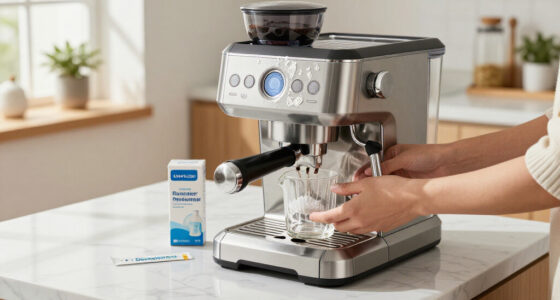
Descaling is slower and more methodical than backflushing, because you’re running acid through the entire water circuit. Here’s the safe sequence:
- Mix your descaling solution — citric acid or a commercial descaler in your reservoir, per the product’s dilution instructions.
- Run the solution through every water path: the group head, the hot water tap, and the steam wand. You want the acid in contact with scaled surfaces, not just sitting in the tank.
- Let it soak for the recommended time — usually 20–30 minutes with the machine on but idle, so the acid keeps working.
- Flush thoroughly. Empty the reservoir, fill with fresh water, and run at least two full tanks through every outlet until no trace of acid remains.
Never use vinegar. It attacks rubber seals and gaskets, and its flavor clings to internal surfaces in a way that takes weeks of flushing to erase. Lemon juice is similarly discouraged — citric acid solution is the safer DIY route because it’s gentler, effective, and rinses clean.
Here’s a diagnostic tip that saves people real money: if your machine still runs slow after a proper descale, the problem probably isn’t scale. A clogged shower screen from coffee debris causes identical symptoms — and that means you needed a backflush, not acid. Matching the right cleaning to the right symptom is the entire game.
5 Mistakes That Quietly Kill Espresso Machines
Most espresso machine damage doesn’t come from hard use — it comes from well-intentioned maintenance done wrong. These five mistakes cover the majority of preventable failures:
- Backflushing a machine with no three-way valve. The pressure has nowhere to go, and something gives — usually a seal or gasket. Check the manual first, every time.
- Using vinegar as a descaler. It degrades seals and leaves flavor behind. Citric acid costs about the same and doesn’t.
- Skipping descaling because there’s a filter. Filters reduce scale; they don’t eliminate it. Machines with filters still need descaling, just less often.
- Confusing symptoms. Slow shots get treated with descaler when the real culprit is a coffee-clogged screen — or vice versa. Read the symptom before choosing the cure.
- Never backflushing at all. The slow slide is predictable: rancid flavors first, then clogged group screens, then a sticky solenoid valve, then a repair bill that dwarfs a $12 tub of detergent.
One bonus mistake: assuming super-automatic machines are exempt. They self-rinse, yes — but they still accumulate scale in the boiler and oil in the brew unit, and they still need descaling solutions and cleaning tablets on schedule.
The Smarter Strategy: Prevent Scale Before It Starts
The best maintenance is the maintenance you don’t need. Water quality is the single biggest variable in descaling frequency, and the specialty coffee community has turned water chemistry into a genuine lever. Custom water recipes — like Third Wave Water mineral packets or the water profiles popularized by Barista Hustle — let you control exactly which minerals enter your machine, cutting scale to nearly zero.
Soft or filtered water dramatically extends your descaling interval; hard tap water compresses it. It’s the difference between descaling twice a year and descaling every six weeks — same machine, same routine, radically different workload.
If mixing your own water sounds excessive, even a simple filtration step or a distilled-water-remixed blend moves you in the right direction. Your heating element will thank you by lasting years longer.
And if eco-friendliness matters to you, this space has improved: citric acid-based descalers and biodegradable detergents are now widely available and work as well as the harsher legacy products.
Frequently Asked Questions
Can I backflush with just water and no detergent?
Yes, a water-only backflush is safe and works as a quick daily rinse. But water alone doesn’t dissolve coffee oils, so it’s far less effective than a detergent backflush. Use detergent for your real cleaning cycles and plain water for quick rinses between them.
How often should I descale if I use filtered water?
Filtered water typically stretches your descaling interval to 3–6 months or longer, since less mineral enters the machine in the first place. Watch for warning signs instead of watching the calendar: dropping flow rate and a louder pump both tell you it’s time.
Is descaling necessary if my machine has a water filter?
Usually yes — just less often. Filters reduce scale but don’t eliminate it entirely, especially in hard-water areas. Note that some manufacturers, including Breville/Sage on certain models, now recommend filter replacement as the primary approach, so check your machine’s specific guidance.
Can I use vinegar or lemon juice to descale my espresso machine?
No — vinegar is generally discouraged because it degrades rubber seals and gaskets and can leave a lingering flavor in your espresso. Lemon juice has similar problems. If you want a DIY option, a properly diluted citric acid solution is the safer, cleaner-rinsing choice.
What happens if I never backflush my espresso machine?
The decline is predictable: rancid, stale flavors in your shots come first, then clogged group screens, then a sticky three-way solenoid valve. Left long enough, you’re looking at a costly repair — all preventable with a five-minute detergent backflush and a $12 tub of espresso cleaner.
Conclusion
Remember this: descaling treats your water, backflushing treats your coffee. Match the cleaning to the culprit — slow flow and a loud pump mean scale; rancid, bitter shots mean oils — and your machine will outlive your grinder, your kettle, and probably three upgrades of bean subscription.
A dead espresso machine rarely dies suddenly. It dies in small, preventable increments, one skipped clean at a time. Five minutes a week and an afternoon every few months is all the insurance it needs. Your morning shot — rich, clean, and tasting like the beans you paid for — is the receipt.
Fall Picks
fall essentials
As an affiliate, we earn on qualifying purchases.