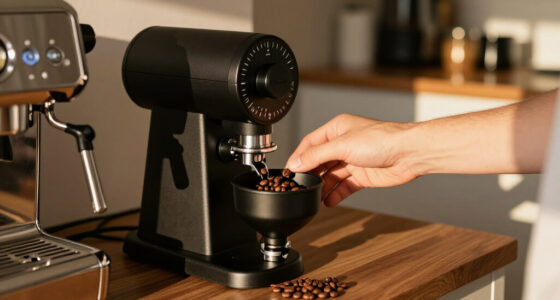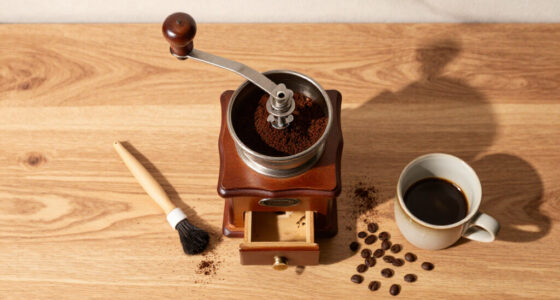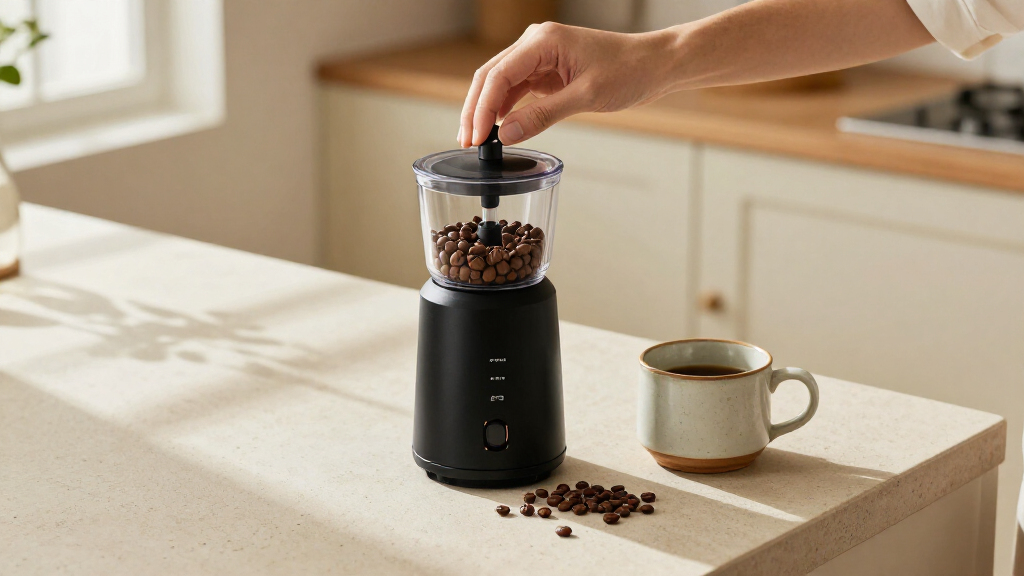

Electric burr and blade grinders solve the same basic problem, but they suit different priorities. Burr grinders crush beans between two surfaces and usually offer settings for different brewing methods; blade grinders use a spinning blade to chop beans, with grind size controlled mostly by how long you run the motor. That difference affects the taste and repeatability of a cup, as well as the price and effort involved. A burr grinder is the stronger choice for regular coffee drinkers who care about consistency or switch between brew methods. A blade grinder makes more sense for occasional use, a tight budget, or a kitchen where compact simplicity matters most.

Get coffee and tea gear delivered free with Prime
- Fast, free delivery on millions of items
- Prime Video, Amazon Music and more included
- Member-only deals all year

SHARDOR Electric Coffee Grinder with Timer Knob
- ✔ Model: UL-CG728
- ✔ Capacity: 2.5 ounces
- ✔ Timer: 1–30 seconds

Hamilton Beach Fresh Grind Electric Coffee Grinder for Up to 12 Cups
- ✔ Model: 80335R
- ✔ Manufacturer part number: 80335G
- ✔ Capacity: Up to 12 cups

BLACK+DECKER One Touch Coffee Grinder, 2/3 Cup Capacity, Stainless Steel Blades
- ✔ Model: CBG110S
- ✔ Capacity: 2/3 cup (56.6 g)
- ✔ Wattage: 150 watts
At a Glance
| Criteria | Electric burr grinders | Electric blade grinders | Winner |
|---|---|---|---|
| Grind consistency | More even grounds from adjustable burrs | Uneven particle sizes; some powder and large pieces are common | A |
| Brewing-method control | Multiple settings, often from fine to coarse | Limited control; timing the grind is imprecise | A |
| Flavor potential | More repeatable extraction and fewer extreme particle sizes | Can make acceptable coffee, but uneven extraction is harder to avoid | A |
| Ease of use | Select a setting and grind a measured dose | Few controls; shake or pulse to influence the result | Depends |
| Speed and cleanup | Simple routine, though grounds can collect in the chamber | Fast to run; chamber and blade area can take effort to clean | B |
| Purchase cost and value | Higher upfront cost; worthwhile for frequent brewing | Low upfront cost; practical for occasional or basic use | Depends |
| Size and noise | Often larger and still noisy | Usually compact, with a small footprint | B |
SHARDOR Electric Coffee Grinder with Timer Knob
The SHARDOR is our top pick for buyers who want more control without moving to a larger or more complicated grinder. Its 1–30-second timer knob lets us set a run time and step away, while the removable cup’s measurement markings make it easier to portion beans. Those details give it a more repeatable workflow than the push-button BLACK+DECKER and the single-switch Hamilton Beach.Its 2.5-ounce capacity suits a modest daily batch, but it is not the most convenient choice for a group. Hamilton Beach is specified for up to 12 cups, while SHARDOR may need multiple rounds for that amount. Its 60-decibel operating claim and compact footprint may appeal to people mindful of kitchen noise and counter space, though buyers should still expect motor sound. The blade design also limits consistency compared with burr models, so this is better for routine home grinding than for dialing in highly precise brewing.The removable stainless steel cup can be rinsed clean, and the included brush gives us another way to clear grounds. The description does not say that the cup is dishwasher-safe, unlike Hamilton Beach’s bowl. Choose SHARDOR when timed operation and measured portions matter more than maximum batch size; skip it if we need a large capacity or burr-level uniformity.
Pros:
- Timer knob supports hands-free runs from 1 to 30 seconds.
- Removable cup has measurement markings for easier portioning.
- Compact footprint and stated 60-decibel operating level suit space- and noise-conscious kitchens.
- Cleaning brush and removable cup support cleanup.
Cons:
- 2.5-ounce capacity can require multiple batches for larger quantities.
- Blade grinding may produce less uniform grounds than a burr grinder.
- Dishwasher safety is not specified for the removable cup.
Best for: Home brewers who make small batches and value a timed, repeatable grinding routine.
Not ideal for: Households regularly grinding large amounts at once, or brewers who need the uniformity and adjustment of a burr grinder.
Bottom line: We recommend SHARDOR for controlled small-batch grinding, provided its limited capacity and blade-style results fit our brewing needs.
“We recommend SHARDOR for controlled small-batch grinding, provided its limited capacity and blade-style results fit our brewing needs.”
Hamilton Beach Fresh Grind Electric Coffee Grinder for Up to 12 Cups
When serving several people is the priority, Hamilton Beach makes a stronger case than the two smaller-capacity picks. It is described as grinding enough for up to 12 cups, giving us more room to prepare a pot without splitting the work into several rounds. Its removable, dishwasher-safe bowl is another practical advantage over SHARDOR, whose cup is removable but not specified as dishwasher-safe.The tradeoff is control. Hamilton Beach has a single on/off function, with no adjustable grind setting or timer. We must manage the run ourselves, while SHARDOR lets us set a time and BLACK+DECKER offers one-touch operation intended to vary the grind by how long we press. Since these are all blade grinders, that extra manual control should not be mistaken for the precise, repeatable adjustment offered by a burr grinder.A hidden cord storage feature helps keep the counter tidy between uses, and the blades are described as suitable for beans, herbs, spices, and seeds. That flexibility can be useful, though aromatic ingredients may leave flavors behind if we use one bowl for everything. Hamilton Beach is our practical batch pick for straightforward drip-coffee routines; buyers who prioritize timing or smaller, measured portions should consider SHARDOR instead.
Pros:
- Stated output is enough for up to 12 cups.
- Removable stainless steel bowl is dishwasher-safe.
- Hidden cord storage helps reduce countertop clutter.
- One-button operation is simple for routine grinding.
Cons:
- No adjustable grind coarseness settings.
- No timer, so grinding time must be managed manually.
- Blade-style grinding may be less uniform than burr grinding.
Best for: People who regularly prepare a larger pot and want a removable bowl that can go in the dishwasher.
Not ideal for: Brewers who want a timer, explicit grind settings, or a compact measured-batch workflow.
Bottom line: We favor Hamilton Beach for larger, uncomplicated batches and easy bowl cleanup, but its basic control offers less repeatability than SHARDOR.
“We favor Hamilton Beach for larger, uncomplicated batches and easy bowl cleanup, but its basic control offers less repeatability than SHARDOR.”
BLACK+DECKER One Touch Coffee Grinder, 2/3 Cup Capacity, Stainless Steel Blades
BLACK+DECKER makes sense when we want a small, uncomplicated grinder for a modest amount of coffee. The one-touch push-button gives us direct control over how long the blades run, and its description says that this can take the grind from coarse to fine. A locking lid safety feature helps prevent accidental operation and spills. These controls feel more hands-on than SHARDOR’s timer, which is better suited to setting a run and stepping away.The 2/3-cup capacity is adequate for a small routine, but it is a constraint when we prepare coffee for a household or guests. Hamilton Beach is specified for up to 12 cups, so it is the more practical choice when batch size comes first. BLACK+DECKER’s compact dimensions and 0.65-kilogram weight are easier to fit into a limited storage space, though the supplied information does not include a removable dishwasher-safe bowl like Hamilton Beach’s.Its stainless steel blades and bowl are described as durable, and the grinder can also handle spices, herbs, and grains. As with the other blade models here, pulsing for different durations does not guarantee uniform grounds, and it does not offer burr-style precision. This is our straightforward compact recommendation for occasional or small-batch grinding, not for buyers who need high consistency or frequent large batches.
Pros:
- One-touch control provides a simple way to vary grinding time.
- Locking lid safety mechanism helps prevent accidental activation and spills.
- Compact dimensions and relatively light stated weight suit storage in a small kitchen.
- Stainless steel blades and bowl; also described for spices, herbs, and grains.
Cons:
- 2/3-cup capacity may mean multiple batches for larger households.
- Blade grinder can produce less uniform results than a burr grinder.
- No timer or dishwasher-safe removable bowl is specified.
Best for: A coffee drinker with limited counter or storage space who usually grinds a small amount at a time.
Not ideal for: Larger households, buyers who want a dishwasher-safe removable bowl, or anyone seeking burr-grinder consistency.
Bottom line: We recommend BLACK+DECKER for compact, small-batch convenience, while larger routines are better served by Hamilton Beach and timed grinding by SHARDOR.
“We recommend BLACK+DECKER for compact, small-batch convenience, while larger routines are better served by Hamilton Beach and timed grinding by SHARDOR.”
As an Amazon Associate we earn from qualifying purchases.
Key Differences
The biggest difference is control over particle size. A burr grinder uses a gap between grinding surfaces to set the grind, producing grounds that are more uniform from one batch to the next. A blade grinder chops beans into a mix of small and large pieces, and running it longer does not reliably create a uniform fine grind. In the cup, that unevenness can mean some particles extract quickly while others extract slowly. The result may taste less balanced, especially with brewing methods that depend on a consistent grind.
That control costs more and can add bulk. Burr grinders are generally a better investment for daily brewing, espresso or pour-over, and households that use more than one method. Blade grinders cost less, are compact, and are quick to operate, so they remain a sensible entry point when coffee is occasional or convenience outweighs repeatability. Paying more for a burr grinder is worthwhile when you will use its consistency and settings; it is hard to justify if the grinder will see little use or the brewing method is forgiving.
Detailed Comparison
Grind consistency (Electric burr grinders wins — major)
Burr grinders win by a major margin. Their adjustable grinding gap produces a more consistent particle size, while blade grinders leave a mixture of fines and larger fragments. In everyday brewing, that can make a burr-ground cup more balanced and easier to reproduce. If predictable results matter, this is the most consequential difference.
Brewing-method control (Electric burr grinders wins — major)
Burr grinders win by a major margin for people who change how they brew. Their settings make it practical to choose a finer or coarser grind for a particular method and return to it later. A blade grinder offers little precise adjustment: timing and pulsing can change the result, but not with the same reliability. For one simple routine, that limitation may not matter.
Flavor potential (Electric burr grinders wins — moderate)
Burr grinders have a moderate advantage. More uniform grounds make extraction more even, which can help coffee taste cleaner and more balanced. A blade grinder can still produce a pleasant cup, but uneven particles make the outcome less predictable and can bring both bitter and weak notes into the same brew. Beans and brewing technique still matter, so the grinder alone does not guarantee better coffee.
Ease of use (minor difference)
This is a close call. Blade grinders are very simple: add beans, pulse or run the motor, then pour out the grounds. Burr grinders ask the user to select a setting and may need occasional adjustment, but that extra step is useful rather than burdensome for many daily drinkers. Choose blade for the fewest decisions; choose burr for a routine that is easy to repeat.
Speed and cleanup (Electric blade grinders wins — minor)
Blade grinders take a minor win for quick, occasional batches. They are usually straightforward to run, although grounds can cling around the blade and chamber. Burr grinders may have more parts and pathways where grounds collect, so cleaning can take a little more attention. For either kind, regular cleaning helps prevent old coffee residue from affecting fresh grounds.
Purchase cost and value (major difference)
Neither is the better value for every buyer. Blade grinders cost less and deliver reasonable value when the goal is an inexpensive way to grind beans now and then. Burr grinders cost more, but daily users can get more benefit from consistent grounds and adjustable settings. The premium pays off when those advantages improve a routine you use often; for occasional coffee, it may not.
Size and noise (Electric blade grinders wins — minor)
Blade grinders usually win by a minor margin on footprint: many have a compact, simple design that is easy to store. Electric burr grinders vary, but models with a hopper and larger grinding mechanism may take up more counter space. Neither category should be assumed quiet; both use a motor, so noise can be a factor in a shared home or early-morning routine.
Electric burr grinders: Pros and Cons
Pros:
- More consistent grounds for a balanced, repeatable cup
- Adjustable settings suit different brewing methods
- Better fit for regular brewing and users who want control
Cons:
- Costs more upfront
- Can take up more counter space
- Needs setting selection and occasional cleaning
Electric blade grinders: Pros and Cons
Pros:
- Low purchase cost
- Compact and straightforward to operate
- Good enough for occasional use and simple brewing routines
Cons:
- Uneven grounds can make extraction and flavor less predictable
- Limited control over grind size
- Less suitable for methods that depend on repeatable grind settings
Who Should Choose What
Choose Electric burr grinders if:
- You brew coffee most days and want consistent results.
- You switch between methods such as drip, pour-over, or French press.
- You want repeatable settings and are willing to pay more for control.
Choose Electric blade grinders if:
- You grind beans occasionally and want to keep the initial cost low.
- You have limited counter or storage space.
- You value simple operation more than precise grind adjustment.
Skip both if: Skip both if you mainly buy pre-ground coffee and do not need to grind whole beans; paying for an appliance you will rarely use is poor value.
Value for Money
Blade grinders offer the lower entry price, and that is real value for occasional coffee drinkers who want freshly ground beans without a large commitment. For people brewing daily, a burr grinder is usually the better value over time because its consistency and settings can improve repeatability across batches and brewing styles. Pay more for burr grinding when you will use those controls; if your needs are basic and infrequent, the lower-cost blade option is easier to justify.
Final Verdict
For most people who plan to grind beans regularly, choose an electric burr grinder. Its consistent grounds and useful settings address the differences that matter most in the cup, particularly when you brew with more than one method. Choose a blade grinder if price, compact size, and simple operation matter more than fine control, especially for occasional use. The deciding factor is frequency: daily coffee makes the burr grinder’s higher cost easier to justify; infrequent coffee rarely does.
Frequently Asked Questions
Is a burr grinder worth the extra cost?
Usually, if you grind beans regularly or want to adjust grind size for different brewing methods. The more consistent grounds can make results easier to repeat. For occasional use, a blade grinder may be the better value.
Can a blade grinder make good coffee?
Yes. It can make an enjoyable cup, especially when the brewing routine is simple. Its uneven particle sizes make extraction less predictable, so it is harder to get the same result consistently.
Which grinder is better for French press?
A burr grinder is generally the better fit because you can select a coarser setting and repeat it. A blade grinder can be used, but it may leave both fine particles and larger pieces in the batch.
Which grinder should a beginner buy?
Choose based on how often you will use it. A beginner who expects to brew most days will likely get more from a burr grinder’s adjustable settings. Someone trying whole-bean coffee on a tight budget can start with a blade grinder.