
TL;DR

Get coffee and tea gear delivered free with Prime
- Fast, free delivery on millions of items
- Prime Video, Amazon Music and more included
- Member-only deals all year
Scale buildup is a hard, chalky deposit primarily made of calcium carbonate that forms when hard water is heated. A layer just 1-2 mm thick cuts heat transfer by 8-15% and raises energy use by 10-30%, eventually killing heating elements and pumps. Test your water hardness, descale every 1-3 months if your water is hard, and use filtered or softened water to slow buildup before it starts.
Your kettle takes twice as long to boil as it did a year ago. Your espresso machine sputters instead of pours. And somewhere in the back of your mind, you’ve noticed a chalky white film on the glassware. That’s not coincidence — that’s scale buildup, and it’s been working against you for months.
Here’s the part most people don’t realize: scale starts costing you money on day one. Every millimeter of chalky crust wrapped around a heating element forces it to work harder, run hotter, and burn more electricity. Then one morning the machine just doesn’t turn on. By then, the damage is done.
In this article, you’ll learn exactly what scale is, how to spot the early warning signs, which descaling methods actually work (and which ones can wreck your machine), and how often to descale based on your water. It’s the maintenance guide you wish came with the appliance.
Scale is calcium carbonate that precipitates out when hard water is heated — it forms fastest on heating elements, exactly where it does the most damage.
A 1-2 mm scale layer cuts heat transfer by 8-15% and raises energy use by 10-30%, so an unscaled machine costs money on every single use before it ever fails.
Water above roughly 120 ppm (7 gpg) counts as hard — and about 85% of U.S. households have it. A $5 test strip tells you where you stand.
Descale every 1-3 months in hard-water areas using citric acid or a commercial descaler; check your manual before using vinegar, since some manufacturers advis…
Too-soft water is also a problem: SCA guidelines target 50-100 ppm hardness for coffee equipment, because distilled or pure RO water can corrode boilers and br…
What Scale Buildup Actually Is (In Plain English)
Scale buildup is a hard, chalky deposit primarily made of calcium carbonate and magnesium carbonate that forms when hard water is heated or evaporates [1]. That’s the whole story in one sentence — but understanding the mechanism helps you fight it, so stick with me.
Your water, unless it’s been treated, carries dissolved calcium and magnesium picked up from rock and soil as it travels to your tap. This is what “hard water” means: water with a high concentration of these dissolved minerals. Nothing wrong with them — your body needs both. The problem is chemistry.
When water is heated, those dissolved calcium and magnesium bicarbonates become less soluble. They can’t stay dissolved anymore, so they precipitate out of the water and bond to whatever surface is nearest — usually the hottest one. That’s your heating element, your boiler walls, the inside of your pipes [1].
Think of it like sugar in iced tea versus hot tea. Stir sugar into hot tea and it vanishes. Let that tea go cold and the sugar reappears as grit at the bottom of the glass. Scale is the same process in reverse: minerals happily dissolved in cold water turn to rock-hard crust the moment heat enters the picture.
And it accumulates fastest exactly where you least want it — on heating elements, where water is hottest [1]. Every cup of coffee, every boil of the kettle adds another invisible layer.
How Hard Is Your Water? The Number That Decides Everything
Water hardness is measured in parts per million (ppm) or grains per gallon (gpg), and water above roughly 120 ppm (about 7 gpg) is officially considered “hard” [1]. That single number tells you how aggressively your appliances are scaling up.
Here’s the scale most water authorities use:
| Hardness Level | ppm (mg/L) | What It Means for Your Machines |
|---|---|---|
| Soft | 0-60 | Minimal scale risk, but very soft water can taste flat and corrode metal |
| Moderately hard | 61-120 | Light scale over time; descale every 3-6 months |
| Hard | 121-180 | Visible scale within months; descale every 1-3 months |
| Very hard | 180+ | Aggressive buildup; consider a softener or filtration system |
If you’re in the United States, the odds are stacked against you: hard water affects roughly 85% of U.S. households, and it’s common across the UK, Europe, and Australia too [1]. London’s water, for instance, runs through chalk aquifers and regularly tests above 250 ppm.
Testing takes two minutes. Home hardness test strips cost a few dollars, and TDS (total dissolved solids) meters are cheap and increasingly popular with coffee enthusiasts [1]. Dip, wait, compare colors, done. Some municipal water suppliers also publish annual water quality reports with hardness figures — check your local utility’s website before buying anything.
6 Warning Signs Your Machine Is Already Scaling Up
Scale announces itself quietly: look for white flakes in your water, slower brewing, longer heat-up times, a cloudy film on glassware, reduced water pressure, and unusual machine noises [1]. None of these scream “emergency” individually — which is exactly why scale gets away with so much damage.
Here’s what each sign looks like in real life:
- White flakes in your coffee or tea. That’s chunks of scale breaking off the element or boiler walls. Genuinely unpleasant, and a sign the layer is thick.
- Slower brewing. Your pour-over machine that used to finish a cycle in 4 minutes now takes 7. Scale is narrowing the internal tubes and spray nozzles.
- Longer heat times. The element is insulated from the water by its own chalky crust, so it runs longer to hit the same temperature.
- Cloudy film on glasses. Your dishwasher is fighting hard water, and the same minerals coating your wine glasses are coating its heating coil.
- Reduced water pressure. Pipes and valves narrowed by scale restrict flow — a classic sign in older homes with hard water.
- Gurgling, popping, or whining noises. Steam trapped under a scale layer on a kettle element makes it pop and rumble like it’s about to launch.
The kettle is the best early-warning device you own. Lift the lid and look at the element. A white or greyish crust means your espresso machine, dishwasher, and water heater all have the same problem — just hidden from view.
What Scale Actually Costs You: The Math Nobody Shows You
Scale costs you money in two stages: first through higher energy bills, then through premature machine failure. Both are avoidable, and the numbers are more dramatic than most people expect.
Stage one is the slow drain. Scale is a terrible heat conductor — a poor one — so even a 1-2 mm layer can reduce heat transfer efficiency by roughly 8-15%, forcing heating elements to run hotter and longer to do the same job [1]. Scaled appliances consume noticeably more electricity, with figures often cited at 10-30% more [1]. Run the math on a household kettle used five times a day plus a water heater, and you’re looking at real money added to every monthly bill — for years.
Stage two is the funeral. Overheating elements burn out. Pumps strain against narrowed pipes and wear out early. Seals degrade. Scale is one of the most common causes of kettle, espresso machine, and water heater failure [1] — and it hits tankless water heaters especially hard, since their compact heat exchangers scale up fast.
A machine killed by scale never fails cheaply. The element that overheated for a year takes the pump, the thermostat, or the control board down with it.
The bitter irony? Prevention costs about five dollars of citric acid and twenty minutes of your time. Replacement espresso machine boilers cost hundreds. This is one of the steepest asymmetries in home maintenance.
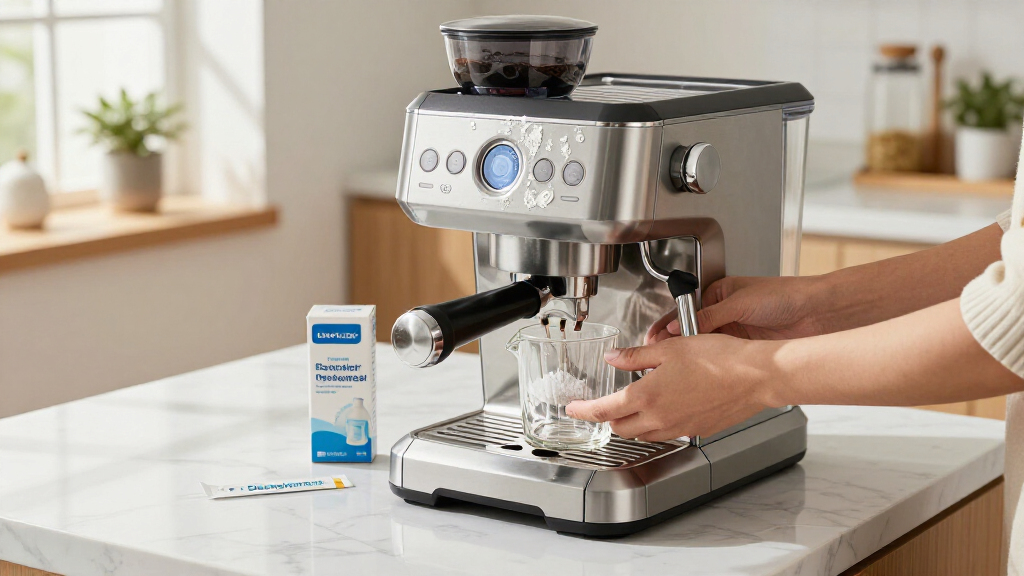
How to Descale Safely: A Step-by-Step Method That Won’t Wreck Your Machine
Descaling works because scale is a carbonate, and acids dissolve carbonates — citric acid, vinegar (acetic acid), sulfamic acid, and commercial descalers all exploit this chemistry [1]. The trick is matching the right acid to the right machine, because the wrong choice can damage seals and leave flavors behind.
- Check your machine’s manual first. Some espresso machine manufacturers explicitly void warranties if you use vinegar — it can degrade certain seals and gaskets and leaves an odor that takes multiple rinse cycles to purge [1].
- Mix your descaling solution. A safe DIY option for kettles and drip machines: 1-2 tablespoons of food-grade citric acid per liter of warm water. Commercial descalers come pre-mixed with dosing instructions.
- Run the solution through the machine. Fill the reservoir (or kettle), run half a brew cycle, then pause for 15-30 minutes so the acid has time to dissolve the scale. Heat gently — warm, not boiling — for stubborn buildup.
- Flush thoroughly. Run at least two full tanks of clean water through the machine afterward. Residual acid tastes terrible and shouldn’t touch your next coffee.
- Wipe and inspect. Look for white flakes in the drip tray — proof the descale worked — and check that flow has returned to normal speed.
Frequency isn’t a fixed rule — it depends entirely on your water hardness and how much you use the machine [1]. As a practical baseline: descale espresso machines every 1-3 months in hard-water areas, every 3-6 months in soft-water areas [1]. If your machine has a built-in scale sensor or descaling alert — increasingly common in modern coffee makers, dishwashers, and tankless heaters — let it tell you when it’s time [1].
Descaling Methods Compared: What Works, What’s Risky, What’s Hype
Not all descaling methods are equal, and the safest choice for a kettle can be the worst choice for a $1,500 espresso machine. Here’s how the main options stack up:
| Method | Cost | Effectiveness | Machine Safety Notes |
|---|---|---|---|
| Citric acid | Very low | Excellent on carbonates | Safe for most machines; mild odor, rinses clean |
| White vinegar | Very low | Good | Risky for some espresso machines — can damage seals, strong lingering odor [1] |
| Commercial descaler | Moderate | Excellent | Formulated for specific machines; often the manufacturer-endorsed choice |
| Sulfamic acid | Moderate | Very strong | Best for heavy industrial or boiler scale; harsher handling required |
| Electromagnetic descalers | High upfront | Mixed evidence | Widely marketed; independent evidence of effectiveness is inconsistent [1] |
A quick note on the eco side: the industry is shifting away from harsh chemicals toward citric-acid-based and biodegradable descalers, which work well and are safer to pour down the drain [1]. For most home users, citric acid is the sweet spot — cheap, effective, gentle, and food-safe.
Prevention Beats Cure: Your Water Treatment Options
The best descale is the one you never need, and you have four realistic prevention options: water softeners, filtration, salt-free conditioning, and simply matching your maintenance schedule to your water hardness [1].
Ion-exchange water softeners replace calcium and magnesium with sodium, attacking the problem at the source. Effective, but they add sodium to your water and require salt refills — and if you brew coffee, fully softened water isn’t ideal on its own.
Filtration is the coffee-world favorite. Reverse osmosis and scale-inhibiting filter cartridges are common in serious coffee setups [1]. But here’s the nuance most articles skip: too-soft water causes its own problems. The Specialty Coffee Association targets hardness of roughly 50-100 ppm, because ultra-pure distilled or RO water can corrode boiler metal and brew flat, lifeless coffee [1]. If you use RO water, blend it or remineralize it.
Salt-free conditioning — template-assisted crystallization (TAC) or polyphosphate dosing — doesn’t remove minerals; it changes them so they don’t adhere to surfaces [1]. TAC systems are gaining market share among homeowners who want scale protection without sodium [1].
The low-tech option works too: if your water tests moderately hard, skip the hardware and just keep a disciplined descaling calendar. A $5 test strip and a recurring phone reminder will outperform an expensive softener you forget to maintain.
4 Scale Myths That Cost People Money
Scale attracts more bad advice than almost any other home-maintenance topic. Here are the four myths that do the most damage:
- Myth 1: “Boiling water removes hardness.” The opposite — boiling is what triggers scale formation. Hardness minerals precipitate out when water is heated [1]. Every boil makes your kettle slightly worse.
- Myth 2: “Vinegar is safe for everything.” Fine for a cheap kettle. Risky for espresso machines, where it can degrade seals and leave an odor no one wants in their morning shot [1].
- Myth 3: “Limescale is a health hazard.” Calcium carbonate isn’t toxic — swallowing a flake is unpleasant, not dangerous [1]. Scale is a machine problem, not a medical one.
- Myth 4: “Magnetic descalers solve everything.” These devices are heavily marketed, but independent evidence on their effectiveness is genuinely mixed [1]. Buy proven methods first; treat magnets as an experiment, not a solution.
One more distinction worth money in your pocket: cleaning is not descaling. Cleaning removes coffee oils and residue; descaling dissolves mineral deposits. Coffee machines need both, on different schedules. A clean-looking machine can be scaling up internally the whole time.
Frequently Asked Questions
How do I know if my machine has scale buildup?
Look for white flakes in your water, slower brewing cycles, longer heat-up times, cloudy film on glassware, reduced water pressure, and unusual popping or gurgling noises. The fastest check is visual: open your kettle and inspect the heating element for a white or greyish crust. If it’s there, every hot-water appliance in your house likely has the same buildup hidden inside.
Is limescale harmful to health if I accidentally drink it?
Generally no. Calcium carbonate is not toxic — it’s the same compound found in calcium supplements and antacids. Swallowing a flake of scale is unpleasant but not dangerous. Scale is a machine-damage and taste problem, not a health problem.
Is vinegar safe for descaling coffee machines and kettles?
It depends on the machine. Vinegar works fine for simple kettles and basic drip makers. However, some espresso machine manufacturers advise against it because acetic acid can degrade rubber seals and gaskets and leaves an odor that takes several rinse cycles to remove. Check your manual — citric acid is a safer universal alternative.
How often should I descale my machine?
There’s no fixed rule — it depends on your water hardness and usage. In hard-water areas (above ~120 ppm), descale espresso machines and kettles every 1-3 months. In soft-water areas, every 3-6 months is usually enough. If your machine has a built-in scale sensor or descaling alert, follow its prompts.
Can scale damage be reversed, or is my machine ruined?
Mild to moderate scale is fully reversible — descaling dissolves the carbonate deposits and restores normal flow and heating. Severe cases are different: if the heating element has already burned out or blockages have damaged the pump, descaling comes too late. That’s why a regular schedule matters more than an aggressive rescue attempt.
Conclusion
Scale buildup is the rare home-maintenance problem with a fully predictable script: minerals in, heat applied, crust formed, bills rise, machine dies. But every step of that script is interruptible. Test your water this week, look inside your kettle tonight, and put a descaling reminder on your calendar before the white flakes show up in your cup.
Your machine spent a lot of money heating water for you. The least you can do is spend twenty minutes and a few dollars making sure it doesn’t slowly cook itself inside a limestone shell.
Halloween Picks
halloween
As an affiliate, we earn on qualifying purchases.