TL;DR

Get coffee and tea gear delivered free with Prime
- Fast, free delivery on millions of items
- Prime Video, Amazon Music and more included
- Member-only deals all year
Temperature stability means keeping delivered water at a steady, safe temperature despite heat loss, mixing, and demand spikes. Water at 60°C (140°F) can scald in about 5 seconds, while Legionella bacteria thrive at 20–45°C (68–113°F), so the standard solution is storing water hot (60°C) but delivering it warm (49–50°C) through a thermostatic mixing valve. Most ‘shower goes cold’ and ‘takes forever to get hot’ problems trace back to undersized tanks, long pipe runs, or sediment buildup — all fixable.
You’re standing in the shower, perfectly warm, halfway through rinsing shampoo out of your hair — and then someone downstairs starts the dishwasher. The water turns arctic in two seconds flat. You do the awkward shiver-dance, cursing whoever invented plumbing.
That moment isn’t bad luck. It’s physics, equipment sizing, and a safety-vs-bacteria compromise all colliding at once. Hot water seems like the simplest thing in your house — it’s either hot or it isn’t, right? But temperature stability, the ability to keep water at a steady, predictable temperature from tank to tap, is one of the most misunderstood parts of home plumbing.
In this guide, you’ll learn why hot water fluctuates, the surprisingly serious safety math behind your thermostat dial, and what actually fixes the problem. No fluff — just the science and the practical fixes.
Store water at 60°C (140°F) to kill Legionella, but deliver at 49–50°C (120°F) via a thermostatic mixing valve — 60°C water scalds in ~5 seconds while 49°C tak…
The ‘shower goes cold’ problem is almost always inlet mixing in an undersized tank or simultaneous demand exceeding your heater’s capacity — not a broken heate…
Flush your tank once a year: sediment insulates the water from the burner and is a leading cause of erratic, unstable hot water.
Insulate hot water pipes and consider a demand-controlled recirculation pump if hot water takes more than 30 seconds to arrive.
Tankless heaters eliminate standby losses but introduce the cold water sandwich; heat pump heaters are efficient but recover slowly, so usage timing matters mo…
Home systems · Comfort · Safety
Temperature Stability: Why Hot Water Is Not as Simple as It Sounds
The heater setting is only the start. Pipe distance, flow, household demand, and mixing controls all shape the water that reaches your tap—and explain why a shower can begin cold or suddenly change.
01 / The journey to your tap
Why the temperature changes along the way
A thermostat measures water at or near the appliance. Between there and your shower, pipework loses heat, valves blend hot and cold, and other household use can change the flow. A display reading is not a promise about the first splash.
Distance cools the line
Water left in a long or exposed pipe run cools between uses. The tap must clear that volume before warmer water arrives. Accessible pipe insulation can reduce heat loss, but not eliminate the wait.
Mixing changes delivery
A shower valve combines hot and cold water. Changing pressure or a worn valve can shift that blend, even when the heater itself is operating normally.
Patterns reveal clues
If the shower settles and stays steady, cooled pipe water may explain the start. Repeated swings can point to flow, pressure, capacity, or a component that needs attention.
Read the symptom: A slow warm-up at one distant fixture suggests pipe distance. Sudden fluctuations across several fixtures suggest a shared supply, heater, or control issue.
02 / Demand, flow & response
How to narrow down an inconsistent shower
A heater has a finite ability to warm moving water. Faster flow can mean cooler output from some instantaneous units, while turning the flow too low can cause certain models to stop heating. The exact response depends on the unit and incoming water temperature.
Notice when
Does it start cold, swing mid-shower, or fade after a long use?
Check other use
Note whether a flush, appliance, or second shower triggers a shift.
Compare fixtures
See whether the same pattern occurs elsewhere in the home.
Get it assessed
Ask a qualified professional to check pressure, flow, valves, and capacity.
Keep safety controls in place. Follow the appliance manual. Do not disable temperature or pressure safeguards, open equipment, or adjust controls unless qualified.
03 / Two system types
Storage tanks and tankless heaters handle demand differently
A storage heater holds a supply that can run low or take time to recover. A tankless heater warms water as it flows, so output depends on flow, incoming temperature, and unit capacity. Neither behaves exactly the same in every home.
| System | What affects temperature | What you may notice |
|---|---|---|
| Storage heater | Stored volume, household demand, recovery time, and thermostat operation | Supply or temperature falls after extended use |
| Tankless heater | Flow rate, incoming water temperature, and unit capacity | Output changes when flow or simultaneous use increases |
| Either system | Pipe heat loss, mixing valves, and maintenance | Slow warm-up or uneven delivery at a fixture |
Heat-pump heaters can use less energy, but recovery time and operating conditions affect how quickly they replenish hot water.
04 / Comfort meets protection
Balance scald protection with safe storage
Store hot. Control delivery.
Water stored hot enough to limit microbial growth can scald at a tap. A thermostatic mixing valve can blend hot and cold water near a controlled outlet temperature, when properly selected, installed, and maintained.
Settings depend on context. Follow local guidance and the appliance manufacturer’s instructions; storage and tap temperatures serve different purposes.
Pressure matters. A worn, unsuitable, or poorly adjusted valve may not hold a steady delivery temperature.
Consider who uses the water. Children, older adults, and people with reduced sensation or mobility can face greater harm from a sudden hot surge.
Monitoring helps, inspection matters. Sensors can reveal temperature drift, but placement and calibration affect readings, and alarms do not replace maintenance.
Why Hot Water Seems Simple but Really Isn’t
Hot water seems like a solved problem: heat water, store it, send it through a pipe. But between the tank and your showerhead, at least four physical forces are quietly working against you. Temperature stability is the fight to keep that water predictable despite all of them.
Think of your hot water system like a cup of coffee. The moment it’s poured, it starts cooling. Every pipe it travels through steals heat. Every time you draw water, cold water rushes in the bottom of the tank to replace it. Your shower is the last stop on a journey with a dozen chances for things to go wrong.
The key aspects to understand are stratification (hot water rises and layers on top of cold), standby losses (tanks bleed heat 24/7), inlet mixing (cold water entering during use), and pipe heat loss (long runs that start cold and cool fast after you turn the tap off). Each one alone is manageable. Together, they explain almost every hot water complaint you’ve ever had.
The Physics Working Against Your Shower
Why does your shower go cold when someone runs the dishwasher? Because your tank is refilling with cold water at the bottom while drawing hot water off the top — and eventually those layers collide. In an undersized tank, that collision happens fast, sometimes within 10 minutes of heavy use.
Stratification: your tank is layered like a cocktail
Hot water rises; cold water sinks. Over a few hours, your tank develops distinct layers — hot on top, cold on the bottom — like a poorly mixed latte. This is actually useful, because you draw from the top. But the moment demand exceeds recovery, the cold layer creeps upward and your shower pays the price.
Standby losses: the slow leak you can’t see
Your tank loses heat every single hour, even at 3 a.m. while you sleep. A poorly insulated or aging tank can cycle on and off dozens of times a day just maintaining temperature. That’s pure wasted energy — one reason water heating is typically the second-largest energy expense in a home, roughly 15–20% of utility bills [1].
Pipe heat loss: the long, cold commute
If your water heater is in the garage and your bathroom is on the far end of the house, the water travels through 40, 60, sometimes 80 feet of copper or PEX. All of that pipe is cold when you start. You run the tap, wait, wait some more, and finally hot water arrives — carrying heat that’s already been partly stolen by cold pipe walls. Turn the tap off for five minutes, and much of that warmth drains away again. The fix candidates:
- Insulate hot water pipes — cheap foam sleeves, one afternoon of work
- A demand-controlled recirculation pump — brings hot water to the fixture in seconds without wasting energy on constant circulation
- Point-of-use heaters — small units placed right under a distant sink
The 60°C vs. 49°C Problem: Burns vs. Bacteria
What temperature should your water heater be set to? The answer is a genuine dilemma: 60°C (140°F) for storage to kill bacteria, but 49–50°C (120°F) at the tap to prevent scalding — achieved with a mixing valve rather than a lower thermostat setting. This is the single most important temperature stability concept in your home, and getting it wrong has real consequences in both directions.
The scalding math is brutal. Water at 60°C (140°F) can cause a serious burn in about 5 seconds. Drop the delivery temperature to 49°C (120°F), and it takes roughly 5 minutes for the same injury [1]. Five seconds versus five minutes — that’s the difference between a startled yank of the hand and a hospital visit, especially for children and older adults with slower reaction times and thinner skin.
But here’s the catch. Legionella pneumophila, the bacterium behind Legionnaires’ disease, thrives in exactly the temperature range you’d want for a comfortable bath: roughly 20–45°C (68–113°F) [1]. Turn your tank down to save energy, and you’ve built a lukewarm incubator. Large buildings take this seriously enough that ASHRAE Standard 188 in the US and various EU guidelines require formal water management plans, including periodic high-temperature thermal disinfection flushes in hospitals and care facilities.
The rule: store hot, deliver warm. Keep the tank at 60°C to kill Legionella, and let a thermostatic mixing valve (TMV) blend in cold water so what reaches your tap is 49–50°C. Many building codes now require TMVs in new construction for exactly this reason.
One more risk worth knowing: dead legs — stagnant pipe sections where water barely moves, like a line to an unused outdoor faucet. These are a major Legionella risk factor because sitting water drifts into that bacterial comfort zone. If you have a fixture you rarely use, run it weekly for a minute.
Tank vs. Tankless: Which Actually Holds Temperature Better?
Which keeps temperature more stable — a tank or a tankless heater? Neither wins outright: tank heaters deliver steady mixed water but eventually run out; tankless heaters never run out but can fluctuate under demand and produce brief cold bursts. It depends entirely on your usage pattern.
| Factor | Tank Heater | Tankless Heater |
|---|---|---|
| Standby losses | Continuous (heat bleeds 24/7) | Nearly zero |
| Runs out of hot water | Yes — 30–60 min heavy use typical | No — as long as flow stays within capacity |
| Temperature under simultaneous demand | Gradual cooling as tank drains | Sudden drops when flow exceeds capacity |
| Cold water sandwich | No | Yes — brief cold burst between back-to-back uses |
| Best for | Steady households, lower upfront cost | High-demand households, energy savings |
The infamous cold water sandwich deserves explanation. With a tankless unit, turn off the shower, then turn it back on two minutes later — the heater has shut off, and the burst of cooled water sitting in the pipes hits you before the burner catches up. It lasts seconds, but it’s memorable. High-quality modern units mitigate it; cheap ones don’t.
Heat pump water heaters are a third path, increasingly common thanks to electrification incentives like US Inflation Reduction Act tax credits and EU efficiency mandates [1]. They’re extremely efficient but have slow recovery rates — meaning usage timing matters more, not less. A family that showers back-to-back at 7 a.m. may outpace one.
Your 6-Step Fix-It Checklist for Stable Hot Water
How do you actually fix temperature instability at home? Work through this checklist in order — each step addresses one of the four physical problems above, and the first three cost almost nothing.
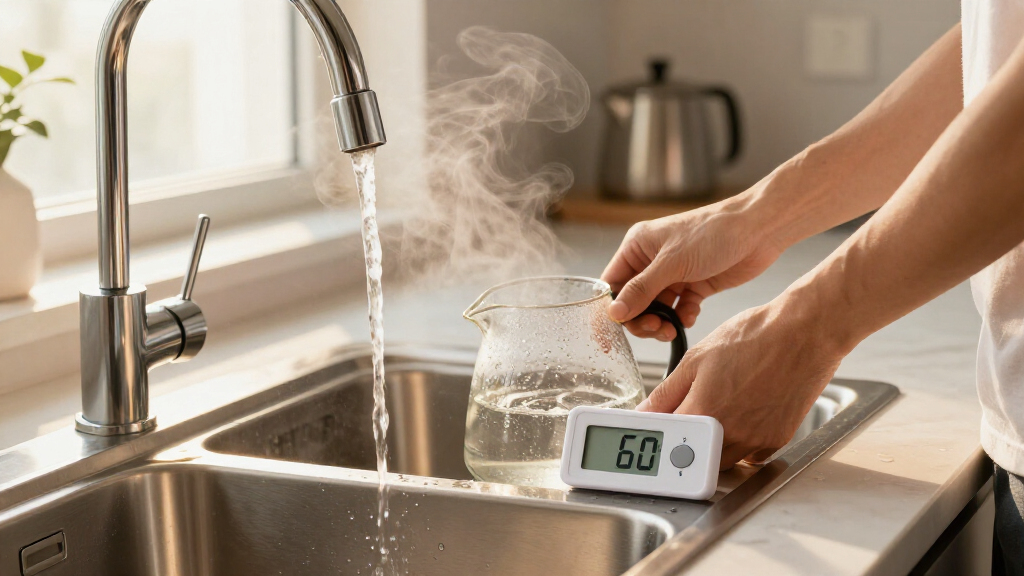
- Verify your thermostat. Confirm the tank is at 60°C and delivery at the tap is 49–50°C with a cooking thermometer. Don’t guess — tank dials are notoriously inaccurate.
- Flush the tank annually. Sediment builds up on the bottom, insulating the water from the burner and causing erratic heating. A yearly flush restores efficiency and stability. (A rotten-egg smell, by the way, usually means sulfur bacteria reacting with a magnesium anode rod — replacing the rod with an aluminum/zinc one fixes it.)
- Insulate exposed hot water pipes. Foam sleeves cost a few dollars per foot and keep the water in the pipe warm between uses.
- Install or check a thermostatic mixing valve. This is the safety-critical piece — it keeps tap water scald-proof even if the tank runs hot.
- Fix that dripping hot tap. A dripping faucet on the hot line can drain a tank surprisingly fast and force constant reheating cycles.
- Consider a demand-controlled recirculation pump if your wait time exceeds 30 seconds. It cuts both wait time and water waste, without the constant circulation that raises Legionella risk.
Safety note: If you have young children, elderly family members, or anyone with reduced heat sensitivity in the house, the TMV isn’t optional. Anti-scald protection at the fixture is the last line of defense when someone else flushes a toilet mid-shower.
What’s Changing: Smart Heaters and Smarter Codes
Temperature stability technology is improving fast. Smart water heaters now learn your usage patterns, schedule heating for off-peak hours, and in some regions join grid-interactive demand response programs that trim your bill [1]. Digital shower valves offer ±1°C precision — set it once, and it compensates automatically when someone starts the washing machine.
Building codes are tightening too, especially for facilities housing vulnerable people. Stricter standards now emphasize routine thermal disinfection — periodic high-temperature flushes of the entire hot water system — in hospitals and care homes, alongside mandatory water management plans under ASHRAE 188 [1].
And a fun piece of physics trivia to close: under certain conditions, hot water can freeze faster than cold water — the Mpemba effect, which physicists still debate [1]. The myth that hot pipes freeze first isn’t quite true either, though hot lines do sometimes burst first because of different usage patterns and sediment buildup. Water, it turns out, never stops being weird.
Frequently Asked Questions
What temperature should my water heater be set to?
Set the tank to 60°C (140°F) for storage and let a thermostatic mixing valve deliver 49–50°C (120°F) at the tap. This combo kills Legionella bacteria while preventing scalds — 60°C water can burn skin in about 5 seconds. If you have no mixing valve, don’t simply turn the tank down to 49°C, since lukewarm storage invites bacterial growth.
Why does my shower go cold when someone flushes a toilet or runs the dishwasher?
Cold water entering the tank or a sudden pressure/flow change pulls from the same supply your heater is managing. In a tank system, heavy demand drains the hot layer faster than the tank reheats; in a tankless system, total flow exceeding the unit’s capacity forces it to cut the temperature. A thermostatic shower valve compensates automatically.
Is it safe to lower my water heater temperature to save energy?
Lowering delivery temperature saves energy and reduces scald risk, but lowering the tank storage temperature below 60°C risks Legionella growth (the bacteria thrive at 20–45°C). The better approach is a mixing valve: hot storage, warm delivery. You can also insulate pipes and flush sediment for efficiency without touching the thermostat.
What is the ‘cold water sandwich’ with tankless water heaters?
It’s a brief burst of cold water that hits when you restart hot water shortly after shutting it off. The tankless heater has already shut down, and the cooled water sitting in the pipes arrives before the burner fires up again. It lasts seconds, and higher-end units minimize it with buffer technology.
How often should I flush my water heater, and why?
Flush once a year. Sediment — mostly dissolved minerals that settle out — builds a layer on the tank bottom that insulates water from the burner or element. That causes slower heating, erratic temperatures, more energy use, and eventually tank damage. It’s a 30-minute job with a garden hose.
Conclusion
If you remember one thing, make it this: hot water temperature is a system, not a dial. The tank temperature, the mixing valve, the pipe runs, the tank’s sediment level, and everyone’s shower schedule all interact — and instability is almost always one of those five acting up, not bad luck.
Start with the free wins this week: thermometer-check your delivery temperature, flush the tank if you haven’t in a year, and wrap the exposed pipes. Your future self — warm, unstartled, mid-shower while the dishwasher runs — will thank you.
Halloween Picks
halloween
As an affiliate, we earn on qualifying purchases.