TL;DR

Get coffee and tea gear delivered free with Prime
- Fast, free delivery on millions of items
- Prime Video, Amazon Music and more included
- Member-only deals all year
Coffee makers with built-in grinders grind whole beans shortly before brewing, combining two steps in one appliance and helping preserve more aroma than long-stored pre-ground coffee. Compare brew style, grinder consistency, cleaning access, capacity, noise, and warranty; more settings do not automatically mean better coffee.
Your kitchen can smell like a coffee shop before you have even found your mug. A machine that grinds beans right before brewing brings that fresh, warm aroma into your morning while combining two appliances in one.
These grind-and-brew coffee makers can make a good cup easier, but they also add noise, cleaning, and mechanical complexity. Here are the features that matter, the tradeoffs to expect, and a practical way to choose a machine that fits your routine.
A built-in grinder can add aroma by grinding whole beans shortly before brewing, but it cannot rescue stale beans or poor brewing.
Burr grinders usually give you more consistent grounds and control than blade grinders.
Choose drip, espresso, or single serve based on the coffee you make most often.
Check cleaning access, noise, capacity, counter clearance, warranty, and parts availability before buying.
Store beans sealed in a cool, dry place, and clean the grinder and grounds path on the manufacturer’s schedule.
Get fresher coffee with one less morning step
Coffee makers with built-in grinders combine grinding and brewing in one machine, so you can turn whole beans into a fresh pot with fewer steps. Grinding just before brewing can preserve more aroma than using grounds that have been sitting open, although bean quality and brewing still shape the flavor. These appliances are usually called grind-and-brew coffee makers.[1]
Imagine setting out your mug while the machine whirs, then hearing coffee patter into the carafe. That convenience is the main appeal: you skip transferring beans from grinder to brewer and clear space by keeping both functions in one machine. In exchange, both jobs depend on the same appliance, so a grinder issue can interrupt brewing too; with separate machines, one can often keep working while the other needs attention.
Convenience does not guarantee a better cup. Fresh beans, the right grind for the brew method, clean equipment, and suitable water all matter because they affect how evenly and completely the coffee extracts. A stale bag of beans will still taste stale, even when the machine grinds it seconds before brewing. Think of the built-in grinder as a way to simplify the path from bean to brew, not as a substitute for good beans or sound brewing.
Choose a burr grinder when consistency matters
Coffee makers with built-in grinders generally use either a burr or blade grinder, and burr grinders usually offer more consistent grounds and better adjustment. Consistent particles make extraction more predictable: when grounds are closer in size, water passes through them at a more similar rate. A blade grinder tends to chop beans into a less even mix, so fine particles can release flavor quickly while larger pieces contribute less. Grinder type is a useful clue, though the machine’s overall design matters too.[1]
That difference becomes clear when you compare cups: uneven grounds can leave some coffee tasting thin and other sips sharp or bitter. If you enjoy adjusting a brew to suit a new bag of beans, look for grind-size controls and a burr grinder. The extra control is most useful when the machine has settings suited to your brew method; a wide range of adjustments adds little if you make the same pot every day or the controls are difficult to repeat.
Blade grinders can suit shoppers who value simplicity and price over fine control. They may be adequate for a straightforward morning pot, especially if the machine is otherwise easy to use. Think about your usual drink: a simple drip coffee may not need many settings, while a coffee enthusiast may value more ways to tune flavor. Either way, grinder consistency is only one part of the result; water, dose, and brewing still matter.
Match the machine to the coffee you actually drink
Coffee makers with built-in grinders come in different brew styles, and drip, espresso, and single-serve machines do not work the same way. Choose the style that matches what you make most often before comparing extra features. Brew method affects the grinder, controls, capacity, and daily routine.[1]
| Machine style | Good fit if you want | Check before buying |
|---|---|---|
| Automatic drip | A carafe for breakfast or a few cups for the office | Carafe size, brew strength, and timer |
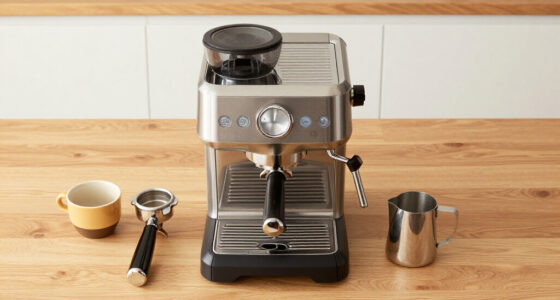
| Espresso | Concentrated coffee and drinks made with milk | Grind adjustment, workflow, and cleaning access |
| Single serve | One quick cup with portion control | Compatible serving sizes and whether it accepts ground coffee |
For example, if you brew a full pot before your household wakes up, an automatic drip machine with a thermal carafe may suit you better than an espresso-focused unit. A thermal carafe keeps coffee warm without relying on a hot plate, which can continue heating it and change its flavor over time. If you mainly make one cup, a large carafe brewer could take up counter space and leave you with more coffee than you want.
Some models combine features, but a long feature list does not make brewing styles interchangeable. Espresso typically calls for finer, adjustable grinding and a different workflow from drip coffee. Check the machine’s instructions for grind settings and coffee options for the drinks you plan to make; a mismatch can limit flavor or make the daily process feel unnecessarily complicated.
Compare the controls, capacity, and footprint
Coffee makers with built-in grinders are easiest to live with when their controls and capacity fit your daily habits. Look for useful options such as grind size, brew strength, cup count, and a timer; each can help you tailor a pot, but each may add setup and cleaning. A machine with more settings is not automatically the better choice.[1] The practical test is whether a control solves a problem you actually have: cup-count adjustment helps when your batch size changes, while an unused menu adds steps without improving your cup.
For instance, if you make two cups on weekdays and a full pot on Sunday, a cup-count setting offers real value because it lets the machine adapt to different amounts. If you always brew the same amount, simple controls may be quicker to use and easier to set consistently. Newer products may add scales, sensors, or app controls, but these trends are not standard and do not necessarily improve taste.[1] Consider whether the added feature makes a repeated task easier; otherwise, its cost and setup may outweigh the convenience.
Measure your counter before buying. Check the bean hopper, water reservoir, carafe, and space needed to open the lid; a tall cabinet can turn a roomy machine into an awkward one. These dimensions affect more than appearance: if refilling beans or water means moving the machine each time, a convenient appliance can become a daily nuisance. Capacity matters too: a large reservoir helps a busy household avoid frequent refills, while a compact design may be easier to fit in a small kitchen but require more frequent attention.
Keep the grinder clean so your coffee stays bright
Coffee makers with built-in grinders need regular cleaning because grounds and coffee oils collect in the grinder, chute, filter basket, and brew unit. Trapped residue can clog the grounds path or leave old, bitter flavors in a new batch. Accessible, removable parts make this routine easier.[1] Since the grinder and brewer share a housing, cleaning access can influence whether maintenance feels manageable enough to do consistently.
A realistic example: if your Monday coffee tastes dull after a weekend of brewing, old grounds in the chute may be part of the problem. Residue can mix with fresh grounds and add stale flavors, while compacted grounds can interfere with the machine moving new coffee into the basket. Follow the manufacturer’s cleaning schedule, empty accessible grounds regularly, and wash removable parts as directed. If the routine requires tools or disassembly, factor that effort into your choice rather than assuming a quick rinse will be enough.
Oily beans can leave extra residue, so check whether the manufacturer recommends them. Also check if you can use pre-ground coffee; some models have a bypass chute or separate setting, while others do not. That option can be useful when you want decaf or a different coffee without emptying the hopper, but it only helps if the machine is designed to route grounds past the grinder. The manual gives the answer for that specific machine.[1]
Cleaning is part of the coffee routine. A grinder that is easy to reach will be easier to maintain than one that hides grounds in a narrow passage, and regular care can protect both flavor and reliable operation.
Use a short checklist to pick the right machine
Coffee makers with built-in grinders are worth comparing by their complete daily routine, not by their number of buttons. Walk through these five checks before you buy; a little planning can spare you a machine that is too loud, too bulky, or too fussy for weekday mornings. Each check affects ownership in a different way, so a strong match means balancing flavor and convenience with the effort the machine asks of you.
- Start with brew style: Choose drip, espresso, or single serve based on what you drink most. This prevents paying for a brewing setup that does not fit your usual cup.
- Check grinder and controls: Compare burr or blade design, grind adjustment, and strength settings. More control matters when you plan to use it; otherwise, straightforward operation may suit you better.
- Inspect cleaning access: Find out which parts detach and how the manufacturer says to clean them. A routine that is awkward to reach is harder to keep up, and residue can affect both flavor and operation.
- Measure the setup: Check hopper, water reservoir, carafe, cabinet clearance, and counter space. A machine that fits only when lids are closed may be inconvenient to refill and use.
- Review ownership costs: Compare warranty, replacement-part availability, noise, and likely repair complexity.[1] An integrated grinder saves space but makes the appliance more complex, so service options matter if it stops working.
For example, a person who leaves home early may love a timer but dislike a grinder that wakes the household. Some programmable machines grind beans as part of a scheduled cycle, but features vary; check how long beans sit in the hopper and what the timer actually controls. A timer is valuable when it genuinely removes a morning step, but less so if it requires leaving beans exposed for longer than you prefer.
Whole beans generally hold their aroma longer than ground coffee when stored properly. Use an airtight container in a cool, dry place away from heat and light, and avoid keeping a large supply in the hopper for a long time. The brewer’s timer can be convenient, but it does not replace sensible bean storage.
Know when a separate grinder makes more sense
Coffee makers with built-in grinders suit people who want fewer steps and appliances, while separate grinders and brewers may suit people who want more flexibility or easier maintenance. The best setup depends on how much you value convenience, grind control, and the ability to replace one appliance at a time.[1] Combining equipment reduces counter clutter, but it also ties two functions to one machine and can make cleaning or repairs more involved.
If you experiment with different beans and brew methods, a separate grinder can give you more choice because you can select a grinder independently and pair it with different brewers. That flexibility may also make it easier to replace or service one part of your setup. If you mostly want a fresh pot without juggling equipment, an integrated machine can simplify the counter and the morning. A buyer who drinks one consistent drip coffee may prefer ease; a hobbyist may prefer control, even if that means more equipment and steps.
Compare the warranty and replacement-part availability alongside the purchase price. The built-in grinder adds mechanical complexity, and repairs can involve more than replacing a basic drip brewer. A lower initial price may be less compelling if parts are hard to find or the machine is difficult to service. Check current prices and model availability when shopping, since product lineups change over time.[1]
Frequently Asked Questions
Does a built-in grinder make coffee taste better?
It can add more aroma than coffee brewed from grounds that have been sitting, but it does not guarantee a better cup. Bean freshness, grind consistency, water, and brewing all affect flavor.
Are burr grinders better than blade grinders?
Burr grinders usually produce more consistent grounds and offer better control. A blade grinder may work for a simpler setup, but its grounds can be less even; the machine’s full design also matters.
Can I put pre-ground coffee in a grind-and-brew machine?
Some machines accept pre-ground coffee through a bypass chute or a separate setting, and some do not. Check the specific model’s manual before buying if you want that option.
Can I leave coffee beans in the hopper?
You can, but avoid storing a large amount there for a long time if you want to preserve freshness. Keep your main supply sealed in a cool, dry place away from heat and light.
How often should I clean the grinder?
Follow the manufacturer’s schedule, since designs and cleaning needs vary. Regularly clear accessible grounds and clean removable parts as directed to help prevent buildup, clogs, and stale flavors.
Conclusion
Choose a coffee maker with a built-in grinder when one-step convenience fits your routine and the grinder is easy to clean. Match its brew style and capacity to what you actually drink, then check its noise, warranty, and counter fit before bringing it home.
When the grinder hums and fresh coffee begins to drip, the best machine is the one that makes that small morning ritual easy to repeat.
Halloween Picks
halloween
As an affiliate, we earn on qualifying purchases.