
TL;DR

Get coffee and tea gear delivered free with Prime
- Fast, free delivery on millions of items
- Prime Video, Amazon Music and more included
- Member-only deals all year
Espresso fines are very small coffee particles that extract quickly and can slow water flow, while boulders are unusually large particles that extract slowly. Too many of either can make a shot taste uneven: fines may add harsh bitterness or clogging, while boulders may contribute sour, weak flavors. You can improve consistency by checking your grinder, changing one variable at a time, and tasting the shot alongside its flow and timing.
A shot can taste both bitter and sour at once—and an uneven grind may be part of the reason. Your grinder does not turn every bean into identical grains. It makes a spread of particle sizes, including fines at the small end and boulders at the large end.
That spread matters because water moves through a tamped coffee bed, not through each particle separately. Tiny grounds and large chunks respond differently to the same hot water, like sand and pebbles sharing one narrow path. In this guide, you’ll learn what fines and boulders are, how each can affect espresso, and how to troubleshoot without changing five things at once.
You do not need a laboratory or a sieve to start. A careful look at your grounds, a consistent recipe, and a few deliberate taste tests can tell you a lot. The goal is not a perfectly uniform grind; it is a repeatable shot that tastes good in your cup.
Fines are the smallest particles in the grind; boulders are unusually large particles relative to the rest.
Fines can extract quickly and restrict flow, while boulders can extract slowly and contribute weak or sour notes.
A shot can taste bitter and sour together when different parts of the puck extract unevenly.
Taste, flow, timing, and repeatability offer better clues than visual inspection alone.
For troubleshooting, keep dose and yield steady, adjust one variable, and compare another shot.
What Espresso Fines and Boulders Actually Look Like
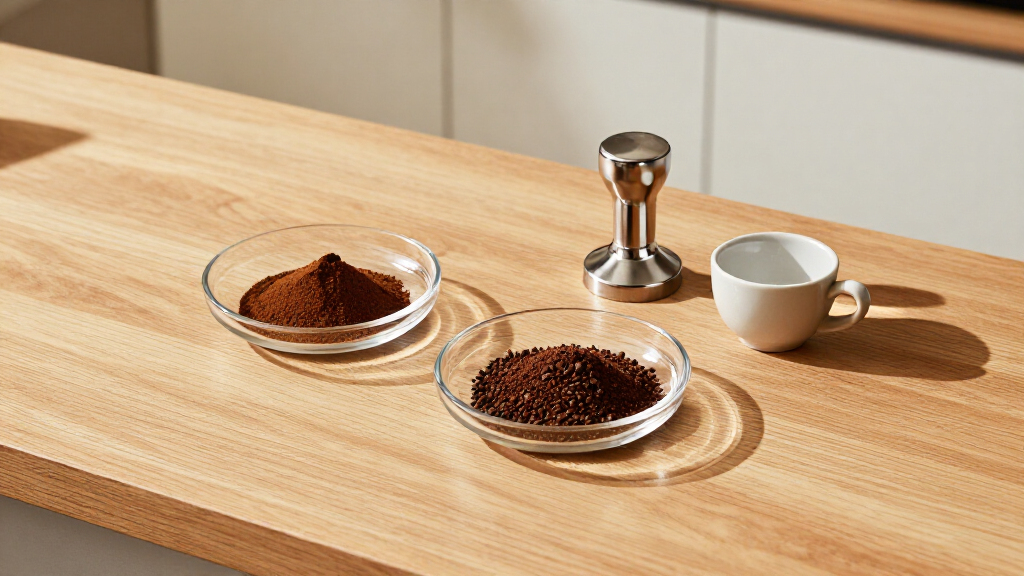
Espresso fines and boulders are the unusually small and unusually large particles in a coffee grind. Fines look powdery, while boulders look like coarse grains or tiny chips; both can appear in the same dose from an ordinary grinder.
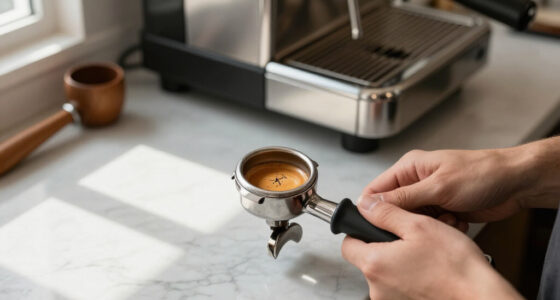
Think of your grinder as a tool that makes a range, not a machine that stamps out identical coffee grains. Most particles may cluster around a useful espresso size, but smaller fragments and larger pieces remain. A pinch of grounds on a white plate can make the contrast easier to see: dust-like specks sit beside grains that look visibly chunkier.
“Fines” does not mean every particle in an espresso grind is too small. It refers to the smallest portion of the grind distribution. Likewise, a boulder is not simply any particle you can see. It is large compared with the rest of that particular dose. This is why a grind can look generally fine yet still contain both extremes.
Imagine a gravel path with sand caught between the stones. The sand can pack into gaps; the stones leave larger spaces. In a coffee bed, particle size also changes how water finds its way through. You do not need to identify each particle by eye to use the idea: if a shot behaves unpredictably, the size spread may be one clue alongside dose, distribution, and puck preparation.
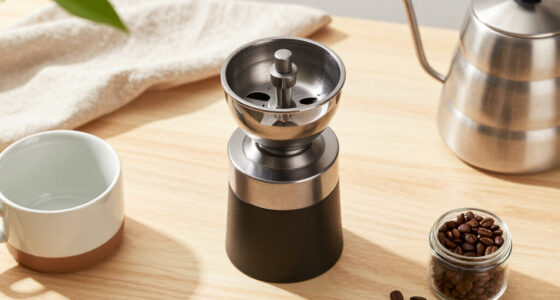
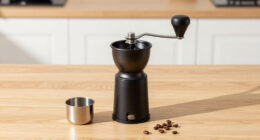
espresso grinder with adjustable grind size
As an affiliate, we earn on qualifying purchases.
As an affiliate, we earn on qualifying purchases.
How Fines and Boulders Pull Espresso in Opposite Directions
Espresso fines and boulders affect extraction in opposite ways: fines offer more exposed surface and can slow flow, while boulders offer less surface and can extract more slowly. The result is not a simple “fine equals bitter, large equals sour” switch, but a mix of particle behavior inside one puck.
Small particles expose more coffee to water relative to their size, so they can give up soluble compounds quickly. They may also settle into gaps and make parts of the coffee bed less permeable. That matters because espresso water follows paths of least resistance: a dense patch can slow flow locally, while nearby gaps or channels take more water. The shot may therefore contain both highly extracted areas, which can taste harsh or drying, and under-extracted areas, which can taste sharp or sour. Slower flow alone does not guarantee even extraction.
Large particles have less surface area for their size, so water may extract them more slowly. If many oversized pieces are present, they can contribute a thin or sour impression even while fines elsewhere release plenty of bitter compounds. The taste is an average of these different contributions, so a cup can seem confusing rather than cleanly “over-extracted” or “under-extracted.”
For example, suppose you pull your usual dose and yield, but the espresso tastes hollow at the front and harsh at the finish. A broad particle spread could help explain the split personality: some parts of the puck may give up compounds quickly while others lag behind. But it is not proof. Channeling, stale beans, water, and recipe changes can create similar results. Treat taste, flow, and puck condition as clues that work together.
| Particle type | Typical behavior | Possible cup or flow clue |
|---|---|---|
| Fines | High surface area; may pack into gaps | Slow flow, harsh bitterness, or uneven extraction |
| Boulders | Low surface area; may extract slowly | Weak or sour notes, sometimes alongside other flavors |
The practical implication is to avoid diagnosing from one flavor or one timing result. A slower shot that tastes balanced may be preferable to a faster one, and a little variation in particle size is unavoidable. You are trying to reduce the kind of unevenness that repeatedly harms flavor, not eliminate every fine or large fragment.
As an affiliate, we earn on qualifying purchases.
Why Your Grinder Produces a Mix of Particle Sizes
Espresso fines and boulders come from the grinding process, and every grinder produces some variation. Burr design, alignment, condition, adjustment, coffee type, and how you operate the grinder can all shape the particle spread. A grinder that makes a more consistent grind may reduce extremes, but no setting turns every bean into a perfect, uniform powder.
Burrs crush and shear beans into smaller pieces. As the bean breaks, some fragments split repeatedly and become very small; other pieces leave the burrs larger. If burrs have accumulated coffee residue, are worn, or are poorly aligned, your results may become less consistent. A sudden change after months of steady shots can be a reason to inspect and clean the grinder, following its manufacturer’s instructions.
Beans matter too. A very light roast may feel harder to grind than a darker roast, and different coffees can behave differently at the same setting. If you switch from a dense light roast to a darker blend and keep the grinder adjustment unchanged, the shot may speed up or slow down. That does not automatically mean your grinder has failed; it may mean the coffee itself responds differently.
As a practical example, imagine you clean your burrs, return to the same beans, and find your usual espresso now runs faster. Before you conclude that the burrs are damaged, check whether you reassembled the grinder correctly and whether the setting shifted. Make one small adjustment, pull another shot, and record what changed. Good troubleshooting is more like tuning a guitar than pressing a reset button.
- Check cleanliness: Coffee oils and fragments can build up around burrs and chutes.
- Check consistency: Keep beans, dose, and grinder setting steady during a test.
- Check the change: Note whether the problem began after new beans, cleaning, or adjustment.
As an affiliate, we earn on qualifying purchases.
How to Tell Whether Your Shot Has a Grind-Consistency Problem
Espresso fines and boulders are not diagnosed by taste alone; compare the flavor with shot timing, flow, and repeatability. Bitter or sour notes can point toward uneven extraction, but they can also come from a recipe that is too long or short, poor puck preparation, or coffee that is past its best.
Start by noticing what the espresso does. Does it begin dripping unusually late? Does one side of the spout gush while the other barely flows? Does the shot vary dramatically even when you repeat your routine? A bed with excess fines may resist water, while channels can let water rush through a small path and leave the rest under-extracted. These clues can overlap.
Suppose your 18-gram dose usually produces 36 grams of espresso in about 28 seconds, but today the same recipe takes 40 seconds and tastes drying. That points to a change worth investigating, not a universal diagnosis. Check whether the grinder setting moved, whether the beans changed, and whether your distribution and tamp differed. A stopwatch cannot tell you particle sizes, but it can help you spot a pattern.
Try to taste the shot after it cools slightly; very hot espresso can hide detail. Note whether the finish is sharply drying, whether the first sip tastes sour, or whether the whole cup feels thin. Keep a simple log with dose, yield, time, bean, and one flavor note. If a problem appears only once, it may be a puck-prep slip. If it repeats across several shots, the grinder or recipe deserves closer attention.
Useful rule: A flavor clue is a starting point, not a verdict. Pair what you taste with what the shot did.
As an affiliate, we earn on qualifying purchases.
A Simple Five-Step Routine for More Even Espresso
Espresso fines and boulders are easier to manage when you change one variable at a time. Use a repeatable routine so you can tell whether an adjustment helped, rather than changing grind, dose, and yield together and losing the trail.
- Choose one coffee and recipe. Keep the same beans and dose for a few tests. For example, start with 18 grams in and aim for 36 grams out.
- Watch the shot. Record the time, flow, and flavor. Use your usual target as a reference rather than treating one timing number as a law.
- Adjust the grinder slightly. If the shot runs too quickly and tastes thin, go a little finer. If it chokes or tastes harsh and drying, try a small move coarser.
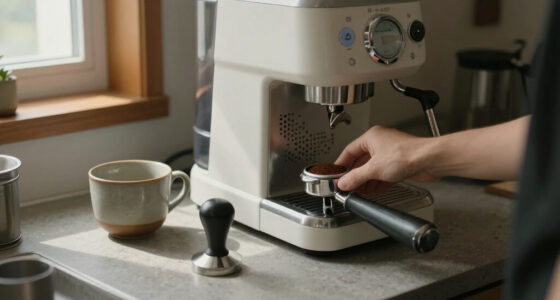
- Keep puck preparation steady. Distribute grounds evenly, break up visible clumps if that is part of your routine, and tamp level. Uneven preparation can imitate a grind problem.
- Repeat and compare. Pull another shot with the same dose and yield. Write down whether flow and taste moved in the direction you wanted.
That process is deliberately plain. Picture a rainy afternoon when your espresso suddenly takes much longer than usual. Instead of changing the dose, tamp pressure, and yield all at once, you keep the dose steady, make a small grind adjustment, and pull again. Now you have a useful comparison.
Sifting can separate some particle sizes, but it is not a default fix for home espresso. Sieves discard coffee, take time, and may remove particles that contribute to the recipe you like. Use them only if you have a specific experiment in mind. For most people, cleaning the grinder when due and dialing in patiently offers better value than chasing a visually perfect pile of grounds.
When Fines Are the Bigger Problem—and When Boulders Are
Fines and boulders can both hurt espresso, but which one matters more depends on the grinder, coffee, recipe, and puck preparation. Fines often draw attention because they can slow water and contribute to clogging, while boulders can leave parts of a puck under-extracted. Neither particle type is automatically the villain in every shot.
If a shot repeatedly drips, stalls, or runs much longer than your usual recipe, excess fines or an overly fine overall setting could be involved. But do not assume fines are the answer before checking the basket, dose, and grinder adjustment. A basket packed too full or a clogged machine can also restrict flow. Clean and inspect equipment according to its instructions rather than forcing water through a blocked path.
If espresso flows quickly and tastes thin or sharply sour, a coarse setting or larger particles may be part of the picture. Yet a fast, sour shot can also come from channeling: water finds a shortcut through the puck and leaves other areas untouched. That is why an even tamp and careful distribution matter. Imagine a garden hose flowing through a bed of dry soil; one open crack can carry most of the water while nearby ground stays dry.
There is a tradeoff in trying to minimize every fine particle. Fines contribute to texture and extraction, and a shot with no small particles is not the only route to good flavor. Your real target is not theoretical uniformity; it is a stable grind and a cup you enjoy. If you make espresso for guests, a repeatable, balanced shot beats a fussy process that takes ten minutes and tastes no better.
- Slow, harsh, or stalled: Check grind setting, dose, residue, and possible excess fines.
- Fast, sour, or thin: Check grind setting, channeling, and puck distribution before blaming boulders.
- Both bitter and sour: Look for uneven extraction and repeatability, not one flavor in isolation.
Use these patterns to choose what to inspect, not to make a final diagnosis. For example, if a shot is slow but tastes sweet and balanced, changing the grinder just to shorten the time could make the cup worse. If it is slow and unpleasant across repeated attempts, check for a fine setting or restricted flow, then make a small controlled adjustment. The tradeoff is between chasing a theoretical particle profile and keeping a practical, flavorful recipe.
What Grinder Upgrades and Sieves Can—and Cannot—Fix
A more consistent grinder can reduce the size spread, but no upgrade guarantees perfect espresso or removes the need to dial in. Burr geometry, alignment, and adjustment precision can influence the grind, yet your beans and preparation still shape what reaches the cup.
Modern grinders may offer finer adjustment steps, stable burr alignment, or digital controls. Those features can help you repeat a setting and make small changes without overshooting. They are useful when you brew often or switch coffees, but a display does not tell you whether the espresso tastes balanced. A simple notebook and careful tasting still do real work.
Particle analysis and sieving can help coffee professionals or curious home brewers study grind distribution. For instance, a café testing two grinder settings might compare how much material falls into different sieve ranges. That can reveal a pattern, but it does not automatically identify the best-tasting shot. Particle measurements describe the grounds; your palate evaluates the drink.
Before buying equipment or sieves, try the low-cost checks. Clean the grinder as directed, make sure the burrs are seated properly after maintenance, and dial in each new coffee. If you repeatedly struggle to get both a manageable flow and a pleasant flavor, a more capable grinder may help. If your shots already taste good, there is no need to chase a number on a particle chart. Better coffee is the goal, not a perfect-looking mound on the counter.
Frequently Asked Questions
Are fines always bad for espresso?
No. Fines are a normal part of grinding, and their presence alone does not mean your grinder or espresso is faulty. They become a concern when the overall grind spread or setting repeatedly causes choking, harsh flavors, or inconsistent shots.
Can I see fines and boulders without special equipment?
You can often spot obvious size differences by spreading grounds on a white plate under good light. Visual checks will not measure the full particle distribution, though, so use them as a clue and judge the shot by taste, flow, and repeatability too.
Does a slow shot prove that I have too many fines?
No. A slow shot can come from an overly fine setting, a high dose, a clogged basket, or puck-preparation issues as well as fines. Check your usual dose and equipment, then change one variable at a time to find the cause.
Should I sieve espresso grounds to remove boulders?
Usually not for everyday brewing. Sieving takes time and discards coffee, and removing particles does not guarantee a better-tasting shot. It can be useful for a controlled experiment, but most home brewers will get more from cleaning and dialing in the grinder.
What should I change first if espresso tastes both sour and bitter?
First, repeat the same dose and yield while checking your distribution, tamp, and shot flow. Sour and bitter notes together can signal uneven extraction, but they do not identify the cause by themselves. Make one small grind adjustment, then compare the next shot.
Conclusion
Remember the useful distinction: fines can slow and intensify extraction, while boulders can lag behind. Either can contribute to an uneven shot, but neither explains every sour, bitter, or slow espresso.
Keep your recipe steady, make one small adjustment, and taste the next cup. The best grind is not the prettiest pile of grounds—it is the one that sends a balanced, fragrant shot into your cup.
Halloween Picks
halloween
As an affiliate, we earn on qualifying purchases.