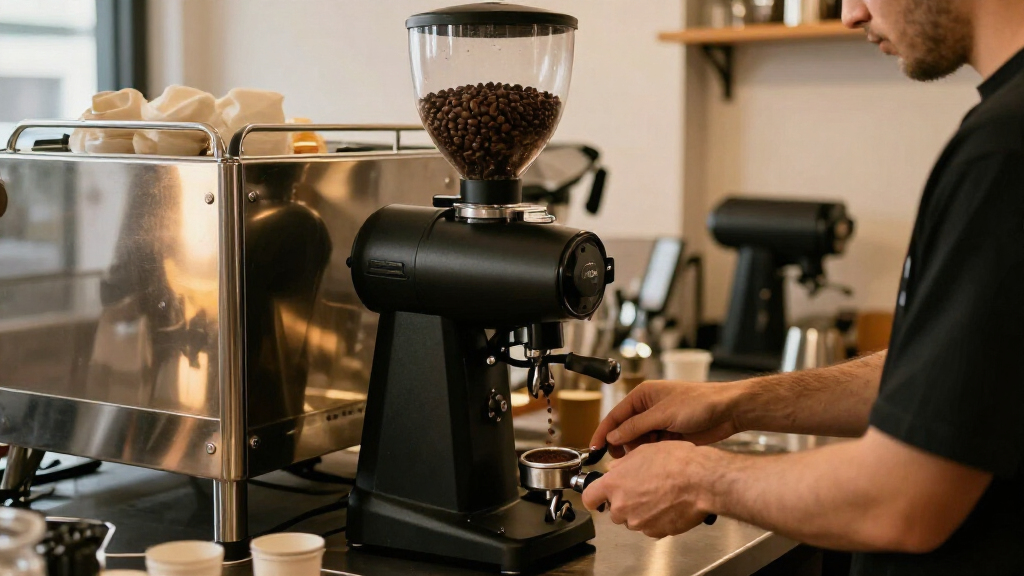
For a café that needs precise, service-friendly espresso grinding, I’d start with the Anfim Luna: its programmable dosing, stepless adjustment, and 2 kg hopper suit a compact bar with steady volume. The Eureka Helios 65 is my pick for touchscreen controls and a large bean supply, while the Flyseago 2-in-1 stands out for combining grinding with an electric tamper. Those features solve different workflow problems, so the best choice depends less on a single spec and more on what slows your bar down.

Get coffee and tea gear delivered free with Prime
- Fast, free delivery on millions of items
- Prime Video, Amazon Music and more included
- Member-only deals all year
Noise, counter space, maintenance, and the amount of control staff need all matter. The Eureka Atom W 65 is the quieter option, but its listed 10.5-ounce capacity is much smaller than the Luna’s 2 kg hopper. The Flyseago offers broad brew-setting flexibility, yet its 14 settings may be less suitable for baristas who want fine, continuous espresso adjustment. I’ve ranked these grinders by how well their stated features fit commercial service, while calling out where a tradeoff could make another pick a better match.
Complete the kit


Key Takeaways
- Anfim Luna: My strongest all-around choice for a small café that needs a slim footprint, programmable espresso doses, and a 2 kg hopper.
- Eureka Helios 65: A good fit for shops that value a large hopper, touchscreen controls, and a slide-out chute for cleaning.
- Flyseago 2-in-1: The distinctive workflow pick, with an electric tamper built in, but its 14 settings offer less adjustment granularity than stepless models.
- Eureka Atom W 65: The quieter option for noise-sensitive counters; its listed 10.5-ounce bean capacity means more frequent refills than the Luna or Helios.
- Before choosing, match hopper size and adjustment style to your service volume and staff workflow; a large burr alone does not determine which grinder suits a café.
| Anfim Luna Espresso Grinder 65mm Flat Burrs, 2 kg Hopper, 3.5″ Touchscreen, Stepless Worm Gear, On-Demand Dosing, Made in Italy |  | Best Overall for Compact Café Espresso Service | Burrs: 65 mm flat steel | Hopper capacity: 2 kg | Adjustment: Stepless worm gear | VIEW LATEST PRICE | See Our Full Breakdown |
| Eureka Helios 65 Commercial Espresso Grinder |  | Best for High-Capacity, Touchscreen-Led Workflow | Burrs: 65 mm flat | Bean capacity: 2.5 pounds | Adjustment: Stepless | VIEW LATEST PRICE | See Our Full Breakdown |
| Eureka Atom W 65 Espresso Grinder |  | Best for Noise-Sensitive Counters | Burr size: 65 mm | Adjustment: Stepless micrometric regulation | Capacity: 10.5 ounces | VIEW LATEST PRICE | See Our Full Breakdown |
| 2-in-1 Commercial Espresso Grinder with Built-in Tamper, 64mm Flat Burr |  | Best for Integrated Grinding and Tamping | Burrs: 64 mm SUS420 stainless steel flat burr | Grind settings: 14 | Hopper capacity: 35 ounces (1 kg) | VIEW LATEST PRICE | See Our Full Breakdown |
| commercial espresso grinder | Burrs | Adjustment | Weight | Dimensions |
|---|---|---|---|---|
| Anfim Luna Espresso Grinder 65 | 65 mm flat steel | Stepless worm gear | 24.7 pounds | 14.6 × 7.7 × 22.8 inches |
| Eureka Helios 65 Commercial Es | 65 mm flat | Stepless | 18 pounds | 10 × 8.5 × 23.5 inches |
| Eureka Atom W 65 Espresso Grin | — | Stepless micrometric regulation | 25 pounds | 9.45 × 7.08 × 21.25 inches |
| 2-in-1 Commercial Espresso Gri | 64 mm SUS420 stainless steel flat burr | — | — | — |
More Details on Our Top Picks
Anfim Luna Espresso Grinder 65mm Flat Burrs, 2 kg Hopper, 3.5″ Touchscreen, Stepless Worm Gear, On-Demand Dosing, Made in Italy
The Anfim Luna earns my top spot by balancing the needs that often compete at a small espresso bar: a compact footprint, a large hopper, and precise controls. Its 65 mm flat steel burrs are paired with a stepless worm-gear adjustment, allowing baristas to make incremental espresso changes rather than selecting from a short list of preset steps. Programmable, on-demand dosing adds another useful layer: a team can set repeatable portions for its workflow instead of relying on every staff member to judge each dose by eye.
Capacity is a standout distinction. The Luna’s 2 kg hopper is substantially larger than the Atom W 65’s listed 10.5-ounce capacity, which makes the Anfim a stronger fit when frequent refilling would interrupt service. It also has the largest listed touchscreen in this group at 3.5 inches, giving staff a clear interface for programmed doses. Compared with the Helios 65, it offers a similarly espresso-focused setup but a more clearly stated compact-bar orientation.
That compact description needs a little context: the Luna measures 14.6 inches long, 7.7 inches wide, and 22.8 inches tall. Its narrow width can help on a crowded counter, but height and overhead clearance still deserve a check before purchase. At 24.7 pounds, it is not a machine I’d choose for frequent moving. It is also designed for espresso rather than a broad range of brew methods, unlike the Flyseago’s stated 14 settings. That is a sensible specialization for an espresso-led café, but less appealing if one grinder must serve several brewing styles.
The removable spout and metal body are practical touches for maintenance, though the supplied details do not describe every cleaning step or the grinder’s performance under a particular shop’s workload. I place the Luna ahead of the Helios because its combination of programmable dosing, worm-gear control, and compact width makes its intended role especially clear. I’d choose it for a focused espresso station; I’d choose the quieter Atom W 65 instead if sound is the main constraint, or the Flyseago if integrated tamping matters more than stepless dialing.
Pros:- 65 mm flat steel burrs and stepless worm-gear adjustment support fine espresso dialing.
- 2 kg hopper helps reduce refill interruptions during service.
- Programmable on-demand dosing can make portions more repeatable across staff.
- Slim stated width and removable spout suit a compact espresso station.
Cons:- Espresso-only design offers less versatility than the Flyseago’s listed brew settings.
- At 24.7 pounds and 22.8 inches tall, it may be awkward to relocate or fit under low shelving.
- Its controls and programmed workflow may require staff familiarization.
Best for: Small cafés and coffee bars that want a narrow-footprint espresso grinder with a large hopper, programmable doses, and fine stepless adjustment.
Not ideal for: Shops that need one grinder for espresso and multiple brew methods, frequently move equipment, or lack clearance for a 22.8-inch-tall machine.
- Burrs:65 mm flat steel
- Hopper capacity:2 kg
- Adjustment:Stepless worm gear
- Dosing:Programmable, on-demand
- Display:3.5-inch touchscreen
- Weight:24.7 pounds
- Dimensions:14.6 × 7.7 × 22.8 inches
- Material:Stainless steel
Our verdict“I’d choose the Luna as the most balanced espresso-focused option here when counter width, dosing control, and hopper capacity all matter.”
Eureka Helios 65 Commercial Espresso Grinder
The Eureka Helios 65 is the straightforward pick for a café that wants a large bean supply and digital controls at the grinder. Its 65 mm flat burrs, stepless adjustment, and responsive touchscreen give a barista a direct way to tune grind size and manage the station. The listed 2.5-pound capacity is notably larger than the Atom W 65’s 10.5-ounce capacity, making the Helios a better match when refill frequency is a concern.
Maintenance is one of its clearest differentiators. The slide-out chute is designed to make cleaning easier, and the built-in burr tracking timer can alert staff when maintenance is due. Those features can help a café build upkeep into its routine rather than treating cleaning as an afterthought. The Luna also has a removable spout, but the Helios’s slide-out chute and timer give it a more explicitly maintenance-oriented story. I’d favor that approach in a shop where several employees share the equipment and predictable upkeep matters.
The Helios is not automatically the best choice for every busy bar. The supplied details give its weight as 18 pounds and dimensions as 10 by 8.5 by 23.5 inches, so buyers should check both counter depth and overhead room. Its stated 570-watt draw is also higher than the Atom W 65’s 430 watts; that figure describes electrical demand, not a complete estimate of operating cost. I would verify the power requirements for the intended station rather than infer energy use from wattage alone.
Compared with the Luna, the Helios puts greater emphasis on a large bean capacity, touchscreen operation, and cleaning aids, while the Luna provides a smaller stated width and programmable dosing detail. The Flyseago takes a different route by combining grinding with tamping, but its 14 settings do not offer the same listed stepless control. I rank the Helios second because it brings a useful commercial feature set without the Luna’s clearly described worm-gear dosing package. It makes the most sense for an espresso bar seeking capacity and maintenance prompts, not a shop that prioritizes quieter grinding or multi-method brewing.
Pros:- 65 mm flat burrs pair with stepless adjustment for fine espresso tuning.
- Listed 2.5-pound bean capacity can reduce refill frequency.
- Touchscreen provides a direct interface for grinder control.
- Slide-out chute and burr tracking timer support routine maintenance.
Cons:- 23.5-inch height may not fit beneath all shelves or cabinets.
- Listed 570-watt draw is higher than the Atom W 65’s 430 watts.
- No noise-reduction feature or non-espresso versatility is specified.
Best for: Espresso bars that want a large hopper, touchscreen-based control, and cleaning features to support a shared staff workflow.
Not ideal for: Cafés with low overhead clearance, a tight power setup, or a need for quiet grinding or one grinder that serves several brew methods.
- Burrs:65 mm flat
- Bean capacity:2.5 pounds
- Adjustment:Stepless
- Controls:Responsive touchscreen
- Maintenance:Slide-out chute and burr tracking timer
- Weight:18 pounds
- Dimensions:10 × 8.5 × 23.5 inches
- Power:570 watts, 120 volts
Our verdict“I’d pick the Helios 65 for a high-capacity espresso station where touchscreen control and maintenance prompts matter more than quiet operation.”
Eureka Atom W 65 Espresso Grinder
The Eureka Atom W 65 earns its place for shops where grinder noise can disrupt conversation or the surrounding workspace. Its Silent Technology is stated to cut grinding noise by about 20 dB, a feature that gives it a distinct role beside the more capacity-oriented Helios and Luna. The 65 mm burrs and high-speed grind dispersion are aimed at quick espresso preparation, while stepless micrometric regulation gives baristas fine control over grind size.
Its workflow details support consistency as well. The ACE system is designed to reduce clumping and static, which can help keep grounds more manageable during dosing. An adjustable hands-free fork accommodates different portafilters, and a quick-release burr holder is intended to simplify access for maintenance. Compared with the Flyseago, the Atom W 65 focuses on grind control, quieter operation, and a more adaptable portafilter setup rather than automating tamping. For a barista-led station, that may be the more useful division of labor.
The principal tradeoff is bean capacity. Its listed capacity of 10.5 ounces is much smaller than the Luna’s 2 kg hopper and the Helios’s 2.5-pound capacity. A café that grinds steadily through a busy shift may need to refill it more often, so I would not rank it first for uninterrupted high-volume service. The supplied specs also list a weight of 25 pounds and dimensions of 9.45 by 7.08 by 21.25 inches. Its narrow footprint can help on a crowded counter, but the weight makes routine relocation less convenient.
Against the Luna, the Atom W 65 wins on specified noise reduction and adds anti-clumping features, while the Luna offers far more hopper capacity and programmable dosing. Against the Helios, the Atom’s stated power draw is lower at 430 watts versus 570 watts, though that alone does not establish total energy use or operating cost. I’d select it for a quieter espresso environment where stepless control matters and refills are manageable. If the priority is a large bean supply or a touchscreen, the Helios is a closer fit.
Pros:- Silent Technology is stated to reduce grinding noise by about 20 dB.
- Stepless micrometric adjustment supports fine grind-size changes.
- ACE system is designed to reduce clumping and static.
- Adjustable hands-free fork and quick-release burr holder support workflow and maintenance.
Cons:- Listed 10.5-ounce capacity is much smaller than the Luna or Helios hopper capacities.
- At 25 pounds, it is heavy to move despite its relatively narrow footprint.
- Its stated feature set is focused on espresso rather than multiple brew methods.
Best for: Coffee bars, open counters, and quieter workspaces where noise reduction and precise espresso adjustment matter more than a large hopper.
Not ideal for: High-throughput stations that want long stretches between refills, or buyers who specifically want a touchscreen interface or built-in tamper.
- Burr size:65 mm
- Adjustment:Stepless micrometric regulation
- Capacity:10.5 ounces
- Noise feature:Silent Technology; stated reduction of about 20 dB
- Clump and static control:ACE system
- Weight:25 pounds
- Dimensions:9.45 × 7.08 × 21.25 inches
- Power:430 watts, 120 volts
Our verdict“I’d choose the Atom W 65 when lower noise and fine espresso control outweigh the need for a large hopper.”
2-in-1 Commercial Espresso Grinder with Built-in Tamper, 64mm Flat Burr
The Flyseago 2-in-1 is the most workflow-specific pick in this group. Its built-in electric tamper applies a stated 10–30 kg of pressure, combining grinding and tamping in one machine. For a café that wants to shorten the handoff between dosing and puck preparation, that integrated approach may reduce steps at the station. The height-adjustable portafilter holder is intended to accommodate different setups, while a 1 kg hopper gives it more bean capacity than the Atom W 65’s listed 10.5 ounces.
Its 64 mm SUS420 stainless steel flat burr is close in size to the 65 mm burrs on the other three models, but burr diameter is only one part of the buying decision. The more important distinction is the Flyseago’s 14 grind settings. That range covers several brewing methods, including espresso and French press according to the supplied description, making this the most versatile stated option in the lineup. For a café with a varied menu, that flexibility may be useful. For a barista who frequently makes tiny espresso adjustments, the Luna, Atom W 65, or Helios has the more suitable listed control style because each offers stepless adjustment.
There are tradeoffs behind the all-in-one convenience. Integrating a tamper adds another mechanism and workflow for staff to learn, and the supplied details explicitly note that its features may require training. The grinder is also described as potentially bulky for small counters, so I’d confirm its actual placement needs before committing. Its hopper is substantial relative to the Atom W 65 but smaller than the Luna’s 2 kg capacity; the Helios also lists a larger 2.5-pound capacity. That makes the Flyseago less compelling for a café whose main concern is minimizing bean refills.
I place it fourth not because the added tamper lacks value, but because the other models offer a clearer fit for an espresso-only station with stepless grind control, and the Flyseago’s fixed settings create a meaningful precision tradeoff. Compared with the Eureka Atom W 65, it offers integrated tamping and broader stated brew coverage, while the Atom brings quieter operation and micrometric adjustment. I’d choose Flyseago when simplifying puck preparation matters more than dialing through continuous grind adjustments; I’d skip it if espresso calibration is the primary requirement.
Pros:- Built-in electric tamper applies a stated 10–30 kg of pressure.
- 64 mm SUS420 stainless steel flat burr supports commercial-style grinding.
- Fourteen settings cover espresso and other listed brew methods.
- 1 kg hopper and adjustable portafilter holder support service workflow.
Cons:- Fourteen discrete settings offer less fine adjustment than the three stepless models.
- The combined feature set may take staff training to operate consistently.
- May be bulky for a small counter and has less hopper capacity than the Luna or Helios.
Best for: Cafés, bakeries, and hotel lobbies that value integrated tamping, a broad set of brew settings, and fewer separate steps at the station.
Not ideal for: Espresso-focused shops that need fine stepless dialing, very compact equipment, or the largest hopper in this comparison.
- Burrs:64 mm SUS420 stainless steel flat burr
- Grind settings:14
- Hopper capacity:35 ounces (1 kg)
- Tamper:Built-in electric; stated 10–30 kg pressure
- Portafilter holder:Height-adjustable
- Frame:Heavy-duty metal frame
- Materials:Plastic and stainless steel
- Color:Black
Our verdict“I’d choose Flyseago for a team that values integrated tamping and multi-method flexibility more than continuous espresso grind adjustment.”
How We Picked
I ranked these four grinders around practical commercial espresso needs: repeatable grind control, service pace, hopper capacity, and day-to-day operating fit. I used the supplied product details rather than treating every machine as interchangeable. A grinder intended for a busy espresso bar should make it possible to adjust extraction, prepare doses consistently, and keep the station moving. A feature only helps if it matches the way a particular shop works.
That led me to distinguish between stepless adjustment and a fixed set of grind settings. The Anfim Luna, Eureka Atom W 65, and Eureka Helios 65 all list stepless controls, which can help a barista make fine changes as beans or conditions shift. Flyseago lists 14 settings and adds an electric tamper, a different kind of workflow benefit. I treated these as distinct approaches, not as equivalent feature counts: broad brew-method coverage is useful, but espresso-focused dialing often calls for smaller adjustments.
I also weighed capacity and physical fit. The Luna’s 2 kg hopper and Helios’s listed 2.5-pound capacity may reduce refill interruptions compared with the Atom W 65’s 10.5-ounce capacity. The Luna is described as compact, but its stated height is 22.8 inches, so I would still check clearance beneath shelves. Weight and overall dimensions matter too, particularly for a crowded counter or a station that gets rearranged.
Finally, I considered workflow and upkeep: programmable dosing, touchscreen controls, quieter operation, anti-clumping features, and access for cleaning. These details can help a team maintain a consistent station, but none replaces proper calibration, cleaning, or staff training. The ranking favors machines with a clear role and a useful mix of commercial features; it does not assume a particular café’s volume, menu, beans, or electrical setup.
| commercial espresso grinder | Adjustment |
|---|---|
| Anfim Luna Espresso Grinder 65 | Stepless worm gear |
| Eureka Helios 65 Commercial Es | Stepless |
| Eureka Atom W 65 Espresso Grin | Stepless micrometric regulation |
| 2-in-1 Commercial Espresso Gri | — |
Factors to Consider When Choosing Best Commercial Espresso Grinders
I’d choose a commercial espresso grinder by starting with the station’s daily bottleneck, not by comparing burr diameter alone. The models here share broadly similar flat-burr sizes, but their adjustment systems, hopper capacities, noise features, and workflows point to different buyers. These checks can help narrow the shortlist before you compare machine dimensions or staff preferences.
Match adjustment style to the drinks you serve
For espresso, small changes in grind size can alter how quickly a shot runs, so adjustment range matters. The Luna, Atom W 65, and Helios 65 are stepless, giving baristas continuous adjustment rather than a fixed list of positions. That can suit a shop that changes beans or makes frequent dialing adjustments. Flyseago’s 14 settings are more structured and cover multiple brewing methods, which may be helpful when one grinder needs to serve a varied menu. I would choose by the level of espresso precision your team needs, not assume more listed settings always mean finer control.
Size the hopper around your refill routine
Capacity affects how often staff need to top up beans, but the right amount depends on service pace and whether the café changes beans throughout the day. The Luna lists a 2 kg hopper, the Helios 2.5 pounds, Flyseago 1 kg, and the Atom W 65 10.5 ounces. The smaller Atom capacity may suit a lower-volume or frequently changing workflow, while the larger hoppers can reduce refills during a steady rush. Check how much coffee your station uses between checks rather than choosing the largest hopper automatically.
Think beyond burr size
All four grinders list flat burrs in the 64–65 mm range, so burr diameter alone does not separate them well. The useful distinctions are stepless control, dosing, noise management, and cleanup features. The Luna emphasizes programmable dosing; the Helios adds a slide-out chute and burr tracking timer; the Atom W 65 includes noise reduction and ACE anti-clumping features; Flyseago integrates an electric tamper. Decide which of those capabilities addresses a real need on your bar.
Measure the counter and overhead clearance
Counter depth and shelf height can rule out a grinder before its workflow features matter. The stated heights range from 21.25 inches for the Atom W 65 to 23.5 inches for the Helios, with the Luna at 22.8 inches. The Luna has a listed width of 7.7 inches, while the Atom W 65 is 7.08 inches wide; the Helios lists a depth of 10 inches. Measure the actual station, including space for a portafilter, hopper access, and staff movement. Weight also matters if the grinder must be moved for cleaning or layout changes.
Treat noise and maintenance as daily workflow issues
If the grinder sits near guests or an open dining area, the Atom W 65’s stated noise reduction may be more valuable than a larger hopper. If cleaning interruptions are the concern, the Helios lists a slide-out chute and burr tracking timer, while the Luna describes a removable spout and the Atom a quick-release burr holder. These are different maintenance aids, not a guarantee that cleaning is effortless. Plan a regular cleaning routine and check how each design fits the way your staff can access and maintain the grinder.
Choose controls your staff can use consistently
Touchscreens and programmed doses can make a shared station easier to standardize, but they may require onboarding. The Luna has a 3.5-inch touchscreen and programmable dosing; the Helios also has a touchscreen. Flyseago’s integrated tamper and range of settings may simplify some steps while adding a feature staff need to learn. The Atom W 65 focuses on quieter grinding and manual fine adjustment. I’d weigh repeatability against simplicity: choose controls that fit your team’s training and the way drinks are prepared during the rush.
Frequently Asked Questions
Which grinder is the best all-around pick for a small café?
I’d start with the Anfim Luna for a small café that primarily serves espresso. Its 2 kg hopper, programmable dosing, stepless worm-gear adjustment, and relatively narrow listed width make a strong mix for a compact espresso station. The Helios may be a better fit if its slide-out chute and maintenance timer are priorities, while the Atom W 65 is the better match when noise is the central concern.
Which option is best if grinder noise matters?
The Eureka Atom W 65 is the clear choice among these four for a noise-sensitive space because its Silent Technology is stated to reduce grinding noise by about 20 dB. The other supplied descriptions do not give comparable noise-reduction claims. Its smaller listed 10.5-ounce capacity is a real tradeoff, so I’d weigh a quieter counter against how often staff can refill the hopper.
Does a larger flat burr automatically make a grinder better for a café?
No. These models have flat burrs ranging from 64 to 65 mm, but that small size difference does not settle which one fits a shop. I’d compare adjustment control, hopper capacity, dosing workflow, noise, and maintenance access as well. For example, the Flyseago adds an electric tamper and multi-method settings, while the Luna provides stepless adjustment and programmable espresso dosing.
Which grinder offers the most flexibility beyond espresso?
The Flyseago 2-in-1 has the broadest stated brew-method range, with 14 settings described for espresso through French press. The Luna, Atom W 65, and Helios are presented as espresso-focused grinders and list stepless adjustment instead. If your menu includes several brew styles, Flyseago’s range may be useful; if espresso dialing is the main job, I’d give greater weight to the stepless controls on the other three.
What should I check before placing a grinder on my counter?
Measure the available width, depth, and overhead clearance, then allow room to access the hopper, hold a portafilter, and clean around the machine. The listed heights are between 21.25 and 23.5 inches, and some units weigh around 25 pounds, so moving one for cleaning may take effort. I’d also compare the hopper size with your refill routine and verify the power requirements for the exact location before settling on a model.
Conclusion
My recommendation depends on what the grinder needs to improve. For most small espresso bars, I’d choose the Anfim Luna for its combination of programmable dosing, stepless adjustment, and a 2 kg hopper. If a large bean supply and cleaning prompts matter more, I’d look at the Eureka Helios 65. For open counters where noise is a concern, the Eureka Atom W 65 is the specialized pick, provided its smaller capacity fits the refill routine. I’d choose the Flyseago 2-in-1 for a team that values integrated tamping and multi-method settings, and skip it if fine, continuous espresso adjustment is the deciding factor. Before buying, I’d check counter clearance, hopper needs, and how readily staff can maintain the machine.
Halloween Picks
halloween
As an affiliate, we earn on qualifying purchases.