
TL;DR

Get coffee and tea gear delivered free with Prime
- Fast, free delivery on millions of items
- Prime Video, Amazon Music and more included
- Member-only deals all year
Iced espresso gets watery because hot espresso (190–200°F) poured over ice melts it instantly, and a 2 oz shot has no flavor margin to spare. Fix it by flash-chilling the shot, filling the glass completely with ice, pulling a slightly stronger ristretto-style shot, and using coffee ice cubes or simple syrup so dilution adds flavor instead of stealing it.
You paid for a double shot. You got maybe half of it. That’s the quiet crime happening in iced espresso drinks everywhere: hot espresso hits a few lonely ice cubes, the cubes collapse into puddles, and three sips later you’re drinking coffee-scented water.
The math is brutal. A double shot of espresso is roughly 2 oz (60 ml) of intensely concentrated flavor. It doesn’t take much meltwater to wreck it — even half an ounce of dilution flattens the balance. Espresso depends on emulsified oils, dissolved solids, and crema for its texture and sweetness, and water washes all of that away.
The good news: this is a solvable physics problem, not a talent problem. In this guide, you’ll learn why dilution happens so fast, the four techniques that prevent it, and exactly how to build an iced drink that stays bold to the last sip.
Pouring 190–200°F espresso over ice causes rapid dilution because a 2 oz double shot has almost no flavor margin — flash-chill it in a shaker for 10–15 seconds…
More ice means less dilution: a full cup of ice self-insulates at 32°F and melts slower than a few floating cubes, so fill the glass completely.
Pull a ristretto-style shot (same dose, shorter pull) to pre-concentrate the flavor and absorb the meltwater you can’t avoid.
Coffee ice cubes made from fresh espresso turn dilution into flavor — freeze in a covered tray and use within two weeks.
Sweeten with 1:1 simple syrup, never granulated sugar; sugar won’t dissolve properly in cold liquid.
Why Your Iced Espresso Turns to Water in Three Minutes
Iced espresso goes watery because of one thing: temperature differential. Espresso is brewed at roughly 190–200°F (88–93°C). Ice sits at 32°F (0°C). When you pour one onto the other, the ice doesn’t just cool the coffee — it sacrifices itself doing it, and every cube that melts becomes flavorless liquid in your cup.
Here’s the part most people miss: espresso has almost no safety margin. A 12 oz iced latte made with brewed coffee might survive some melting, because brewed coffee is a bigger, more forgiving volume. But espresso is 1–2 oz of concentrated flavor. Melt two average ice cubes into it and you’ve cut the intensity nearly in half.
Dilution also attacks texture, not just taste. Espresso’s signature body comes from emulsified oils and crema. Water breaks that emulsion down, which is why a watered-down iced espresso doesn’t just taste weak — it feels thin and hollow on your tongue.
Picture the classic mistake: two shots pulled hot, poured slowly over four floating cubes in a room-temperature glass. The first cube dies on contact. The drink is lukewarm within a minute, the remaining ice keeps melting, and by minute five you’re drinking a ghost of what you brewed. Every fix in this article exists to break that chain reaction.
5 Techniques That Keep Your Iced Espresso Bold
Keeping flavor from going watery comes down to five techniques, and you can combine them: chill the espresso fast, fill the cup with ice, pull a stronger shot, swap in coffee ice cubes, and pre-chill your glass. Here’s each one, in the order you should try them.
- Flash-chill the shot. Pour your fresh espresso over ice in a cocktail shaker, shake hard for 10–15 seconds, then strain into your serving glass with fresh ice. The shaker absorbs the thermal shock, so the ice in your final glass barely melts. Bonus: shaking aerates the espresso and gives it a creamy, slightly frothy texture — this is the whole principle behind the shaken espresso drinks that exploded in popularity at chains like Starbucks.
- Fill the glass completely with ice. This sounds backward, but it’s true: a full cup of ice melts slower overall than a few cubes floating in liquid. Ice holds itself at 32°F and insulates the drink. More ice means less contact with warm liquid per cube, which means less meltwater.
- Pull a shorter, stronger shot. Brew a ristretto-style pull — same dose of coffee, less water through it — so the shot is concentrated enough to survive some dilution. You’re pre-compensating for the melt you can’t avoid.
- Use coffee ice cubes. Freeze leftover espresso or strong brewed coffee in an ice tray. When they melt, they add coffee instead of water. This is the closest thing to a free lunch in iced drinks.
- Chill your glassware. Thirty seconds in the freezer or a minute under cold water drops the glass temperature so it stops acting like a radiator against your drink.
Even adopting two of these — flash-chilling and a full cup of ice — transforms the result. And if you want the drink to stay strong for an hour, coffee ice cubes are non-negotiable.
Shaken vs. Over-Ice vs. Coffee Cubes: Which Method Wins?
The best method depends on what you’re making and how fast you’ll drink it. A shaken espresso behaves differently from a poured-over-ice one, and coffee cubes solve a different problem than chilling does. Here’s how the main approaches stack up.
| Method | Flavor retention | Effort | Best for |
|---|---|---|---|
| Hot espresso poured over ice | Poor — rapid melting, fast dilution | Minimal | Drinking immediately, and accepting the tradeoff |
| Flash-chilled / shaken espresso | Excellent — shaker absorbs the thermal shock | Medium — needs a shaker | Bold, textured drinks you’ll finish in 15–20 minutes |
| Coffee ice cubes + chilled shot | Excellent and long-lasting — melting adds flavor | Medium — requires planning ahead | Slow sippers, iced lattes, hot afternoons |
| Ristretto over full ice | Good — concentrated shot absorbs dilution | Low — just adjust your pull | Everyday iced drinks with no extra gear |
| Cold brew substitute | N/A — smooth and low-acid by design, never needs melt management | High — 12–24 hour steep | Batch prep, sensitive stomachs, café-style iced drinks |
One note on cold brew: it’s not better or worse, it’s different. Cold brew steeps for 12–24 hours, producing a naturally smooth, low-acid concentrate. Many cafés actually build their iced menus on cold brew concentrate rather than iced espresso precisely because it sidesteps the dilution problem entirely.
Shake it like a cocktail: 10–15 seconds of hard shaking flash-chills espresso and creates a creamy texture that pouring can’t match.
The Exact Recipe: An Iced Espresso Drink That Won’t Fade
A properly built iced latte uses roughly 1–2 shots of espresso, 6–8 oz of milk, and a genuinely generous amount of ice. But the order of operations matters as much as the ratio. Follow this sequence and you’ll taste the difference on the first sip.
- Chill your glass. Pop it in the freezer while your machine heats up. Even two minutes helps.
- Fill the glass to the top with ice. Not half. Not “a few cubes.” Full. The ice should look almost excessive.
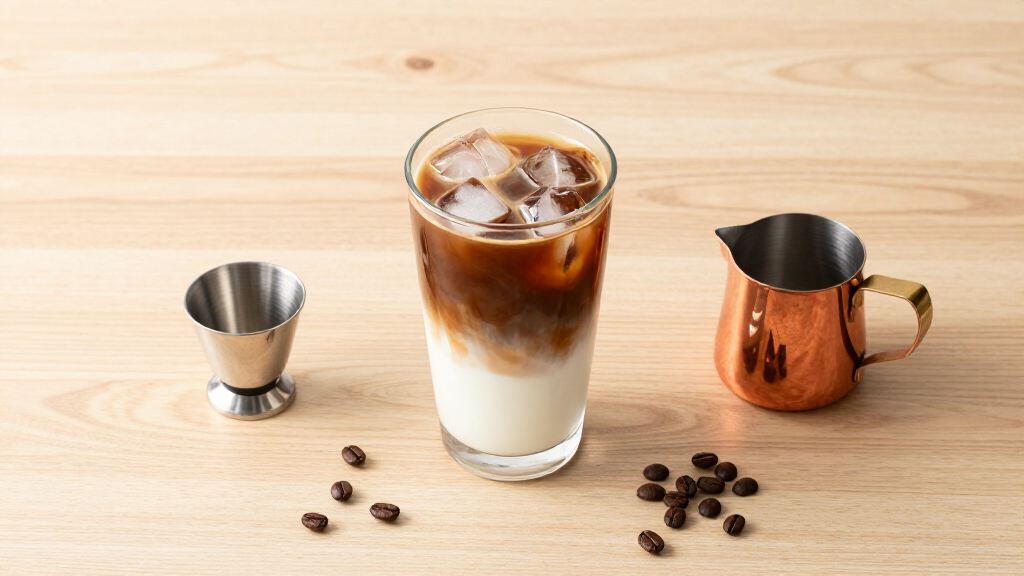
- Add milk first (if making a latte). Pouring milk over ice before the espresso buffers the temperature shock and creates natural layering — the espresso sits on top in a dramatic dark ribbon.
- Pull your shot — slightly strong. Aim ristretto-style: same dose, pulled a touch short, so it lands around 1.5 oz per double instead of 2.
- Flash-chill immediately. Either shake the shot with a small handful of ice for 10–15 seconds and strain it over the drink, or pour it straight over the full ice cup if you’re skipping the shaker.
- Sweeten with simple syrup, never granulated sugar. Sugar barely dissolves in cold liquid — you’ll get gritty sips and an unsweetened drink. Simple syrup (1:1 sugar to water) mixes instantly.
- Stir once, top with cold foam if you want, and serve. A cold foam layer — whipped cold milk, often flavored — sits on top and slightly insulates the drink below.
Oat milk has become the favorite non-dairy pairing here for good reason: it’s naturally creamy, stands up to espresso’s intensity, and doesn’t curdle or separate in cold drinks the way some alternatives can.
Allergen note: oat milk contains gluten-adjacent proteins and is often processed in facilities handling wheat; traditional dairy milk is a common allergen; and some flavored syrups contain nuts or soy. Check labels if you’re serving guests.
Why Your Iced Espresso Tastes Bitter or Sour (It’s Not the Ice)
Bitter or sour iced espresso is almost always an extraction problem, not a dilution problem — and ice makes it easier to notice. Over-extracted espresso (grind too fine, or pulled too long) tastes bitter and hollow. Under-extracted (grind too coarse, or rushed) tastes sour and thin. Cold temperatures mute sweetness and amplify those off-notes, so a shot that tastes merely okay hot can taste genuinely bad over ice.
Diagnose it simply: sour and salty means under-extraction — grind finer or extend the pull. Bitter, ashy, and drying means over-extraction — grind coarser or pull shorter. Dial in your shot hot, before you ever add ice, because you can’t fix extraction with temperature.
And don’t refrigerate espresso overnight expecting a rescue. Espresso loses its volatile aromatics fast, and stored shots develop stale, oxidized notes — some people describe it as cardboard or lemony off-flavors. Fresh is better. Chill within minutes of brewing, or freeze into those coffee ice cubes if you have leftovers.
No espresso machine? You can get close. A moka pot or an AeroPress “espresso-style” press with a fine grind produces concentrated coffee that works beautifully in iced drinks. Compact manual makers like the Flair have made real iced espresso a home proposition at any budget.
Food Safety and Storage: The Part Nobody Tells You
Iced espresso is a cold drink, which changes the food-safety picture. Keep your drink below 40°F (4°C) once it’s assembled — that’s the temperature zone where bacterial growth stays slow. A full cup of ice does most of this work for you, which is one more reason to be generous with it.
Milk matters most. Never leave dairy milk sitting out for more than two hours; that drops to one hour on a hot day. If your iced latte has been sitting on your desk all afternoon in a warm room, pour it out. Plant milks are more forgiving but still separate and sour over time.
For coffee ice cubes: freeze them from fresh espresso or brewed coffee within a day of brewing, and use them within about two weeks. Freeze in a covered tray — uncovered cubes absorb freezer odors, and nobody wants a latte that tastes faintly of last month’s frozen peas.
- Keep it cold: below 40°F once assembled, thanks to full ice
- Milk deadline: two hours out, one hour in heat — then discard
- Coffee cubes: covered tray, made from fresh coffee, used within two weeks
- Simple syrup: refrigerate it; a 1:1 syrup keeps about a month
Espressoguide’s standing rule: brew fresh, chill fast, finish the drink. Iced espresso rewards momentum.
Frequently Asked Questions
Should I pour espresso over ice, or ice over espresso?
Build the drink over a full glass of ice and pour the espresso onto it — but ideally, flash-chill the shot first by shaking it with a small handful of ice for 10–15 seconds, then strain it over fresh ice. This way the shaker ice absorbs the heat and your drinking ice barely melts.Do coffee ice cubes actually work, or do they taste stale?
They work well if you make them from fresh espresso or brewed coffee, frozen within a day of brewing in a covered tray. When they melt, they add coffee flavor instead of diluting the drink. Espresso stored liquid in the fridge goes stale and oxidized, but frozen cubes lock in flavor for about two weeks.What’s the difference between iced espresso, an iced latte, cold brew, and a shaken espresso?
Iced espresso is just chilled shots over ice; an iced latte adds 6–8 oz of milk per 1–2 shots; cold brew is a 12–24 hour cold steep that’s smooth, low-acid, and never needs melt management; and a shaken espresso is flash-chilled in a cocktail shaker, giving it a creamy, aerated texture.How do I sweeten iced espresso when sugar won’t dissolve?
Use simple syrup — equal parts sugar and water, heated briefly to dissolve, then cooled. It mixes instantly in cold drinks. Granulated sugar mostly sits at the bottom of an iced drink, leaving you gritty sips and an unsweetened coffee. Refrigerated simple syrup keeps for about a month.Does espresso have more caffeine than cold brew?
Per ounce, yes — espresso is far more concentrated. But per serving, often no: a typical cold brew serving is much larger and can contain more total caffeine than a double shot. A standard double shot of espresso carries roughly 120–150 mg of caffeine.Conclusion
If you remember one thing, make it this: chill the espresso before it meets your drinking ice, and fill the glass completely. Those two moves eliminate most of the dilution problem on their own. Add ristretto pulls and coffee cubes, and you’re building iced drinks better than most cafés.
Your espresso worked hard to be that concentrated. Don’t let a handful of ice cubes steal it from you — shake it cold, pack the glass, and sip something that’s still bold at the bottom.
Fall Picks
fall essentials
As an affiliate, we earn on qualifying purchases.