
TL;DR

Get coffee and tea gear delivered free with Prime
- Fast, free delivery on millions of items
- Prime Video, Amazon Music and more included
- Member-only deals all year
Espresso is measured in grams because weight provides a consistent, repeatable way to control the coffee-to-water ratio. Scoops vary in size and density, making them less reliable. Using a scale helps you dial in your perfect shot every time.
Imagine tasting a shot of espresso that’s bright, balanced, and perfectly intense. Now picture one that’s flat, bitter, or overly sharp. The secret to that difference? Precision. When it comes to espresso, the tiny margins matter, and measuring in grams makes all the difference. If you’ve ever struggled to reproduce your favorite shot, it’s likely because you relied on scoops or guesses. This guide reveals why espresso is measured in grams instead of scoops, and how this simple change can elevate your brewing game.
Forget vague estimates. We’re talking about a method that’s consistent, accurate, and backed by coffee professionals worldwide. Ready to understand the science — and art — of perfect espresso? Let’s dive in.
Measuring in grams guarantees consistency, helping you reproduce your favorite espresso shot every time.
Scoops are convenient but unreliable for precise brewing; they’re better for rough estimates.
A scale turns espresso brewing into a science, allowing you to fine-tune variables and improve flavor.
Even a 1-gram difference in dose can significantly change the taste, extraction, and crema quality.
Start weighing your coffee today — it’s the easiest way to become a better barista at home.
Why Espresso Is Measured in Grams Instead of Scoops
Espresso is a controlled ratio of coffee to brewed liquid — and grams make that ratio repeatable. Scoops measure volume, which shifts with bean density, grind size, and packing. Weight removes the guesswork and lets you dial in your perfect shot every single time.
“A scoop can get coffee into the basket — a scale makes the recipe measurable and repeatable.”
Grams Are the Gold Standard for Espresso Precision
Coffee beans are dense, dry, and vary in size — a scoop of one coffee might weigh 8 g while another weighs 12 g at the same volume. Weighing your coffee controls exactly how much dry matter enters the basket, so you can replicate that shot tomorrow, next week, or at a different time of day.
Remove the Guesswork
An espresso shot is a tiny, delicate balance of coffee and water. Weight-based recipes — like baking — turn out reliably, while volume estimates vary wildly from brew to brew.
Small Margins, Big Effects
The extraction process depends on the coffee-to-water ratio, grind size, tamping, and temperature. Small dose variations lead to over- or under-extraction — sour, bitter, or weak shots.
Clear, Shareable Ratios
Dose is the dry coffee in the basket; yield is the espresso in the cup. A recipe like “18 g in, 36 g out” (a 1:2 ratio) is only meaningful when both are measured by weight.
How a Scale Turns Brewing Into a Reproducible Science
Weighing both your dose and your yield transforms espresso from an art of guesses into a controlled process. Four simple steps:
Tare the Portafilter
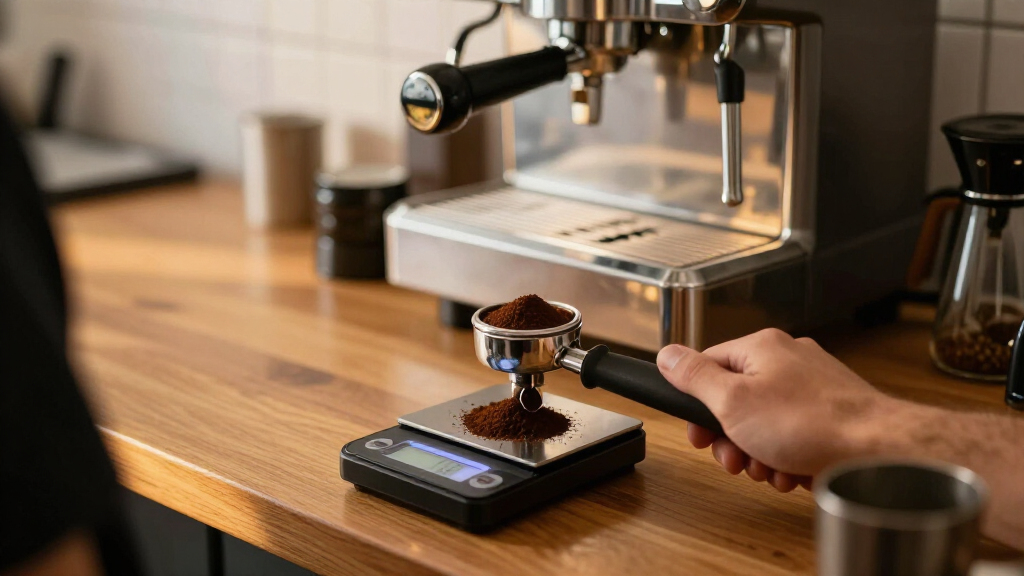
Place your portafilter on the scale and zero it out so you measure only the coffee.
Weigh the Dose
Add ground coffee until you hit your target weight — for example, 18 g of dry coffee.
Start the Shot
Brew and watch the live weight of espresso accumulating in the cup on the scale.
Stop at Yield
Stop the shot at your desired yield — e.g. 36 g for a clean 1:2 brew ratio.
How Small Differences Change Your Coffee
You’re aiming for 18 g in, 36 g out. A dose of 17 g lengthens extraction and pushes the shot bitter; 19 g can rush it and taste weak. Research indicates small measurement errors can swing extraction efficiency by 10–15%.
Crema & Volume Mislead
Shot volume is unreliable as a measure of output because crema adds volume and settles over time. Weighing the shot in the cup gives a stable, comparable reading of yield.
A Scale Isn’t Everything
Grind setting, freshness, distribution, tamping, machine temperature, and the coffee itself all matter too. But weight is the variable that makes every other adjustment measurable.
Grams vs. Scoops — Which Is Better for Your Coffee?
| Feature | ★ Grams (Weight) | Scoops (Volume) |
|---|---|---|
| Accuracy | ✓ High — precise and consistent every brew | ✗ Low — depends on bean density, packing, and scoop size |
| Repeatability | ✓ Excellent — reproduce exact doses shot after shot | ✗ Poor — varies with user technique and bean type |
| Ease of Use | ~ Simple — requires a scale, but straightforward | ✓ Quick — no equipment needed |
| Ideal For | Precision brewing, dialling in recipes, professional setups | Casual brewing, rough estimates, convenience-first moments |
| Dose Stability | ✓ Fixed — 18 g is 18 g, always | ✗ Moving target — same scoop can hold 7 g today, 9 g tomorrow |
Every Variable, Connected
Weight is the anchor of the espresso chain — it makes each downstream variable tunable and traceable.
Why Grams Are The Gold Standard for Espresso Precision
Measuring in grams isn’t just a fad; it’s the backbone of consistency. Think of it like baking. Recipes with weight measurements turn out reliably every time, while volume estimates can vary wildly. Coffee beans are dense, dry, and vary in size. A scoop of one type of bean might weigh 8 grams, while another could be 12 grams for the same volume.
When you weigh your coffee, you control exactly how much dry matter goes into your basket. This means you can replicate that shot tomorrow, next week, or at a different time of day. It’s about removing guesswork. An espresso shot is a tiny, delicate balance of coffee and water. Even a 1-gram difference can shift flavor and strength noticeably.
Why does this matter? Because espresso brewing is a precise science. The extraction process depends heavily on the coffee-to-water ratio, grind size, tamping pressure, and temperature. Small variations in dose can lead to over- or under-extraction, producing shots that are sour, bitter, or weak. Using grams allows you to control these variables tightly, leading to more predictable and desirable results. It’s a tradeoff—while it might seem more effortful initially, the payoff is consistency and quality that’s hard to achieve with volume estimates or scoops.
As an affiliate, we earn on qualifying purchases.
Scoops Are Nice for Rough Estimates, But That’s All
Scoops seem simple. Dip, level, and dump. But here’s the snag: volume varies. A scoop of lightly packed beans might weigh half as much as the same scoop packed tightly. Grind size also affects volume — finer grounds pack more densely, coarser ones less.
Imagine you’re at a café. The barista’s scoop might hold 7 grams today, but tomorrow it could be 9 grams. That’s enough to change your shot’s strength and flavor. Plus, different brands and types of beans have different densities. Relying on scoops is like trying to hit a moving target.
Why is this a problem? Because inconsistent dosing leads to inconsistent extraction. Even small differences in dose can change the contact time between water and coffee, which directly impacts flavor development. When you use scoops, you’re essentially guessing how much coffee you’re adding, and that guess can vary significantly. For serious espresso brewing, this variability can mean the difference between a balanced shot and one that’s off-flavor or overly bitter.
While scoops are convenient for casual brewing, they lack the precision needed for high-quality espresso. If you want to improve your consistency, consider weighing your grounds instead of relying solely on scoops. Even if you prefer scoops for everyday use, periodically measuring your scoop’s weight helps you understand the actual dose you’re using, making it easier to reproduce your favorite shots reliably.
As an affiliate, we earn on qualifying purchases.
How a Scale Turns Your Coffee Into a Reproducible Science
Imagine you’re making a latte art masterpiece and want it to look perfect every time. Using a scale gets you there. Weighing your coffee dose and the espresso yield turns brewing into a repeatable process.
Start with a simple step-by-step:
- Place your portafilter on a scale and tare it to zero.
- Add ground coffee until you reach your target weight (say, 18 grams).
- Start your shot, and watch the weight of the espresso as it brews.
- Stop when you reach your desired yield (for example, 36 grams for a 1:2 ratio).
This method guarantees you know exactly how much coffee and water are involved. Without weighing, small inconsistencies in dose or yield can lead to unpredictable results. For example, if your dose is slightly off or your grind size varies, your extraction time and flavor profile will shift. By weighing, you can identify these variables precisely and adjust accordingly. This is especially useful when dialing in a new coffee or troubleshooting extraction issues.
In essence, a scale transforms brewing from an art into a science. It removes guesswork, allowing you to analyze and control every variable. Over time, this leads to a deeper understanding of how different doses, yields, and grind settings interact, empowering you to craft your perfect espresso consistently.
As an affiliate, we earn on qualifying purchases.
The Real Impact: How Small Differences Change Your Coffee
Here’s a concrete example: you’re aiming for an 18-gram dose and a 36-gram yield. If your dose is 17 grams instead, the extraction time might increase slightly, leading to a more bitter shot. If it’s 19 grams, the shot could be under-extracted and weak.
Research shows that even a 1-gram variance affects flavor profiles. An anonymous researcher notes that small measurement errors can result in a 10–15% difference in extraction efficiency. This isn’t just a theoretical concern; it has real implications for flavor balance, crema quality, and overall shot consistency. A tiny measurement mistake can mean the difference between a vibrant, sweet espresso and a flat, over-extracted one. It’s like adjusting a recipe—small tweaks in grams can have outsized effects on the final taste and mouthfeel. Understanding this sensitivity underscores why precise measurement isn’t just a habit—it’s a necessity for serious espresso enthusiasts.
By controlling the dose in grams, you’re effectively dialing in the parameters that influence extraction. This allows for more predictable results and a better understanding of how different variables interact. Over time, this precision helps you develop a more refined palate and a consistent brewing routine that yields the espresso you desire.
As an affiliate, we earn on qualifying purchases.
Comparison: Grams vs. Scoops — Which Is Better for Your Coffee?
| Feature | Grams | Scoops |
|---|---|---|
| Accuracy | High – precise, consistent | Low – depends on bean density, packing, and scoop size |
| Repeatability | Excellent – easy to reproduce exact doses | Poor – varies with user technique and bean type |
| Ease of Use | Requires a scale, but straightforward | Quick and simple, no equipment needed |
| Ideal For | Precision brewing, dialling in recipes, professional setups | Casual brewing, rough estimates, when convenience outweighs accuracy |
What You Need to Start Measuring in Grams Today
All you need is a good digital scale with at least 1-gram resolution. Compact, affordable scales fit under most espresso cups and respond quickly. Look for one with tare functionality — so you can zero out your container or portafilter easily.
Set your scale on a sturdy surface, and test it with a known weight to verify accuracy. Once calibrated, you’re ready to start measuring your dose and yield precisely. It’s a small investment that pays off in consistent, delicious espresso.
Remember: always weigh your grounds before tamping, and weigh your espresso as it brews for best results. Over time, you’ll learn how small tweaks in grams produce big flavor improvements.
Frequently Asked Questions
Can I use a regular kitchen scale for espresso?
Yes, a standard kitchen scale with gram accuracy works perfectly. Just make sure it responds quickly and has a tare function for zeroing out your portafilter or cup.How much coffee should I use for a double shot?
Most recipes start around 18–20 grams of ground coffee. Adjust based on your basket size and flavor preferences, but always weigh to be precise.Why does my shot taste different even when I use the same grams?
Small variables like grind size, tamping pressure, machine temperature, or bean freshness can change the outcome. Measuring grams is just one piece of the puzzle, but it’s the most reliable starting point.Is weighing worth it if I’m just brewing at home?
Absolutely. It helps you understand how your machine and grind affect your shot. Over time, you’ll develop a much better sense of what works, making every cup more consistent.What if I don’t have a scale? Can I still make good espresso?
You can, but it’s harder to be consistent. Use scoops cautiously and aim for the same scoop size each time. For best results, investing in a simple scale is well worth it.Conclusion
Switching to grams isn’t just about numbers; it’s about taking control of your espresso. When you measure with precision, you unlock consistency, flavor, and confidence. The next time you brew, think of your scale as the secret to a perfect shot—no more guesswork, just delicious results.
So, grab a scale, dial in your dose, and enjoy the art of precise espresso. Your taste buds will thank you.
Halloween Picks
halloween
As an affiliate, we earn on qualifying purchases.