
TL;DR

Get coffee and tea gear delivered free with Prime
- Fast, free delivery on millions of items
- Prime Video, Amazon Music and more included
- Member-only deals all year
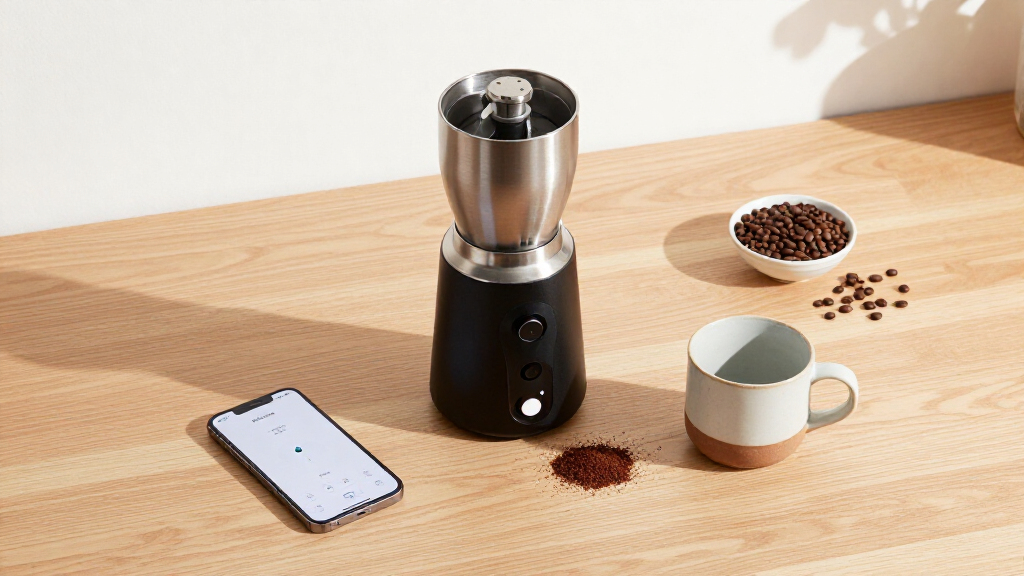
Smart coffee grinders use connectivity to enhance repeatability and convenience, but they cannot fix poor grind quality or bad brewing habits. The best approach is to prioritize mechanical performance first, treating app features as a bonus rather than a solution to fundamental flaws.
You stand in your kitchen, phone in hand, tapping a button to grind beans for your morning espresso. The grinder whirs, the app logs the data, and you feel a surge of modern efficiency. But when you taste the shot, it’s sour, weak, and disappointing. Why did the smart coffee grinder fail you?
The answer lies in a common misconception: that connectivity equals quality. In reality, what connectivity can do is streamline your workflow and help you repeat successful recipes. It cannot, however, fix bad burrs, stale beans, or incorrect brewing ratios. This article breaks down exactly where the technology helps and where it hits a hard mechanical wall.
You’ll learn how to evaluate these devices without falling for marketing hype. We’ll explore the specific benefits of digital controls, the limitations of software, and how to determine if a connected grinder fits your actual coffee routine. Let’s separate the signal from the noise.
Connectivity enhances repeatability and convenience but cannot improve grind quality or fix mechanical flaws.
Always prioritize burr quality and dosing accuracy over app features when evaluating a grinder.
Verify that the grinder functions fully offline to avoid dependency on manufacturer servers.
Use data tracking as a learning tool, not a substitute for sensory evaluation and intuition.
Assess whether the smart features solve a specific workflow problem in your daily routine.
Why Repeatability Is the Real Superpower of Connected Grinders
Connectivity shines when it solves the problem of human inconsistency. You might grind for a pour-over on Tuesday, then switch to espresso on Wednesday, and forget the exact dial position you dialed in last week. An app saves these profiles, allowing you to return to a familiar setting with a single tap. This is particularly valuable in households where multiple people share one grinder or if you frequently rotate between different bean varieties.
Consider a scenario where you find the perfect grind size for a specific Ethiopian light roast. Without a smart profile, you might spend ten minutes adjusting the dial, tasting, and adjusting again. With a saved profile, you recall the setting instantly. The app doesn’t make the grind better; it makes reproducing the grind easier. This reduces waste and saves time, which is a tangible benefit for busy coffee drinkers.
However, this benefit relies on the grinder’s mechanical consistency. If the burrs drift out of alignment or wear unevenly, a saved digital setting won’t guarantee the same particle size distribution. The app records the motor speed or time, not the actual physical state of the burrs. So, while connectivity can make a grinder easier to control and repeat, it assumes the hardware is stable. If your grinder requires frequent recalibration, the app’s memory becomes less useful.
Products Worth Considering

Ninja Luxe Café Mini Plus Espresso and Drip Coffee Machine with AutoFroth, Stainless Steel (ES351)

De'Longhi Magnifica Duo Fully Automatic Espresso Machine with Milk Frother, Silver

Breville Barista Express Espresso Machine, Black Sesame
As an affiliate, we earn on qualifying purchases.
The Limits of Software: Why Apps Can’t Fix Bad Burrs
Software cannot alter physics. If a grinder has poor burr geometry, it will produce inconsistent particles regardless of how sophisticated the app is. Connectivity cannot fix the underlying grind quality. A cheap grinder with a Bluetooth connection still produces cheap grounds. You might control the time precisely to 0.1 seconds, but if the burrs create excessive fines or boulders, the extraction will remain uneven.
Think of it like a high-end dashboard in a car with a broken engine. The digital speedometer might be accurate, but the car still won’t run well. Similarly, an app might tell you the motor is running at 1,200 RPM, but if the burrs are misaligned, the coffee will taste muddy. The mechanical limitations of the device—such as retention, static, and clumping—remain physical problems that require physical solutions, not digital ones.
Furthermore, apps cannot compensate for user error in bean selection. If you use stale beans, no amount of precise grinding will extract vibrant flavors. The app might suggest a grind size based on a database, but it doesn’t know if your beans are three weeks old or roasted yesterday. It lacks sensory awareness. Therefore, while connectivity can make a grinder easier to control and repeat, it cannot make a poor grinder produce great coffee if the inputs or hardware are flawed.
Convenience vs. Complexity: When Smart Features Become a Burden
Not every smart feature adds value. Some add friction. Imagine you want to grind beans quickly. You pull out your phone, unlock it, open an app, wait for it to connect via Bluetooth, and then start the grinder. If the connection drops, you’re stuck. This connectivity can make a simple task more complicated if the implementation is poor. For many users, a physical dial or a simple timer button is faster and more reliable.
Remote control is another feature that sounds great but often fails in practice. You might want to start the grinder from bed, but you still need to stand next to it to dose the beans or supervise the grind. If you’re already in the kitchen, the remote control offers little benefit. The value of convenience depends entirely on your specific workflow. If you’re a multi-tasker who wants to start the grind while pouring water, it might help. Otherwise, it’s just another step.
Additionally, app dependency can be a risk. If the manufacturer’s servers go down or the app is discontinued, your grinder might lose functionality. Always check if the grinder works fully offline. A good device should operate independently of the cloud. If essential controls require an account or internet connection, you’re trading reliability for novelty. Smart coffee grinders should enhance your routine, not hold it hostage.
How to Evaluate a Smart Grinder’s Real-World Value
Before you buy, you need to assess whether the connectivity features solve a problem you actually have. Don’t get dazzled by the app interface. Instead, focus on the grind quality first. Look for credible testing data on particle size distribution and consistency. If the grinder performs poorly mechanically, no app can save it.
Next, examine the dosing and adjustment mechanisms. Is dosing by time, weight, or another method? How easy is it to make and repeat small adjustments? A smart grinder should offer precise control, but that control should be accessible even without the app. If the app is the only way to make fine adjustments, it’s a design flaw. You want a device that offers repeatable workflows without forcing you to use a smartphone for every cup.
Finally, consider the total cost. Smart grinders often carry a price premium. Compare this cost against non-connected models with similar burr sets and build quality. If the premium is $50-$100 for an app you’ll use twice, it’s a poor investment. However, if the integration with a specific brewing system saves you significant time daily, it might be worth it. Check out our guide on best smart coffee grinders to see how top models balance these factors.
Data Tracking: Useful Insight or Unnecessary Noise?
Some smart grinders log every grind session, recording time, weight, and settings. For data enthusiasts, this is gold. You can track how grind size affects extraction over time, correlating it with taste notes. This data and tracking can help you dial in new beans faster by providing a historical record of what worked and what didn’t.
However, for most users, this data is overwhelming. You don’t need a spreadsheet to make a good cup of coffee. Relying too heavily on data can lead to “analysis paralysis,” where you obsess over numbers instead of tasting. The goal is to develop intuition, not just follow logs. If you find yourself checking the app more than tasting the coffee, the technology is working against you.
Moreover, data accuracy depends on the grinder’s sensors. If the scale inside the grinder is inaccurate, the logged data is misleading. Always verify readings with an external scale. Connectivity can make the logging process automatic, but it doesn’t guarantee the data is meaningful. Use it as a tool for learning, not as a crutch for decision-making.
The Future: Automation vs. Connectivity
There is a difference between a connected grinder and an automated one. A connected grinder sends data to your phone. An automated grinder might adjust its settings based on input from a smart scale or brewer. Currently, true automation is rare. Most “smart” features are manual controls with a digital interface.
True automation would require the grinder to know the bean density, roast level, and desired extraction yield. It doesn’t. It only knows the time or weight you set. Therefore, automation can make a routine more consistent only when its assumptions are correct. If you change beans, the automation might produce a bad grind because it’s applying old settings to new inputs.
Look for devices that offer useful automation rather than just connectivity. For example, a grinder that automatically adjusts dose based on weight is more valuable than one that just logs the dose. The former reduces human error; the latter just records it. As technology evolves, the line will blur, but for now, prioritize mechanical precision and ease of use over app features.
Frequently Asked Questions
Does a smart grinder make better-tasting coffee?
Not by itself. It may help you repeat a successful recipe more easily, but taste still depends on the grinder’s mechanical performance, bean freshness, and brewing technique. Connectivity is a convenience layer, not a quality upgrade.Is Bluetooth or Wi-Fi necessary for a good grinder?
Usually not. It is worthwhile if remote control, recipe storage, or integration with other devices fits your routine. Otherwise, it may add cost and complexity without improving the coffee.Can an app choose the right grind setting for any coffee?
An app can offer a starting point, but there is no universally correct setting. Beans, roast level, burr condition, dose, and brewer all affect the result. You still need to taste and adjust.Are smart grinders more consistent than manual ones?
They can be, if their controls or dosing system help repeat a process accurately. However, connectivity alone does not ensure accurate dosing or uniform grounds. Mechanical consistency is still key.Will the grinder still work if the internet or app stops working?
It depends on the product. Buyers should verify which functions work locally. A good smart grinder should allow basic operation, such as grinding and dosing, without an internet connection or app.Conclusion
Smart coffee grinders are tools, not magic wands. They can streamline your process and help you remember what worked, but they cannot brew the coffee for you. The best approach is to choose a grinder with excellent mechanical performance first, then consider connectivity as a bonus if it fits your lifestyle. Don’t let the app distract you from the fundamentals: fresh beans, good burrs, and proper technique.
Next time you’re shopping, ask yourself: “Does this app save me time, or just add another screen to look at?” If the answer is the latter, stick with a reliable, simple grinder. Your coffee will taste better, and your mornings will be simpler.