
TL;DR

Get coffee and tea gear delivered free — and shop member deals
- Fast, free delivery on millions of items
- Access to Prime Big Deal Days deals on October 6–7
- Prime Video, Amazon Music and more included
Manual lever espresso uses a piston, moved by a hand lever or spring, to push water through coffee. It can make excellent shots, but the result depends on your grinder, preparation, machine design, and willingness to practice. Choose one for the control and ritual—not because you expect better coffee with less effort.
A lever espresso shot can take 25–40 seconds to extract, yet that is only the brief, dramatic part. Before the coffee runs, you may need to warm the machine, grind and prepare the puck, and get your cups ready. Afterward, there is the cleanup. The lever’s handsome pull is the visible tip of a longer routine.
Manual lever espresso attracts people who want direct control and enjoy making coffee as much as drinking it. A mechanical piston replaces the usual pump action, but that does not guarantee a better shot or a simpler morning. Your grinder, patience, kitchen space, and appetite for repetition all matter.
This guide helps you decide whether a lever would make your coffee routine feel like a beautiful ritual or a daily headache. You’ll see how the two main lever styles work, what affects shot consistency, which practical details to check before buying, and when a pump machine may suit you better. Think about your ordinary Tuesday morning—not just the satisfying video of a perfect pull.
A lever moves a piston to push water through coffee; spring and direct levers deliver pressure differently.
The 25–40-second extraction is only part of the routine: warm-up, preparation, and cleanup add time.
Budget for an espresso-capable grinder, scale, tamper, and upkeep supplies, not just the machine.
A lever does not automatically outperform a pump machine; coffee, grinder, water, temperature, and preparation shape the cup.
Choose a lever if you enjoy hands-on control and the routine fits your mornings; prioritize convenience if you make several drinks quickly.
Home Espresso · Buyer’s Guide
Manual Lever Espresso: Beautiful Ritual or Daily Headache?
A lever moves a piston to push water through coffee—by hand or by spring. It can make excellent shots, but the result depends on your grinder, preparation, machine design, and willingness to practice. Choose one for the control and ritual—not because you expect better coffee with less effort.
01 · The Mechanism
How a Lever Turns Your Pull Into Espresso
A pump machine relies on an electric pump for pressure; a lever machine puts more of the action into a spring or your hand. The workflow still resembles other espresso brewing—grind, prepare the puck, lock in, pull—but pressure delivery changes, and often how much control you have over the shot.
Pump Machine
Electric & Steady
An electric pump pushes water through the puck at a largely consistent pressure. Convenient and repeatable, with less of the outcome riding on your hands.
Spring Lever
The Spring Shapes It
A compressed spring creates a declining pressure profile during the shot. More of the pressure pattern lives in the machine’s design—you cock the lever and let it work.
Direct Lever
Your Hand Shapes It
You apply force directly through the lever. You can adjust pressure mid-shot—but you also own every inconsistency your pull introduces.
02 · The Real Time Cost
The Handsome Pull Is the Tip of a Longer Routine
Videos show polished metal and a golden stream—not the warm-up, dialing-in, or wiping down the counter. Think about your ordinary Tuesday morning, not the satisfying clip of a perfect pull.
Warm Up
Many lever machines need time to reach stable brewing temperature.
Grind & Dose
Weigh beans, grind fine, and distribute evenly in the portafilter.
Tamp & Lock
Level tamp, seat the portafilter, position the cup under the spout.
Pull the Shot
The dramatic 25–40 seconds everyone films.
Clean Up
Knock the puck, rinse or wipe the parts, reset the counter.
Illustrative routine · actual times depend on machine and your established workflow
03 · The Honest Question
Would You Still Enjoy This on a Rushed Weekday?
The ritual suits people who make one or two coffees and enjoy learning by taste. It gets less convenient with several drinks in a row—or when guests want milk drinks too. Ask yourself directly: if the answer is yes, the ritual may last beyond the novelty.
Beautiful Ritual
If this sounds like you
- You enjoy slowing down; the work is part of the pleasure—like cooking from scratch
- You usually make one or two drinks, not a café queue
- You like learning by taste and changing one variable at a time
- You have counter space, patience, and a decent grinder
- The process matters as much as the cup
Daily Headache
If this sounds like you
- You have ten minutes before leaving and no margin for error
- You make several drinks in a row, especially milk drinks
- You expect better coffee with less effort—the lever offers neither
- Your grinder can’t do fine, repeatable espresso adjustments
- You’d rather press a button than repeat a hands-on routine
04 · Taste Drivers
A Lever Is Not Automatically Better Espresso
A lever gives you a different way to deliver pressure—not a promise. Coffee, grinder, water, temperature, and puck preparation still matter more than the theatrical movement of the handle.
Relative influence on what lands in the cup · the machine category matters less than the fundamentals
Dialing-in starting points: sour and fast → finer · slow and harsh → coarser. Keep notes — 18 g in, 36 g out, grind setting, shot time — so you know what changed.
05 · Which Fits Your Hands
Spring or Direct Lever?
Details vary by machine—leverage, features, feel—so check the specific model, and try one in person if you can. Neither style removes the need to learn your grinder or prepare coffee consistently.
| Attribute | Spring Lever | Direct Lever | Pump Machine |
|---|---|---|---|
| Pressure source | Compressed spring | Your hand on the lever | Electric pump |
| Pressure profile | Declining, built into the design | Shaped by you, adjustable mid-shot | Mostly steady |
| Repeatability | ✓ More consistent by design | ~ Depends on your technique | ✓ Highly repeatable |
| Hands-on control | ~ Moderate | ✓ Maximum | ✗ Minimal |
| Learning curve | Moderate | Steeper — you own the pull | Gentlest |
| Best for | Deliberate routine without micromanaging pressure | Tinkering with the shot as you pull it | Speed, volume, and convenience |
06 · Verdict
Five Things to Remember Before You Buy
Budget for an espresso-capable grinder, scale, tamper, and upkeep supplies—not just the machine. And check the specific model for warm-up time, steam capability, ergonomics, and how easy it is to clean and repair.
A lever moves a piston to push water through coffee; spring and direct levers deliver pressure differently.
The 25–40-second extraction is only part of the routine: warm-up, preparation, and cleanup add real time.
Budget for the whole setup—grinder, scale, tamper, maintenance—not just the machine itself.
A lever doesn’t automatically outperform a pump; coffee, grinder, water, temperature, and preparation shape the cup.
Choose a lever if you enjoy hands-on control and the routine fits your mornings; prioritize convenience if you make several drinks quickly.
How a Lever Turns Your Pull Into Espresso
Manual lever espresso uses a lever to move a piston, which pushes hot water through a compact bed of ground coffee. A pump machine relies on an electric pump for that pressure; a lever machine puts more of the action into a spring or your hand. The lever is a mechanism, not a promise of a perfect cup.
The basic workflow still resembles other espresso brewing: grind coffee, prepare a puck in the portafilter, position it in the machine, and run hot water through it under pressure. What changes is the way pressure is delivered and, often, how much control you have over the pull. Water moving through the coffee is a little like a garden hose: tiny changes to the opening and resistance can change how smoothly it flows.
Two broad designs behave differently. A spring lever uses a spring to create its pressure profile, which declines during the shot. A direct lever lets you apply force more directly by hand. Details vary by machine, so check its design rather than assuming every lever gives you the same feel or control.
For example, imagine pulling two shots from the same beans. With a direct lever, you may adjust your force during the shot; with a spring model, the spring shapes that part of the process. Neither approach guarantees a superior espresso. Coffee, grinder, water, temperature, and puck preparation still matter more than the theatrical movement of the handle.
As an affiliate, we earn on qualifying purchases.
Will You Love the Ritual or Miss the Convenience?
A manual lever feels rewarding when you enjoy slowing down, repeating a hands-on routine, and paying attention to how each shot changes. It can feel like cooking a meal from scratch rather than pressing a microwave button: the work is part of the pleasure. If you want fast, repeatable coffee with little fuss, that same work can feel like a chore.
Consider an ordinary morning with ten minutes before you leave. You might need to warm the machine, weigh and grind coffee, distribute and tamp it, pull the shot, and rinse or wipe the parts. The extraction itself may take roughly 25–40 seconds, but it is only one part of the job. Actual time depends on the machine and your established routine.
The ritual often suits people who make one or two coffees and enjoy learning by taste. It can be less convenient when you’re making several drinks in a row, especially if guests want milk drinks and you need to steam milk as well. Some levers include steam wands; others focus on espresso or offer less convenient steaming. Check the particular machine rather than reading “lever” as shorthand for a complete café workflow.
Videos tend to show the lovely part: polished metal, a slow pull, and a golden stream in the cup. They rarely dwell on warm-up, adjustment, or wiping down the counter. Ask yourself a direct question: Would you still enjoy the process on a rushed weekday? If your answer is yes, the ritual may last beyond the novelty. If not, convenience deserves more weight than appearance.
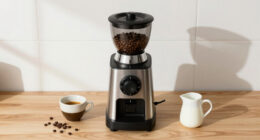
espresso grinder for lever machines
As an affiliate, we earn on qualifying purchases.
As an affiliate, we earn on qualifying purchases.
What Actually Makes a Lever Shot Taste Good?
A lever does not automatically make better espresso; a good shot depends on the coffee, grinder, water, temperature, machine, and preparation working together. The lever gives you a different way to deliver pressure, and sometimes more direct control over the pull. Whether that suits your taste depends on the coffee and your technique—not just the machine category.
Your grinder is a major part of the setup. Espresso needs a grinder that can produce fine grounds with repeatable adjustments. If one setting chokes the shot and the next runs too quickly, changing how you pull the lever may not fix the underlying problem. A costly machine paired with an unsuitable grinder can leave you frustrated, much as a fine chef’s knife feels clumsy when it is badly dulled.
Small preparation differences also show up in the cup. Uneven distribution, a crooked tamp, a changed dose, or a slightly different grind can affect how water travels through the puck. If your coffee tastes sour and runs quickly, you might adjust the grind finer; if it drips slowly and tastes harsh, a coarser setting may help. These are starting points, not universal rules, because recipes and machines vary.
Use a scale and keep brief notes when you’re learning. For instance: 18 grams of coffee in, 36 grams of espresso out, with the grind setting and shot time recorded. If tomorrow’s cup tastes better after one small adjustment, you know what changed. A lever can reward that attention, but it also gives inconsistent preparation more room to show itself.
As an affiliate, we earn on qualifying purchases.
Spring or Direct Lever: Which One Fits Your Hands?
Spring levers use a spring to create a declining pressure profile, while direct levers let you control applied force more directly by hand. The first puts more of the pressure pattern into the machine’s design; the second asks you to shape more of it yourself. Your preferred feel depends on how much manual input you want and how much repeatability you expect.
A spring model may suit you if you like the idea of a deliberate lever routine but don’t want to manage every part of the pressure by hand. A direct lever may appeal if adjusting force during a shot sounds engaging rather than distracting. Those descriptions are broad; machine design, leverage, and other features vary, so try one in person if you can.
Neither style removes the need to learn your grinder or prepare coffee consistently. Imagine dialing in a new bag on a Saturday: you might make one shot, taste it, and make a careful change. On a direct lever, you can also explore how your pull affects the shot. On a spring lever, the built-in spring sets more of that motion. Either way, one variable at a time makes your experiments easier to understand.
Use this comparison as a starting point, then look at the actual machine’s features. A pressure gauge or temperature controls may help you understand what is happening, but not every model includes them, and a gauge does not make coffee for you. Buy the interaction you’ll enjoy repeating, not a technical label that sounds impressive.
| Feature | Spring lever | Direct lever |
|---|---|---|
| How pressure is applied | A spring creates a designed pressure profile that declines during the shot. | Your hand applies force more directly during the pull. |
| What you control | You control preparation and timing while the spring shapes pressure delivery. | You have more direct influence over the force applied. |
| Good fit if you… | Want a manual routine with a more machine-shaped pressure profile. | Want hands-on input and are happy to practice your technique. |
| What remains the same | Both need suitable coffee, an espresso-capable grinder, consistent puck preparation, and a workflow you can live with. | |
As an affiliate, we earn on qualifying purchases.
Check These Daily-Use Details Before You Buy
A lever machine fits daily life only if its warm-up, size, water handling, cleaning, and drink-making features work for your home. The motion may catch your eye, but the ordinary details determine whether you reach for it every morning. Check the full setup, not just the machine body.
Start with your actual counter and routine. Measure the available space, including room to work at the handle and access the water supply. Find out whether the machine needs electricity for heating or temperature controls, or a separate heat source. Warm-up time and temperature stability differ by design, so don’t assume a model will be ready the moment you wake up.
If you mostly drink straight espresso, limited steaming may not trouble you. If your household wants cappuccinos, ask how well the machine steams milk and whether it can keep up with several drinks. A Sunday brunch for four is a different test from making one espresso for yourself. Portafilter size, ergonomics, water capacity, and ease of cleaning matter more as the number of drinks grows.
Before you commit, use this practical checklist. A demo or detailed manufacturer information can answer questions that attractive photos cannot. Parts availability, repair options, and warranty also matter: a machine is a long-term tool, and a small seal or service issue should not become a mystery.
- Check the whole setup budget. Include an espresso-capable grinder, tamper, scale, and maintenance supplies—not only the machine.
- Match capacity to your household. Think about water, warm-up, steam performance, and the number of drinks you make back-to-back.
- Test the physical fit. Check counter space, handle clearance, ergonomics, and whether you can comfortably operate the lever.
- Look for useful controls. See whether the model offers a pressure gauge, temperature management, or other features that support your learning.
- Ask about upkeep and support. Check cleaning instructions, seals, boiler care, parts, repairability, and warranty.
Build a Repeatable Routine Without Chasing Perfect Shots
You can make lever espresso more consistent by changing one variable at a time and writing down what you did. The machine rewards steady preparation more than a dramatic wrist motion. A simple record helps you tell whether a shot improved because of a finer grind, a better-prepared puck, or a change in the pull.
Start with a scale, a grinder with fine repeatable adjustment, and a familiar coffee. Record the dose and the espresso yield; note the shot time if it helps you compare attempts. For example, if an 18-gram dose produces a thin, fast-tasting shot, change the grind slightly finer and keep the dose and other steps steady. If you alter grind, dose, and technique all at once, you won’t know what helped.
Expect some learning time, particularly if espresso is new to you. The physical lever movement is usually manageable; consistent puck preparation and understanding the machine take more practice. A pressure gauge or temperature control can make experimentation easier on some models, but neither replaces tasting and careful adjustment.
Keep your goal modest: a satisfying drink you can make reliably, not an identical shot every day. Coffee changes with freshness and beans differ from bag to bag, so a recipe may need adjustment. If the first shot of the morning runs differently from yesterday’s, treat it as information. The ritual becomes less stressful when you’re learning from the cup instead of grading yourself against a perfect-looking video.
Choose a Lever for the Routine You Have, Not the One in a Video
A lever is most likely to feel like a beautiful ritual if you enjoy learning, have time for a deliberate routine, and usually make one or two drinks at a time. It is more likely to feel like a daily headache if you need quick, repeatable coffee, make several milk drinks, or dislike adjusting and cleaning equipment. The better choice depends on your mornings, not on a universal ranking.
Imagine two households. In one, you make a single espresso after breakfast, enjoy weighing the dose, and like the feel of a familiar handle. In the other, three people need milk coffees before school and work, and the kitchen counter is already crowded. The same lever can be a pleasant hobby for the first home and a bottleneck for the second.
Pump machines can also produce excellent espresso. A lever’s pressure delivery may suit certain coffees and preferences, but it is not a universal upgrade, and crema alone does not prove a shot tastes better. Freshness, roast, grind, and extraction all affect crema. Machines appeal to different priorities: convenience, control, appearance, repeatability, and the pleasure of making something by hand.
Social media has made lever machines more visible, often focusing on their motion and design. Treat those clips as a view of one moment, not a full account of ownership. If you value hands-on control over speed, and the warm-up, grinder, space, and cleaning fit your real routine, a lever may reward you for years. If you mainly want coffee to appear with minimal attention, choose a workflow that does that well.
Frequently Asked Questions
Is lever espresso better than pump espresso?
No. Both types can make excellent espresso; they differ in workflow and how they deliver pressure. The coffee, grinder, water, temperature, and preparation have a major effect on the result, so choose based on the routine and control you want.
Are manual lever machines good for beginners?
They can suit beginners who enjoy practicing and have an espresso-capable grinder. They are less forgiving than more automated setups because grind, puck preparation, temperature, and technique all affect the shot. A scale and simple notes make the learning process easier to follow.
How long does it take to pull a lever espresso shot?
The extraction may take roughly 25–40 seconds, depending on the machine and recipe. Warm-up, grinding, puck preparation, and cleanup add time, so plan around the whole workflow rather than the pull alone.
Do manual lever espresso machines need electricity?
Some use electricity for heating or temperature controls; others use a separate heat source. Check the specific machine’s manufacturer information before buying, since “manual” describes the lever action and does not tell you how the machine heats water.
Can you make milk drinks with a lever machine?
Some lever machines include a steam wand, while others are espresso-only or offer limited milk-steaming capability. If cappuccinos or lattes are a daily habit, check steaming performance and how many drinks the machine can handle in a row.
Do lever machines need a special grinder?
They need an espresso-capable grinder with fine, repeatable adjustment, but not a proprietary grinder. The grinder is a key part of the setup: an unsuitable one can make it hard to produce consistent shots, even with a well-built machine.
Conclusion
A manual lever makes the most sense when you want the work to be part of your coffee, not when you expect the machine to remove work. Before buying, picture your busiest ordinary morning and check the grinder, warm-up, milk needs, counter space, and cleanup against it. If that routine still sounds satisfying, the lever’s slow, tactile pull may become a pleasure. If it sounds like one more task, listen to that feeling.
Choose for the coffee you’ll make on a Tuesday, not only the shot that looks beautiful on a screen.
Fall Picks
fall essentials
As an affiliate, we earn on qualifying purchases.