TL;DR
Espresso itself is roughly 88–92% water, and your milk drinks are even more diluted, so water chemistry shapes extraction, flavor, and machine health more than almost any other variable. Aim for roughly 50–100 ppm hardness with about 40 ppm alkalinity, no chlorine, and a pH of 6.5–7.5. Test your water first, then choose a fix — from a carbon filter to mineral capsules or DIY concentrates.
You spent hundreds on a grinder, dialed in your beans, timed your shots to the second — and your espresso still tastes flat. Meanwhile, a café pulls the same beans and gets something syrupy and sweet. The difference isn’t your tamp. It’s the liquid making up almost the entire drink.
Here’s the number that changes how you think about brewing: espresso itself is roughly 88–92% water [1]. Add milk and you’re drinking something that’s over 95% water. You’ve been obsessing over the 8% while ignoring the 92%.
In this guide, you’ll learn what dissolved minerals actually do during extraction, what bad water does to your machine, and how to fix your water at any budget — from a $10 test strip to a full remineralization setup.
Espresso itself is roughly 88–92% water, and milk drinks are even more diluted — water chemistry affects extraction and flavor more than almost any other varia…
Target roughly 50–100 ppm general hardness with ~40 ppm alkalinity, pH 6.5–7.5, and no chlorine; the hardness-to-buffer ratio matters more than total minerals.
Never run pure distilled water through an espresso machine — it extracts poorly, can leach metals, and some sensors can’t detect it.
Test your tap water with a $10 kit before buying anything; hardness above ~100 ppm means scale risk and possibly voided warranty coverage.
Fix options run from carbon filters (chlorine only) to mineral capsules, DIY Epsom salt + baking soda concentrates, or an RO system with remineralization.
What Dissolved Minerals Actually Do Inside Your Espresso
Water is the ingredient everyone forgets in espresso, and it’s not a passive liquid — it’s a chemical tool. Dissolved magnesium and calcium ions bind to flavor compounds in the coffee grounds and pull them into your cup. No minerals, no extraction. Too many minerals, and extraction runs away from you [1].
Think of it like this: pure water shows up to the coffee grounds with empty hands. Mineral-rich water shows up with hooks that grab flavor molecules and carry them out. That’s restated simply, but it’s the whole game — water chemistry is extraction chemistry.
There’s a second player most people have never heard of: bicarbonate alkalinity. Alkalinity is a buffer. It soaks up acid. A little of it keeps your shot balanced; a lot of it dulls the bright, fruity acidity that makes specialty coffee worth paying for. Too little, and your espresso tastes sharp, almost vinegary.
And then there’s chlorine. Municipal tap water often carries chlorine or chloramine, and both leave a flat, chemical edge in the cup. A carbon filter removes them for pennies — there’s no excuse for chlorinated espresso.
The ratio of hardness to alkalinity matters more than the total amount of mineral in your water. Around 50–100 ppm hardness with roughly 40 ppm buffer hits the sweet spot for most espresso machines [1].
The Numbers That Matter: SCA Targets in Plain English
The Specialty Coffee Association publishes water standards that most of the coffee world uses as reference points: total hardness of roughly 50–175 ppm as CaCO₃ (many roasters cite 68–70 ppm as ideal), alkalinity near 40 ppm, a pH between 6.5 and 7.5, and zero chlorine or off-odors [1].
You don’t need to memorize all of it. You need two numbers: your general hardness and your alkalinity. Get those two right and pH usually follows.
| Water Profile | Hardness (ppm CaCO₃) | Alkalinity (ppm) | What Happens in the Cup |
|---|---|---|---|
| Distilled / pure RO | ~0 | ~0 | Sour, dull, under-extracted; can corrode metals |
| Target espresso water | 50–100 | ~40 | Balanced, sweet, clear flavor; scale-safe |
| Hard tap water | 175+ | Often high | Bitter, chalky, muted acidity; heavy scale |
One warning about the extremes: distilled water is not a safe shortcut. It won’t scale your machine, true, but it extracts poorly and can leach metal from boiler components. Some machines’ water-level sensors can’t even detect it. Never run pure distilled through an espresso machine [1].
What Bad Water Does to Your Machine (and Your Wallet)
Bad water doesn’t just ruin flavor — it destroys equipment. When hard water heats inside a boiler, calcium carbonate drops out of solution and coats heating elements as limescale. That crust insulates the element, forces it to run hotter, and eventually blocks flow entirely [1].
The symptoms sneak up on you. Shots run slow. Flow weakens. Temperatures drift. By the time your machine is wheezing, a single scale incident can cost hundreds of dollars in repairs — which is exactly why cafés test their water religiously [1].
Here’s the scenario nobody warns you about: you buy a $1,200 machine, run untested city tap water through it for a year, and the heating element dies. You call the manufacturer. They ask what water you used. You say “tap.” The warranty claim is denied for scale damage — many manufacturers explicitly void coverage for scale, and some require specific water profiles [1].
A hardness reading above roughly 100 ppm is your cue to act. Below that, scale builds slowly enough that routine descaling keeps it in check. Above it, you’re on borrowed time.
- Warning signs of scale: slow shot times, weak flow from the group head, temperature instability, louder pump noise
- Descale cadence: every 1–3 months for hard water, less often for soft
- The rule: preventive water care always beats repair bills
Test Your Water in 5 Minutes (Before You Change Anything)
Don’t guess — test. For your brewing setup, a cheap test strip or titration kit answers the hardness and alkalinity questions in under five minutes, and kits from API or Hach cost less than a bag of good beans [1].
- Buy test strips or a titration kit rated for general hardness and total alkalinity (KH)
- Run cold tap water into a clean glass and let it sit a minute — no hot water, which changes readings
- Dip and compare your strip to the color chart; write down both numbers
- Match your results against the 50–100 ppm hardness / ~40 ppm alkalinity target
- Retest every few months or after any change to your water supply or filter
Real example: say your strip reads 140 ppm hardness and 70 ppm alkalinity. That’s classic hard city water. Your shots probably taste muted and slightly chalky, and your boiler is quietly scaling. Now you know exactly why — and the fix list below tells you what to do about it.
If your municipal water authority publishes an annual quality report, check it too. It won’t replace a test strip, but it tells you whether your supply swings seasonally, which matters more than most people realize.
5 Fixes Ranked by Cost and Effort
Once you know your numbers, pick your fix. Water is the ingredient everyone forgets in espresso — but correcting it is one of the cheapest upgrades in coffee, with options from zero-effort to full control [1].
| Option | Cost | Effort | Best For |
|---|---|---|---|
| Carbon filter (e.g., pitcher or inline) | $ | Low | Removing chlorine only; barely changes minerals |
| Bottled spring water | $$ | Low | Convenience — but check the label for Ca/Mg content; many are too hard or inconsistent |
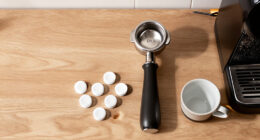
| Mineral capsules + distilled water (e.g., Third Wave Water) | $$ | Low-medium | Consistent, purpose-built espresso profiles |
| DIY concentrates (Epsom salt + baking soda) | $ | Medium | Tinkering home baristas who want custom profiles |
| RO system with remineralization cartridge | $$$ | High setup | Full control; what many specialty cafés run |
The mineral capsule route deserves a mention because it collapsed the learning curve: you dissolve a pre-portioned packet into a gallon of distilled water and get a repeatable profile like “Espresso Light” or a competition-style recipe. No chemistry degree required [1].
DIY water went mainstream after the 2015 book Water for Coffee by Maxwell Colonna-Dashwood and Christopher Hendon laid out the science [1]. The classic home recipe uses two concentrates — Epsom salt (magnesium sulfate) for hardness and baking soda (sodium bicarbonate) for buffer — added to distilled water in tiny, measured amounts. Barista Hustle’s hardness-versus-alkalinity charts make the whole thing visual if you want to go deeper.
One trap to avoid: a water softener is NOT the same as low-mineral water. Softeners swap calcium for sodium, which tastes odd and doesn’t help your espresso at all [1].
Why the Same Beans Taste Better at the Café
Ask a barista why your home shots can’t match theirs, and after grinder quality, the honest answer is usually water. Espresso amplifies water problems because of machine contact — the same water sits in boilers and lines, extracting and scaling simultaneously [1].
Serious cafés don’t guess. They run reverse osmosis with remineralization, blending RO water with a mineral cartridge to hit an exact profile for their coffee. Competition baristas take it further: World Barista Championship rules only require potable water, but competitors increasingly tailor water to the specific coffee they’re serving — boosting magnesium for a fruity natural, adding buffer for a bright washed Ethiopian [1].
Machine makers noticed too. Lelit, La Marzocco, Rocket, and Breville/Sage all now ship with or offer built-in filtration and softening systems, because they got tired of eating scale-damage warranty claims [1]. That should tell you how big this issue really is.
The takeaway for your kitchen: if your beans, grind, and technique are solid and the cup still falls short, water is the variable you haven’t tested. It’s usually the biggest single difference between café and home espresso — bigger than the machine, in many cases.
Frequently Asked Questions
Can I just use tap water in my espresso machine?
Maybe — if your municipal supply happens to be soft and clean. But you won’t know without testing. Run a hardness and alkalinity test strip first; if you’re under ~100 ppm hardness with no chlorine taste, filtered tap water can work fine [1].
Is distilled water safe for espresso machines?
It won’t cause scale, but it’s a poor choice. Pure distilled extracts flavor badly, can leach metal from boiler components, and many machines’ water sensors fail to detect it. If you use distilled water, always remineralize it first [1].
How often should I descale my espresso machine?
It depends on your water hardness and usage — typically every 1–3 months for hard water, less often for soft. Watch for the warning signs: slow shots, weak flow, and unstable brew temperatures. Even good water needs occasional maintenance [1].
Does water chemistry matter for pour-over too, or just espresso?
Water matters for every brewing method, but espresso amplifies the problems. The same water that sits in your boiler is both extracting your coffee and depositing scale on your heating element — a double risk pour-over brewers don’t face [1].
Is a water softener the same as using soft water?
No. An ion-exchange softener replaces calcium with sodium, which tastes flat and strange in coffee. Softened water avoids scale but hurts flavor. Use low-mineral water you’ve remineralized yourself, not softened tap water [1].
Conclusion
Your espresso is only as good as the water carrying it. Test your water this week — it costs less than a bag of beans — and fix whatever the numbers tell you. That single step improves every shot you pull for years.
You’ve spent hours dialing in grind and dose on the 8% of the cup that’s coffee. Give the other 92% the same ten minutes, and taste what you’ve been missing.