TL;DR

Get coffee and tea gear delivered free with Prime
- Fast, free delivery on millions of items
- Prime Video, Amazon Music and more included
- Member-only deals all year
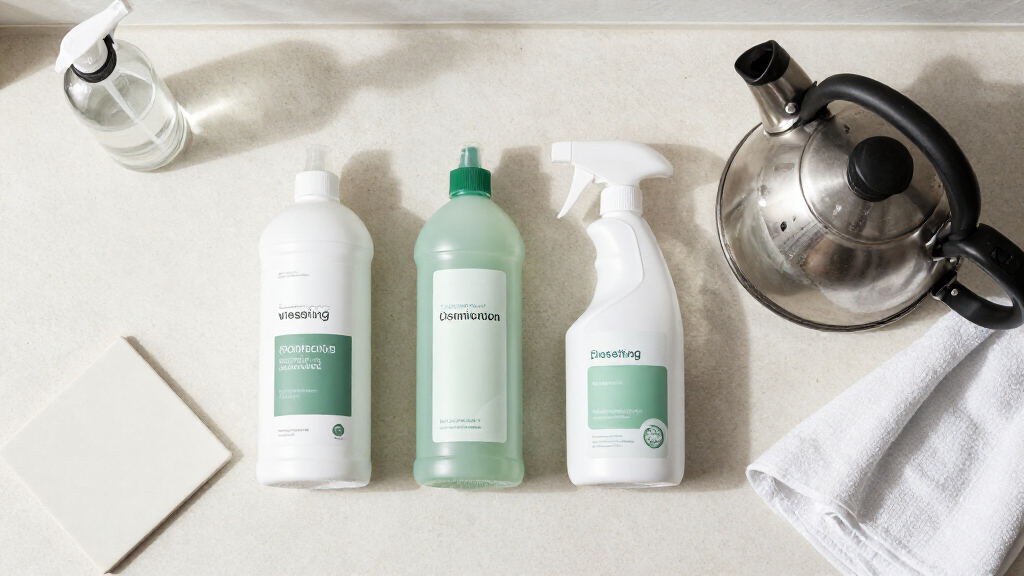
Descaler removes mineral scale, detergent helps lift grease and everyday soils, and cleaner is a broad label for formulas that can do either job—or something else. Match the product to the residue and the surface, follow both product and appliance instructions, and never mix cleaning products.
A kettle can look spotless and still have a crunchy white ring of scale inside. A greasy roasting pan presents the opposite problem: it needs help with oily food, not mineral deposits. Use the wrong product and you may waste time—or damage the surface you wanted to clean.
Descaler, detergent, and cleaner are not interchangeable names. A descaler targets mineral buildup, a detergent helps lift and rinse away everyday soils, and “cleaner” is a broad label whose meaning depends on the formula. Once you know what each product is made to remove, choosing gets much easier.
This guide shows you how to match a product to the residue, read labels without getting distracted by marketing language, and handle appliance care safely. You’ll also learn when a job needs two separate steps, such as washing greasy residue away before tackling scale.
Use descaler for mineral scale, such as chalky deposits linked to hard-water minerals.
Use detergent to help lift grease, oils, food, and ordinary soils; it usually will not dissolve established limescale.
Treat “cleaner” as a broad label and check the formula’s target, compatible surfaces, and directions.
Follow appliance instructions for descaling, dilution, contact time, and rinsing, especially around seals and food-contact parts.
Never mix cleaning products; use separate steps when a job involves both grease and mineral buildup.
Descaler, detergent, cleaner Choose by the residue
These labels describe different jobs. Match the product to what you need to remove, then check the surface and instructions.
The three product roles
The name on the front is only a starting point; the formula determines what the product does.
Descaler
Targets hard-water deposits, such as a chalky ring inside a kettle.
Detergent
Helps lift grease, oils, food, and ordinary grime so they can be rinsed away.
Cleaner
A broad label: check whether the formula targets scale, grease, or another residue.
Match the product to the job
Choose by residue first, then confirm the product is suitable for the surface.
| Product | Main target | Everyday example |
|---|---|---|
| Descaler | Mineral scale and hard-water deposits | White buildup in a kettle |
| Detergent | Grease, oils, food, and everyday soils | Greasy plate |
| Cleaner | Depends on the formula | Glass or bathroom cleaner |
When a job needs two steps
Grease and mineral buildup are different residues; one product may not handle both.
Use an appropriate detergent for greasy or everyday residue.
Use an approved descaler for remaining mineral deposits, following the appliance instructions.
Check before you clean
Labels and material compatibility matter as much as the product category.
- Follow product and appliance directions for dilution, contact time, and rinsing.
- Acidic descalers can damage marble and some metals, coatings, or rubber seals.
- Never mix cleaning products, especially acids with bleach.
- For food-contact surfaces, follow label instructions for rinsing.
Descaler vs. Detergent vs. Cleaner: What Does Each One Remove?
Descaler vs. detergent vs. cleaner comes down to the target: descaler removes mineral deposits, detergent helps lift grease and ordinary soils, and cleaner is a broad name for products with different formulas. The point is that the word on the front of a bottle matters less than its stated use, ingredients, and directions.
Descalers are usually acidic and target mineral scale, commonly deposits such as calcium carbonate left by hard water. Detergents usually contain surfactants, ingredients that help water spread across a surface and loosen soils so you can rinse them away. A cleaner could use detergents, acids, alkalis, solvents, or a combination, depending on the job.
Think of it like choosing a tool in a kitchen drawer: a whisk, a knife, and the word “utensil” don’t describe the same function. For instance, if a coffee machine has oily coffee residue around a removable part and white scale inside its water pathway, one bottle may not be right for both problems. Separate the soils before you choose.
| Product | Main target | Everyday example |
|---|---|---|
| Descaler | Mineral scale and hard-water deposits | White buildup in a kettle |
| Detergent | Grease, oils, food, and everyday soils | Dishwashing liquid for a greasy plate |
| Cleaner | Depends on the formula | Glass cleaner or bathroom cleaner |
These products do not automatically sanitize or disinfect. A cleaner removes soils; a disinfectant must be labeled for that purpose and used as directed. If you want to address a specific residue, read the product label for the named target rather than assuming “cleaner” means “does everything.”
Products Worth Considering

Breville Bambino Espresso Machine, Brushed Stainless Steel

De'Longhi Stilosa Compact Manual Espresso Machine with Milk Frother

Breville Smart Grinder Pro Conical Burr Coffee Grinder, Brushed Stainless Steel
As an affiliate, we earn on qualifying purchases.
Use Descaler When White Mineral Buildup Won’t Wash Away
Descaler removes mineral scale, usually from hard-water deposits such as calcium carbonate, that ordinary washing often leaves behind. If your kettle has a chalky ring or your showerhead sprays sideways from crusted holes, those are classic signs that minerals have accumulated as water evaporated.
Many descalers use acids such as citric, lactic, sulfamic, phosphoric, or hydrochloric acid. The ingredient and strength depend on the product’s intended use. Acid reacts with mineral deposits and helps loosen or dissolve them; that does not mean the same product is suitable for every surface or appliance.
For example, a kettle may have a removable scale buildup that responds to a manufacturer-approved descaler. Natural stone, including marble, is a different story: acidic products can etch or dull the surface. Some metals, coatings, and rubber seals can also be damaged by an unsuitable formula or excessive contact time.
Scale and grease are different jobs. A descaler may clear a mineral crust without cutting through oily residue, much like a key that opens one lock but not another. Check the appliance manual for the approved product and procedure, including dilution, contact time, and rinsing. If the manufacturer gives a schedule or a descale indicator, follow that guidance rather than guessing from the calendar.
Safety note: Never mix a descaler with bleach or another cleaning product. Acids mixed with bleach can release hazardous gas, and other combinations can also cause dangerous reactions.
Choose Detergent for Grease, Food, and Everyday Grime
Detergent helps lift and suspend everyday soils so water can carry them off the surface. Its surfactants help water spread and loosen grime; a formula may also include builders, enzymes, solvents, or other ingredients suited to a particular use.
That is why dishwashing liquid can help with a greasy plate, while laundry detergent is made for fabric and a washing machine’s conditions. They are both detergents, but they are not interchangeable. Using the wrong product can leave residue, create too much foam, or fail to work as intended in the appliance.
Picture a breakfast plate with a slick of butter and a dried smear of egg. A suitable dish detergent helps loosen that organic residue so you can wash it away. But if the kettle beside it has a hard, white crust inside, detergent may clean loose dirt while leaving established mineral scale behind.
Detergent is usually the better first choice for soil, not scale. For a machine part with coffee oils or food residue, use only a product approved for that part and follow its instructions. Rinse food-contact surfaces as directed on the label. A product being called a cleaner does not automatically make it safe to leave on a surface that touches food.
Concentrates can reduce packaging and shipping volume, but they demand accurate measuring. More detergent is not necessarily better: too much can leave a slippery film, while too little may struggle with a heavy soil load. Use the label’s stated amount for the job and water conditions.
Read “Cleaner” as a Label, Not a Promise
Cleaner is an umbrella term, not a precise chemical category, so you need the label to find out what the product is meant to remove. One cleaner may be mild and soap-based; another may be acidic for limescale, alkaline for grease, solvent-based for residue, or made for glass or a particular appliance.
That flexibility is useful, but it can make the name misleading. A bathroom cleaner might target soap scum and scale, while a kitchen degreaser is designed for greasy splatter. A glass cleaner may dry with little residue but have no reason to remove mineral buildup from a kettle.
For instance, imagine a white mark on a bathroom tap. If it is mineral scale, a compatible limescale product may help; if it is soap or oily residue, the appropriate detergent-based product may be a better match. The appearance alone can mislead, so check the product’s stated use and test an unfamiliar formula on a small, inconspicuous area when appropriate.
Look beyond “natural,” “green,” or “eco-friendly” wording. Those terms by themselves do not tell you what the formula removes or whether it suits your surface. Ingredient transparency and specific directions are more useful: check the target soil, compatible materials, dilution, ventilation, protective equipment, and whether rinsing is required.
Also separate cleaning from disinfection. A cleaner removes soil; a disinfectant is labeled to inactivate specified microorganisms under stated conditions, often with a required wet contact time. Cleaning first may be necessary, and a quick wipe is not automatically disinfection.
Match the Product to the Residue Before You Start
Choose by residue first, then check the surface and label. That quick order prevents a common mistake: reaching for a familiar bottle because it says “cleaner,” even though its formula may not address the buildup you can see.
- Identify the residue. Chalky or crusted white buildup often points to mineral scale; greasy, sticky, or food-like residue calls for a detergent or suitable cleaner.
- Check the material. Confirm that the product is approved for the appliance, coating, seal, stone, or other surface you plan to treat.
- Follow the label and manual. Use the stated dilution and contact time, ventilate as directed, and wear the protective equipment listed.
- Rinse when instructed. This matters especially for food-contact surfaces and before you use a different product.
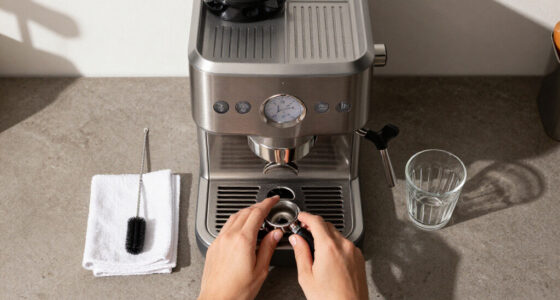
Suppose your coffee machine’s removable tray has dried coffee and the water system shows a descale alert. Those are two different tasks: wash the tray according to the manual, then run the approved descaling procedure. Treating both with one random all-purpose product can leave residue or harm internal components.
Never mix cleaning products. Use them separately, and follow label directions for any rinsing between steps. If you are unsure whether a product is approved for your machine, the manufacturer’s instructions are a safer guide than a general-purpose claim on a bottle.
Handle Appliances and Food-Contact Surfaces More Safely
Safe cleaning depends on compatibility, concentration, and rinsing. A product can work chemically and still be the wrong choice for a seal, coating, stone surface, or appliance component. The bottle’s directions and the equipment maker’s instructions should guide the method.
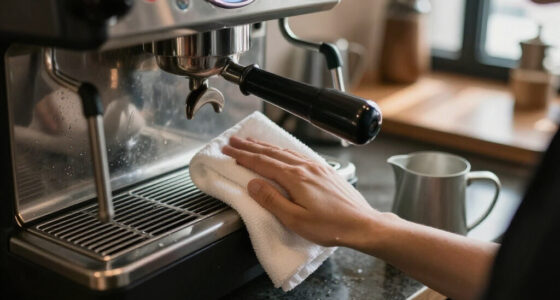
In an espresso machine, for example, the internal water circuit may contain seals and materials that need a particular descaler. A household vinegar solution may dissolve some mineral deposits, but that does not make vinegar suitable for every machine. Check the manual before using it; an unapproved acid can leave odor or affect components.
Keep the basic safety habits simple: do not mix products, provide the ventilation the label calls for, and keep bottles away from children and pets. Wear gloves or other protective equipment if the directions require it. Never assume that a product is safe for a food-contact area just because its name includes “cleaner.”
Rinse food-contact surfaces exactly as directed. A cutting board or removable coffee part may need a thorough rinse after cleaning, while an appliance’s internal procedure may specify a particular rinse cycle. Follow that process rather than improvising with extra chemicals.
Concentrated products deserve careful measuring. A stronger mixture is not automatically more effective; it may increase exposure or damage a surface. Use the amount on the label, and stop if you notice unexpected discoloration, strong fumes, or surface damage. When in doubt, rinse only if the directions allow it, ventilate, and consult the product or appliance maker.
Know When One Cleaning Step Is Not Enough
Some buildup needs separate cleaning and descaling steps because grease and mineral scale respond to different formulas. Trying to make one product solve both problems can leave part of the mess behind or expose the surface to a product it cannot tolerate.
Consider a showerhead with a greasy film from bathroom products and crusty deposits around the spray holes. A suitable cleaner may remove the film, while a compatible descaler may address the mineral buildup. Follow both labels, rinse between products when instructed, and never combine the formulas in a bucket or on the surface.
The order depends on the product directions and the condition of the item. If soil covers the scale, cleaning it away first may help you reach the deposits; in other cases, the appliance maker may specify a particular descaling sequence. This is one reason a manual matters more than a generic online trick.
Regular care can make the next job easier. Wiping away fresh food residue is usually simpler than scrubbing it after it dries, and noticing a descale alert early can prevent you from ignoring buildup for months. Still, frequency depends on water hardness, how often you use the appliance, and its maker’s recommendations.
For a busy household, a practical routine might mean washing removable parts after use and descaling only when the machine’s indicator or manual calls for it. That is more reliable than treating every white mark with acid or every surface with detergent.
Frequently Asked Questions
Can I use detergent instead of descaler?
Usually not for established limescale. Detergent can remove loose dirt or oily residue, but mineral deposits generally need an appropriate descaler. Check the appliance manual before treating a kettle or machine.
Can I use descaler as an all-purpose cleaner?
No, not by default. A descaler targets mineral deposits and may do little for grease; its acid can also harm some stones, metals, coatings, or seals. Use it only on approved surfaces and as directed.
Is “cleaner” the same as detergent?
No. Detergent describes a kind of cleaning formulation that helps lift soils, while cleaner is a broad label for many formulas. Check the product’s target and directions to learn what it actually does.
Is vinegar a descaler?
Vinegar’s acetic acid can dissolve some mineral deposits, but it is not approved for every appliance or surface. Check the manufacturer’s instructions before using it; a recommended descaler may be more suitable.
Can I mix descaler and detergent?
Do not mix them unless both labels explicitly direct you to do so. Use products separately and rinse between steps if instructed. Never mix a descaler with bleach, as the reaction can release hazardous gas.
Does descaling kill bacteria?
Descaling is intended to remove mineral buildup, not necessarily to disinfect. If you need disinfection, choose a product labeled for that purpose and follow its specified contact time and use directions.
Conclusion
Match the product to the mess: detergent for everyday soils, descaler for mineral scale, and a cleaner only after you confirm what its formula is designed to do. Then check the surface, follow the label and appliance instructions, and never mix products.
That small pause before you spray or pour can save a seal, protect a countertop, and turn a stubborn white crust into a routine maintenance job—not a kitchen experiment.