TL;DR

Get coffee and tea gear delivered free with Prime
- Fast, free delivery on millions of items
- Prime Video, Amazon Music and more included
- Member-only deals all year
A finer grind usually slows espresso because water has to move through smaller spaces between coffee particles, but a slower shot is not automatically a better one. If the puck resists water too much, the shot can stall or channel, producing harsh, dry, or uneven flavors. Keep dose and yield steady, change one variable at a time, and use taste—not shot time alone—to decide whether to go finer or coarser.
You grind a little finer, expecting a richer espresso. Instead, the stream crawls, the shot tastes rough, and your next attempt barely drips. That’s not a paradox: finer coffee increases resistance to water, but more resistance does not guarantee more even or better extraction.
Espresso is a balancing act between grind size, dose, beverage yield, time, and puck preparation. Push one part too far and the whole shot can wobble. The grounds behave less like a sponge and more like a crowded hallway: make the gaps too narrow, and water may struggle, then rush through whichever path stays open.
This guide explains why finer grinding can make espresso worse, how to tell a slow shot from a well-extracted one, and what to change when a puck chokes or tastes harsh. You’ll also get a simple dialing-in process you can use tomorrow morning, whether you’re pulling shots on a café machine or a compact setup at home.
A finer grind usually slows espresso by narrowing the spaces water moves through, but extra contact time does not guarantee better flavor.
A shot can taste both sour and harsh when channeling leaves some areas under-extracted and others heavily extracted.
Treat 25–35 seconds as a possible starting reference, not a required shot time; judge the coffee by taste and flow.
Keep dose and beverage yield steady while testing one adjustment at a time, and record each result.
If a shot becomes very slow, stalls, or tastes dry after grinding finer, try a small move coarser before changing several other variables.
Why a finer grind can slow a shot without improving its flavor
Why finer grinding slows espresso is straightforward: smaller particles leave narrower spaces for water to pass through, increasing resistance in the puck. That extra resistance can help a shot that gushes through too quickly, but if you grind past the useful point, water moves too slowly or unevenly. Longer contact is not a flavor upgrade by itself.
Think of water passing through the coffee bed like traffic moving down a road. A little congestion can keep cars from racing past too quickly; a road blocked almost solid just creates a jam. If you tighten the grind on a shot that already takes 30 seconds, you might push it toward a long, sputtering 45 seconds without gaining sweetness or clarity.
A common starting recipe uses 18 grams of coffee for 36 grams of espresso, a 1:2 ratio. Many people begin around 25–35 seconds, but that’s a reference, not a finish line: baskets, machines, beans, and preferences vary. Suppose an 18-gram dose reaches 36 grams in 22 seconds and tastes thin and sour. A small grind adjustment may help. If the same recipe takes 42 seconds and tastes dry, finer is probably the wrong direction.
Shot time works best as a diagnostic clue alongside taste and flow. Research on espresso extraction often distinguishes how much coffee dissolves from whether it dissolves evenly; for practical dialing-in, the visible stream and the flavor in your cup matter more than chasing a number. Record your dose, yield, and time, then taste. A scale and a consistent recipe turn guesswork into a small, readable experiment.
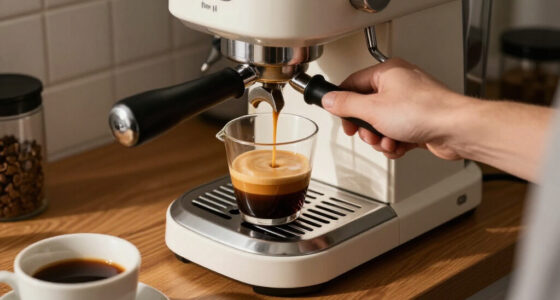
espresso grinder with adjustable grind size
As an affiliate, we earn on qualifying purchases.
As an affiliate, we earn on qualifying purchases.
How an over-fine puck can create both harsh and sour flavors
A finer grind can make espresso worse by causing water to flow unevenly, so some parts of the puck extract heavily while others remain under-extracted. This is why one cup can seem both bitter or dry and sharply sour. Those flavors don’t always mean the whole puck extracted too much or too little; they can come from different regions of the same shot.
When water meets a very resistant coffee bed, it does not necessarily spread evenly through every particle. It may find a narrow, easier route—a channel—and race through that opening while other grounds receive much less water. Picture rain cutting a groove in soft soil: the water keeps using the groove, leaving nearby patches almost untouched. A beautiful, even-looking stream at the spouts does not always prove that the inside of the puck behaved evenly.
For example, your espresso might start with a slow drip, then suddenly gush from one side. The cup could taste both sharp and drying. Grinding even finer may increase resistance at the start, but it won’t repair the route water takes once a weak spot opens. Uneven grounds, clumps, a tilted tamp, or a dose that nearly overfills the basket can all make the problem worse.
People often call every bitter or dry shot “over-extracted,” but bitterness alone does not diagnose extraction. The coffee’s roast, freshness, recipe, and water can all shape flavor, while channeling can mix harshness with sourness. If a slow shot tastes rough, note its whole behavior: when flow begins, whether it favors one side, and whether the cup tastes hollow, dry, or pleasantly sweet. That combination offers better evidence than one adjective.
As an affiliate, we earn on qualifying purchases.
What changes when you reach the edge of a choking shot
Near the choking point, tiny changes can cause big swings in espresso flow. A grind adjustment that barely affects a forgiving puck can turn a borderline shot into a trickle. That makes fine settings harder to repeat, especially when dose, distribution, or the coffee itself changes from one preparation to the next.
Imagine your grinder already produces a 36-gram shot in 37 seconds. You move one step finer and get only 20 grams after 40 seconds. That dramatic change doesn’t mean the coffee suddenly became twice as resistant; it means the puck may have crossed a narrow operating range where water struggles to pass. Some grinders also make adjustment steps that have a larger effect than others, so a “small click” isn’t the same dose of change on every machine.
Preparation starts to matter more at that boundary. A few clumps left in the basket or a small dose difference can be enough to push a restrictive puck toward a stall. If one morning’s 18-gram dose actually weighs 18.5 grams, that extra coffee takes up space and adds resistance. Consistent dosing and level tamping give you a fair comparison between shots; pressing harder is not a dependable fix for a grind that is already too fine.
Grinder particle distribution matters too. A grinder produces a range of particle sizes, not perfectly identical grains, and an excess of very fine particles can fill the gaps between larger grounds. That may make the puck especially resistant or the stream erratic. Average grind size is only part of the story. If repeated adjustments swing between gushes and stalls, check your preparation and dose before assuming you simply need a more extreme setting.
As an affiliate, we earn on qualifying purchases.
How to dial in espresso without chasing the clock
Use a controlled, one-change-at-a-time process to find out whether your espresso needs a finer grind, a coarser grind, or a recipe adjustment. Keep dose and target yield steady first; otherwise, you change several variables at once and can’t tell which one improved the cup. The time helps you track the result, but your taste decides whether it worked.
- Choose a repeatable recipe. Weigh, for example, 18 grams of coffee and aim for 36 grams of espresso. Use the same basket, cup, and machine setup for each test.
- Watch the flow and note the time. Record when the first drops appear, whether the stream runs evenly, and when you reach your target yield. Treat 25–35 seconds as a possible starting reference, not a rule.
- Taste before making another change. A fast, thin, sour shot may benefit from a slightly finer setting. A very slow, drying or harsh shot often points toward a coarser setting or a different recipe.
- Adjust only one variable. Make one small grinder adjustment and keep dose, yield, and preparation consistent. Pull another shot and compare it with the previous one.
Say your first 18-to-36-gram shot takes 21 seconds and tastes sharp. You grind a little finer; the next takes 28 seconds and tastes sweeter. That’s useful evidence. If it takes 39 seconds and tastes dry, return toward the earlier setting rather than deciding that the longest shot must be best.
When flavor is close but not quite right, consider changing beverage yield after you establish a steady grind. A slightly longer or shorter ratio can shift balance without forcing the puck into an awkwardly restrictive setting. Write down dose, yield, time, and taste, even in a phone note. Your own previous shot is a more useful comparison than a universal timer target.
As an affiliate, we earn on qualifying purchases.
When a coarser setting is the better move
Grind coarser when a shot runs very slowly, stalls, or tastes harsh and dry, especially if a finer adjustment made flow more erratic. Going coarser gives water more room to move through the puck. If a fast shot tastes thin and sour, though, going coarser is unlikely to help; the direction of the adjustment depends on both the flow and the cup.
Use the shot’s behavior as a practical comparison. A 36-gram yield arriving in 18 seconds with a watery, sour taste suggests a different problem from the same yield dragging past 40 seconds with a drying finish. The first may need a finer grind; the second may need a coarser grind. These clues aren’t perfect—some coffees taste naturally bright, and time can vary across machines—but they give you a sensible first move.
| What you observe | A useful first test | Why it may help |
|---|---|---|
| Fast flow, thin or sour cup | Go slightly finer | More resistance can slow the water and improve contact, if flow stays even. |
| Very slow flow, dry or harsh cup | Go slightly coarser | Reduced resistance can help restore a steadier flow. |
| Slow start, sudden gush, mixed flavors | Check puck preparation and dose | A channel can create uneven extraction that grind size alone may not fix. |
| Good flow, but flavor feels unbalanced | Hold grind steady; test yield | A recipe change may suit the coffee better than added resistance. |
This table is a starting map, not a promise. If a dark-roasted coffee tastes intense and dry at a familiar ratio, a slightly different yield may suit it better than a dramatic grind change. If a lighter coffee tastes bright even with a steady shot, ask whether that brightness is pleasant or sharply sour before adjusting. One cup’s flavor matters more than a table’s prediction.
How better puck preparation makes finer settings less risky
Consistent puck preparation reduces avoidable flow problems, particularly when you grind fine enough that the coffee bed already resists water strongly. Distribute grounds evenly, break up obvious clumps if you can, dose consistently, and tamp level. These steps don’t make every grind setting work, but they help you judge the setting instead of judging a new problem you accidentally created.
Consider two shots from the same coffee and grinder setting. In the first, grounds fall into a mound on one side of the basket, and the tamp sits slightly crooked. Water may take an easier path through the thinner side. In the second, you spread the grounds evenly and tamp level. If the second shot flows more evenly, you’ve learned that preparation mattered; grinding finer would have treated the symptom by adding resistance without correcting the uneven bed.
Keep dose within a small, repeatable range and avoid filling the basket beyond its intended space. A high dose and fine grind can combine to choke a shot even if either one worked on its own. Similarly, changing coffee can change how your familiar setting behaves: a fresh bag, different roast, or different bean may need its own adjustment. Grinder numbers don’t transfer neatly between machines, so dial in by results rather than copying someone else’s setting.
Tools such as careful distribution techniques, puck screens, and machines with flow controls can help some people repeat their process, but they can’t make “finer is always better” true. Start with the basics before adding gear: consistent dose, even grounds, level tamp. If your shot still chokes, move slightly coarser and test again. Good preparation is a steady floor beneath your recipe, not a substitute for choosing a workable grind.
Which variables to change when the grind is not the answer
Grind size is only one control in an espresso recipe; dose, beverage yield, water temperature, pressure, and the coffee itself also shape the cup. If the stream looks steady and the shot reaches your target in a reasonable, repeatable time, but the taste still feels off, pushing the grinder finer may simply make the puck more difficult to brew. Test another variable instead.
For instance, suppose your 18-gram dose produces 36 grams of espresso with even flow, but the cup feels heavy and dry. You could keep the grind fixed and try stopping a little earlier, perhaps at 32 grams, then taste the difference. A different yield changes the balance in the cup without forcing water through smaller spaces. If your shot tastes sharply sour, a longer yield may be worth testing, though the best direction depends on the coffee and your palate.
Machine temperature and pressure can matter, too, but they’re less convenient first adjustments on many home machines. Begin with variables you can measure easily, and avoid changing temperature, dose, yield, and grind all at once. That is like changing four ingredients in a cake and then trying to work out why the texture changed. A simple notebook keeps the experiment readable.
There is no single ratio or time that suits every bean. An 18-to-36-gram recipe is a useful reference point, not a universal law, and a shot outside 25–35 seconds can still taste good. Repeatable, pleasant flavor is the target. If a modest grind change improves the taste without making flow fragile, keep it. If the shot only gets slower and harsher, trust the cup and try a coarser setting or a different recipe.
Frequently Asked Questions
Does finer grinding always increase espresso extraction?
No. Finer grounds often increase resistance and may increase extraction, but uneven flow or channeling can leave parts of the puck under-extracted. A finer setting can slow the shot and still make the cup taste worse.
Why does my espresso taste bitter after I grind finer?
The finer setting may have made the shot too slow, encouraged uneven flow, or moved the recipe away from what suits that coffee. Bitterness or dryness alone does not prove the whole puck was over-extracted; try a small coarser adjustment and taste again.
Why is my espresso shot barely dripping?
The puck may offer too much resistance because the grind is very fine, the dose is high, or both. Check your measured dose, keep preparation consistent, and try grinding slightly coarser before changing several variables at once.
Should I always aim for a 25–35 second espresso shot?
No. That range can be a useful starting reference for a common espresso recipe, but machines, baskets, coffees, and ratios vary. Use time to compare shots, then choose the one that tastes best and flows consistently.
Should I tamp harder to fix espresso that runs too fast?
Usually not. A level, consistent tamp matters, but pressing harder is not a reliable replacement for choosing a suitable grind and distributing the grounds evenly. Make your puck preparation repeatable, then adjust the grind based on flow and taste.
Can a better grinder solve problems caused by grinding too fine?
A capable grinder can make particle sizes and adjustments more consistent, which can make dialing in easier. It cannot rescue an unsuitable dose, uneven puck preparation, or a grind that is simply too fine for your recipe.
Conclusion
Remember this: finer is a tool, not a finish line. Use it to slow a fast, sour shot when the flow stays even; move coarser when the puck stalls or the cup turns harsh and dry. Hold your dose and yield steady, taste each result, and let the coffee—not the timer—tell you when to stop.
A good espresso shot should feel balanced, not like water squeezing through a blocked hallway. Make one small adjustment, pull the next shot, and follow the flavor.
Halloween Picks
halloween
As an affiliate, we earn on qualifying purchases.