
TL;DR

Get coffee and tea gear delivered free — and shop member deals
- Fast, free delivery on millions of items
- Access to Prime Big Deal Days deals on October 6–7
- Prime Video, Amazon Music and more included
An E61 espresso machine uses a large, heated group head and a thermosyphon loop to keep brewing water circulating between the boiler and the coffee-making assembly. The design dates to Faema’s 1961 machine, but a classic group head does not automatically mean faster warm-up, better temperature control or easier maintenance; compare the whole machine with your daily routine in mind.
An E61 machine can be switched on while its heavy group head is still cold. That gap between a glowing boiler light and a properly warmed brew group explains both the appeal and the daily reality of this famous espresso design.
The E61 group head first appeared on a Faema machine in 1961. Its large metal assembly and thermosyphon circulation helped make it an enduring reference point for espresso equipment. Decades later, you can find E61 machines with modern pumps, PID temperature controls and pre-infusion settings, all built around the recognizable group.
This guide explains what the E61 does, what it does not promise, and how to decide whether it fits your kitchen. You’ll see how water moves through the machine, what the lever controls, how to handle warm-up and cleaning, and what to compare before you buy. The goal is practical: help you choose based on the espresso you make and the time you have, not just the polished steel on the counter.
The E61 is a group-head design introduced by Faema in 1961, not a guarantee that two complete machines share the same features.
Thermosyphon circulation keeps the group warm, but its metal mass also needs time to heat; check the manufacturer’s warm-up guidance.
A lever on a pump-driven E61 usually starts or stops brewing; it does not automatically provide manual pressure profiling.
Pre-infusion can wet a coffee puck before full pressure, but availability and adjustability depend on the machine.
Compare counter fit, water requirements, service access, boiler workflow and cleaning needs alongside the E61’s heritage.
What makes an E61 group head different from other designs?
An E61 group head is a large metal brewing assembly that uses circulating hot water to keep the group warm. Faema introduced the design in 1961, and its mix of thermal mass, mechanical parts and water circulation made it influential well beyond its original era. The term describes the group head, not one single complete machine.
That distinction helps when you shop. Two machines can both have an E61 group while differing in boiler arrangement, pump, temperature controls, water reservoir, dimensions and price. One may offer a PID display; another may rely on a simpler pressurestat. The familiar group shape tells you something about the brew assembly, but it cannot tell you everything about the machine’s performance or convenience.
The group is commonly made from substantial metal parts, often brass or stainless steel, and it holds heat as the machine runs. Think of it like a cast-iron pan: the stored heat can help smooth out temperature swings, but the pan takes time to warm. A quick glance at the power light doesn’t prove the group has reached a steady brewing temperature.
That thermal mass is a trade-off, not an unconditional advantage. Once heated, the group can help resist quick temperature changes as water flows through it; while cold, it absorbs heat that could otherwise be available for brewing. So an E61’s mass matters most during a sustained session, when heat stability can support repeated shots, and can be inconvenient when you want one coffee with little notice. If speed is a priority, compare the complete machine’s warm-up behavior rather than assuming the large group will be ready when the boiler is.
As an affiliate, we earn on qualifying purchases.
How the thermosyphon keeps the E61 warm
An E61 espresso machine uses a thermosyphon loop to move hot water between the boiler and group head. Hot water rises through one path, transfers heat to the group, and cooler water returns toward the boiler; the circulation keeps working without you manually pumping water around the loop. This is why the group can stay warm while the machine sits ready between shots.
Picture a slow-moving radiator loop rather than a kettle that heats only when you press a button. The boiler supplies heat, and the group acts like a metal reservoir that absorbs and releases it. The sizable group head can support thermal steadiness, but the result depends on the full machine design and operating conditions. Boiler settings, room temperature, flow and how long the machine has warmed all matter.
That warmth is useful when you pull several drinks in a row. Imagine making a double espresso, steaming milk, then preparing another shot a few minutes later: a heated group is already waiting, rather than starting cold each time. But the same mass that stores heat also slows the warm-up. Your morning routine may need a timer, a smart plug that suits the machine’s instructions, or a few minutes of planning.
Thermosyphon circulation is not a guarantee that every shot lands at the same temperature. A long idle period, repeated flushes or changes in the machine’s setup can affect what happens at the group. If your espresso tastes unexpectedly sharp or bitter, adjust one variable at a time—grind, dose, yield, temperature—rather than assuming the E61 mechanism has failed.
The practical implication is that a thermosyphon manages heat continuously, but it does not measure or correct brew temperature with precision by itself. Its performance reflects the balance between heat arriving from the boiler and heat lost to the room, the group and each shot. Some machines use additional controls or insulation to manage that balance, while others rely more on the operator’s routine. That is why a machine’s temperature-control system and recommended flush practice matter as much as the presence of the loop.
professional espresso machine with PID
As an affiliate, we earn on qualifying purchases.
As an affiliate, we earn on qualifying purchases.
What the E61 lever does—and what it cannot do
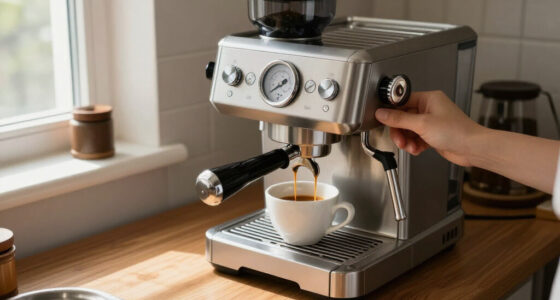
The E61’s front lever operates mechanical valves that direct water through the group and control the brewing cycle. On many modern machines, raising the lever starts the pump and lets water reach the coffee; lowering it ends the shot and releases pressure through the machine’s exhaust path. The lever gives you a clear, physical way to start and stop brewing.
It’s easy to mistake a satisfying lever action for full manual pressure control. On a typical pump-driven E61 machine, the pump—not your hand—provides brewing pressure. Some versions allow a gentler wetting phase or other forms of pre-infusion, but the exact behavior depends on the machine’s plumbing and controls. A lever alone does not mean you can freely shape pressure through every second of a shot.
For instance, you might raise the lever, watch the espresso begin to drip, and lower it when your target yield appears in the cup. That gives you hands-on control over shot timing, but it doesn’t necessarily change the pump’s pressure curve. Pressure profiling requires suitable machine hardware or a specific control system, not merely the classic E61 handle.
Some E61 machines do use manual levers, including vintage designs, while many current models use electric pumps. Ask what the lever actually controls before buying. A useful product description should explain whether the machine has pump-driven extraction, adjustable pre-infusion or pressure profiling, rather than relying on phrases that make the group sound more capable than it is.
This difference affects both the feel of brewing and the results you can deliberately reproduce. A simple start-and-stop lever is intuitive, but it mainly gives you control over when extraction begins and ends; it does not let you compensate for every puck or coffee by changing pressure. A pressure-profiling system offers more ways to experiment, yet it also adds settings and a learning curve. Choose the simpler workflow if repeatable shots are your priority, and pay for advanced controls only if you expect to use them.
espresso machine with pre-infusion
As an affiliate, we earn on qualifying purchases.
As an affiliate, we earn on qualifying purchases.
How pre-infusion can help your espresso puck
Pre-infusion wets the coffee puck gently before full brewing pressure develops. This can help water spread through the grounds more evenly, reducing the chance that it finds one easy channel and rushes through. E61-style machines can support pre-infusion through their valve arrangement, but how it works and how much control you get vary by model.
Think of watering a dry garden bed: a light first pass lets the soil absorb water before a heavier stream arrives. With coffee, the puck is a compact bed of grounds held in a portafilter. If water hits it unevenly at full force, it may carve narrow paths. Those channels can leave some grounds under-extracted while others taste harsh or dry.
In a real kitchen, pre-infusion may be helpful when you are dialing in a fresh coffee and see spurting from one side of the basket. It is not a fix for every uneven shot. A lumpy dose, poor distribution, an unsuitable grind or a damaged basket can still cause trouble. Keep your dose and tamp consistent, then test the machine’s pre-infusion feature rather than changing several things at once.
Check the manual or manufacturer’s specifications to learn whether pre-infusion is passive, timed or adjustable. A machine may offer a brief low-pressure wetting phase without letting you set its duration. That can still be useful, but it is different from detailed pressure profiling. Match the feature to your needs: a beginner may value repeatable shots more than another control to manage.
Pre-infusion is best understood as one aid to even extraction, not a guarantee of it. A gentle wetting phase can give the puck time to absorb water before the main flow arrives, but it cannot correct a poor grind or uneven preparation. More adjustability can help experienced users tune a recipe, while also making it easier to change too many variables and lose a reliable baseline. If you are learning, a fixed, repeatable pre-infusion phase may be more useful than a feature you must constantly fine-tune.
As an affiliate, we earn on qualifying purchases.
Compare the classic E61 with your day-to-day priorities
The best group head for you depends on whether you value heat retention, fast startup, simple controls or detailed shot adjustment most. E61 machines offer a recognizable mechanical design and broad modern variation, but they can take time to warm and need routine care. Comparing the parts of your routine side by side is more useful than choosing by appearance alone.
| What you care about | What an E61 may offer | What to check before buying |
|---|---|---|
| Steady brewing during a session | A heated, substantial group with thermosyphon circulation | Warm-up guidance and temperature-control method |
| Quick coffee before work | A familiar pump-and-lever workflow | Actual warm-up time; group heat takes time too |
| Shot experimentation | Pre-infusion on some models | Whether it is adjustable, passive or timed |
| Easy repairs | A long-established mechanical design | Local parts access, service support and machine-specific layout |
| Small counter space | Classic form with many machine configurations | Full width, depth, height and portafilter clearance |
For example, a home barista who makes four milk drinks on Saturday may appreciate an already-warm group and a machine built for repeated use. Someone who drinks one espresso at 6:30 a.m. and leaves immediately may prefer a machine designed for faster startup, even if it has less of the E61’s visual drama.
Modern E61 machines may add PID temperature control, volumetric dosing or insulation. Those features belong to the machine, not automatically to every E61 group head. If you’re ready to compare current models, use a guide to E61 espresso machines as a starting point, then verify specifications and service details for the version sold in your region.
The table highlights why there is no single “best E61” for every home. Heat retention is most valuable when you make several drinks in a session; it matters less if the machine spends most of the day off and you need coffee immediately. Likewise, adjustable controls are an advantage only if you want to learn them and will use them. Weigh the inconvenience you will encounter every day against the features you might use occasionally.
Repairability deserves the same careful reading. A familiar design can mean that technicians recognize its mechanisms, but it does not guarantee that a particular machine has readily available parts or affordable local service. The boiler layout, electronics and manufacturer support still affect repair options. Before treating “classic” as a long-term ownership advantage, confirm who can service the exact model and what common replacement parts cost.
Use this buying checklist before you choose an E61
Choose an E61 machine by checking how its boiler, controls, maintenance needs and footprint fit your routine—not by group-head styling alone. A careful comparison can prevent the classic regret: buying a machine that makes attractive espresso but takes too long to heat, crowds the counter or asks more maintenance than you want to do.
- Measure your space. Check machine width, depth and height, including room to lift the reservoir lid and lock in the portafilter. Measure under cabinets, not just across an empty counter.
- Ask how it heats and controls temperature. Find out whether it has a PID, a pressurestat or another arrangement, and read the recommended warm-up routine. Do not assume every E61 heats at the same speed.
- Check the boiler and milk workflow. If you make lattes, see whether the machine can brew and steam at the same time, and ask how long it takes to recover between drinks.
- Confirm the pre-infusion and pump features. Look for clear details about adjustable pre-infusion, volumetric dosing and pressure profiling. These are not guaranteed by the E61 name.
- Look into water and service. Confirm the manufacturer’s water guidance, warranty terms, local repair options and availability of seals and other service parts.
- Set a cleaning routine. Find out what backflushing products and intervals the manual recommends, and whether your water requires filtration or periodic descaling.
Imagine your counter has only 45 centimeters of usable depth and a low cabinet overhead. A machine might fit on paper but become frustrating if you can’t open its reservoir or remove the cup tray easily. The dimensions and daily access matter as much as the group’s polished face.
Also think about water. Hard water can leave mineral scale inside a machine, while unsuitable water can affect both flavor and equipment. Follow the manufacturer’s water recommendations rather than guessing at treatment. Good care protects the boiler and valves, but aggressive descaling without the right instructions can create problems too.
Use the checklist to test a machine against your actual habits, not an idealized coffee routine. If you rarely steam milk, paying extra for a boiler setup designed for rapid milk-drink service may not be worthwhile; if you make several cappuccinos back-to-back, steam capacity and recovery time become central. The same principle applies to controls: a feature has value when it solves a problem you encounter often enough to justify its cost and complexity.
Water and maintenance can also affect the real cost of ownership. A machine that fits your budget initially may require suitable filtration, periodic servicing and replacement seals over time. Ask for the manufacturer’s water specifications and service guidance before purchase, because a treatment method that works for one machine or water supply may not be appropriate for another. Clear instructions and accessible service support are part of a machine’s practical value, not afterthoughts.
Keep the E61 clean without turning coffee into a chore
An E61 machine stays dependable when you clean coffee oils from the group and follow the manufacturer’s water-care instructions. The group handles hot water and fine grounds every day, so residue can build up around the shower screen, gasket and portafilter. A short, repeatable routine helps preserve flavor and makes worn seals easier to spot.
After a brewing session, wipe the portafilter basket and rinse loose grounds from the group as directed in the manual. If your machine supports backflushing, use the specified blind basket and an espresso-machine cleaner at the recommended frequency. Do not assume that every model calls for identical products or intervals. A small brush can remove dark, sticky coffee residue from around the gasket.
For example, after making morning drinks, you might rinse the basket, wipe the group face and leave the portafilter out so parts can dry. When the manual calls for a cleaning cycle, set aside a few minutes to follow it rather than waiting until espresso starts tasting stale. Replace a worn group gasket when the handle becomes unusually loose or leaks appear, using the machine’s service instructions.
Hot water and steam can burn. Keep hands away from the group outlet and steam wand during operation, and let components cool before handling parts that require removal. Unplug the machine before user-level maintenance when the manual directs you to do so. Descaling is not a universal monthly chore: water hardness and the manufacturer’s directions should determine the approach.
Cleaning matters for more than appearance. Coffee oils become rancid and can leave stale or bitter flavors, while grounds caught at the gasket can interfere with a good seal and contribute to leaks. Regular, modest cleaning prevents residue from building up into a harder maintenance job. The goal is not to dismantle the group after every session, but to follow a routine that fits the machine and catches wear before it disrupts brewing.
Water care is a separate issue from wiping and backflushing. Cleaning removes coffee residue; it does not remove mineral scale already inside the boiler and water paths. Because scale risk depends on your water and machine, following the manufacturer’s guidance is safer than applying a fixed descaling schedule. This distinction helps avoid both neglect and unnecessary treatments that may damage components.
Know what heritage can—and cannot—tell you
The E61’s long history tells you that the design has lasted; it does not prove that every E61 machine is equally durable, efficient or easy to repair. Machine quality depends on materials, assembly, parts support, water care and how the previous owner treated it. A well-maintained modern machine may suit you better than an abused vintage one, even if the older model has a compelling story.
There is a real trade-off between established mechanics and newer convenience features. A simpler machine may be easier to understand and may have fewer electronic controls, while a PID-equipped model can make temperature adjustments more accessible. Electronics can add convenience but also bring parts that need specialized service. Neither choice wins for everyone.
Consider a secondhand machine advertised as “built to last decades.” Treat that phrase as a reason to ask for maintenance records, not as proof. Ask when the seals were last replaced, whether the boiler has been serviced, what water was used, and whether a technician can inspect it. A shining case can hide scale or worn valves, just as a scratched case can conceal a healthy machine.
The classic group head is one of the most iconic espresso designs because it combines visible mechanics with a practical heating system. But buying is about the whole package: reliable parts, sensible controls, suitable warm-up, and a workflow you’ll enjoy on an ordinary Tuesday. The group head explained clearly is only the start of the decision.
Heritage is useful when it points to a design with established operating principles and a history of service, but it is not a substitute for evidence about the specific machine. With a new model, that evidence includes a clear warranty, available parts and responsive service. With a used one, it includes maintenance records, water history and an inspection. Those details determine whether the design’s theoretical repairability becomes a practical benefit for you.
The same caution applies to modern upgrades. A PID may make temperature adjustments more accessible, but it does not erase warm-up time or poor maintenance; a simpler control system may be easier to service, but it may offer less precise adjustment. Choose based on the compromises you are willing to live with, rather than treating either age or feature count as a shortcut to quality.
Frequently Asked Questions
Is an E61 espresso machine suitable for home use?
Yes. Many E61 machines are designed for home use, but their size, warm-up time and maintenance demands vary. If you usually make one quick coffee before leaving, compare the startup routine with a machine designed to heat faster.
How long does an E61 machine take to warm up?
Warm-up time varies by machine, room conditions and the manufacturer’s instructions. The boiler can reach operating temperature before the heavy group head and portafilter are fully warm, so follow the manual rather than judging by a light alone.
Does every E61 machine have adjustable pre-infusion?
No. E61 machines may offer passive pre-infusion, timed settings or more adjustable controls, depending on their plumbing and electronics. Check the exact model’s specifications; the E61 name by itself does not promise adjustable pre-infusion.
Does the E61 lever control brewing pressure?
Usually, the lever on a pump-driven E61 machine operates the brew valves and starts or stops the shot while the pump supplies pressure. Pressure profiling requires compatible hardware or controls, so confirm the machine’s features before assuming the lever changes pressure.
Are vintage E61 machines better than modern ones?
Not automatically. Vintage machines may appeal for their mechanical character, while modern versions can add PID controls, insulation or other conveniences. For a used machine, condition, water history, service records and access to parts matter more than age alone.
What maintenance does an E61 group head need?
Clean coffee residue from the basket and group, and backflush with the product and schedule specified by the manufacturer if the model supports it. Follow the machine’s water-care guidance, inspect seals for wear and avoid descaling on a schedule that ignores your water and the manual.
Conclusion
Buy an E61 because its workflow, warm-up and maintenance suit the way you actually make coffee—not because the group head looks like a promise of perfect espresso. Check the machine’s controls, water guidance, service support and counter fit before you commit.
A good E61 should earn its place on your counter one well-pulled shot at a time, not merely shine there like a chrome trophy.
Halloween Picks
halloween
As an affiliate, we earn on qualifying purchases.