
TL;DR

Get coffee and tea gear delivered free — and shop member deals
- Fast, free delivery on millions of items
- Access to Prime Big Deal Days deals on October 6–7
- Prime Video, Amazon Music and more included
A 58mm portafilter is a widely used espresso format whose measurement refers approximately to the basket’s top diameter, not the whole portafilter. Commercial adoption made 58mm baskets and accessories easy to find, but the size is a convention rather than a universal fit standard: check your machine’s locking geometry and your basket’s actual dimensions before buying.
A portafilter marked 58mm can still refuse to lock into a machine built for 58mm accessories. That sounds like a measurement problem, but it’s really a naming problem: the number describes approximately the basket’s top diameter, not every dimension that determines fit.
The 58mm format became familiar because it spread through commercial espresso machines and, with them, baskets, tampers, and other accessories. Home-machine makers adopted that well-stocked ecosystem, too. You’ll learn what the measurement means, why size became common, what it changes in your daily routine, and how to check compatibility before you order a shiny new tamper.
Along the way, we’ll separate useful facts from the tempting claim that a larger basket automatically makes better coffee. Think of 58mm as a popular road many espresso makers share—not a guarantee that every vehicle or accessory can use the same exit.
58mm describes approximately the basket’s top diameter, not the whole portafilter or the espresso stream.
Commercial adoption helped make 58mm a common format and expanded the availability of related accessories.
A 58mm label does not guarantee that a complete portafilter will fit: check lug geometry and group-head compatibility.
Choose a tamper for your basket’s internal diameter, and check basket depth and rim design before buying replacements.
58mm offers broad accessory choice, but diameter alone does not determine espresso quality.
58mm Portafilters Explained: Why Size Became a Standard
The familiar 58mm label points to a basket’s approximate top diameter. Commercial adoption made the format easy to find, but it does not promise that every part will fit every machine—or make better espresso by itself.
What does 58mm actually measure?
It describes approximately the basket’s top diameter, where the basket sits in the portafilter. It does not measure the handle, the complete portafilter body, or the espresso stream.
The basket opening
The basket contains the coffee. Its walls can taper, and its rim, depth, and ridge design vary. A nominal diameter is a useful starting point, not an exact dimension everywhere.
The portafilter lugs
The ears engage with the espresso machine’s group head. Their shape and spacing determine whether a complete portafilter can lock, even when both parts carry a 58mm label.
Why did 58mm become the familiar café size?
Commercial equipment helped establish a shared format. As more cafés and manufacturers used it, the accessory supply grew—and home machines could draw on the same ecosystem.
Commercial adoption
Many commercial machines used 58mm baskets suited to common double-shot preparation and repeatable café routines.
Shared accessories
More machines using the format gave suppliers reason to stock baskets, tampers, and other preparation tools.
Home adoption
Domestic makers could use a familiar, well-stocked format. The result is an industry convention, not a universal rule.
What does 58mm change in daily use?
The format affects your available tools and the shape of the coffee bed. Basket design, dose, grind, distribution, machine performance, and technique still shape the result.
Check the basket’s dose range
A 58mm basket commonly holds a double-shot dose, but capacity varies with depth and design. Follow the basket maker’s guidance instead of assuming every basket holds the same amount.
Match the inside diameter
A close-fitting tamper supports an even coffee bed. “58mm” is a rounded label; compare the actual tamper specification with your basket’s internal diameter.
A wider bed changes shape
Surface area can affect puck geometry and may affect extraction. Diameter alone cannot predict whether espresso will taste balanced, sharp, or sweet.
Example dose: 18g
Check that the specific basket is intended for your recipe. A nominal diameter does not define capacity.
How to check whether a 58mm part fits
Start with your exact machine model and the component you are replacing. Use manufacturer specifications where available, then compare the dimensions that do the actual work.
Identify the part
Basket, tamper, and complete portafilter each need different checks.
Find your model
Check the manual or maker’s information; one brand can use multiple group heads.
Compare dimensions
Check lug geometry, basket rim and depth, or tamper-to-interior fit as applicable.
Confirm compatibility
Use the manufacturer’s specifications before ordering a replacement or accessory.
| Part | Check these details | Does “58mm” settle it? |
|---|---|---|
| Complete portafilter | Group head, lug shape, lug spacing, locking geometry | No — confirm machine fit |
| Replacement basket | Outer dimensions, depth, rim, ridge design | Not by itself |
| Tamper | Tamper specification and basket internal diameter | Nominal size can vary |
Popularity is an accessory advantage—not a taste score.
A widely used format gives you more choice in baskets, tampers, distribution tools, and puck screens. Recent gear developments improve components within 58mm setups, including precision, high-flow, and ridgeless baskets, as well as more closely specified tampers.
Does 58mm automatically make better espresso?
No. Smaller 54mm and proprietary formats can make excellent espresso too. Diameter is one part of puck geometry; basket design, dose, grind, distribution, machine performance, and technique all matter. Choose for fit, workflow, and the accessories you want.
Follow the fit from machine to tool
What does 58mm actually measure?
A 58mm portafilter is a portafilter made for a basket whose top diameter is approximately 58 millimeters. The number refers to the basket’s opening where it sits in the portafilter, not the full width of the handle and metal body, and not the diameter of the espresso stream.
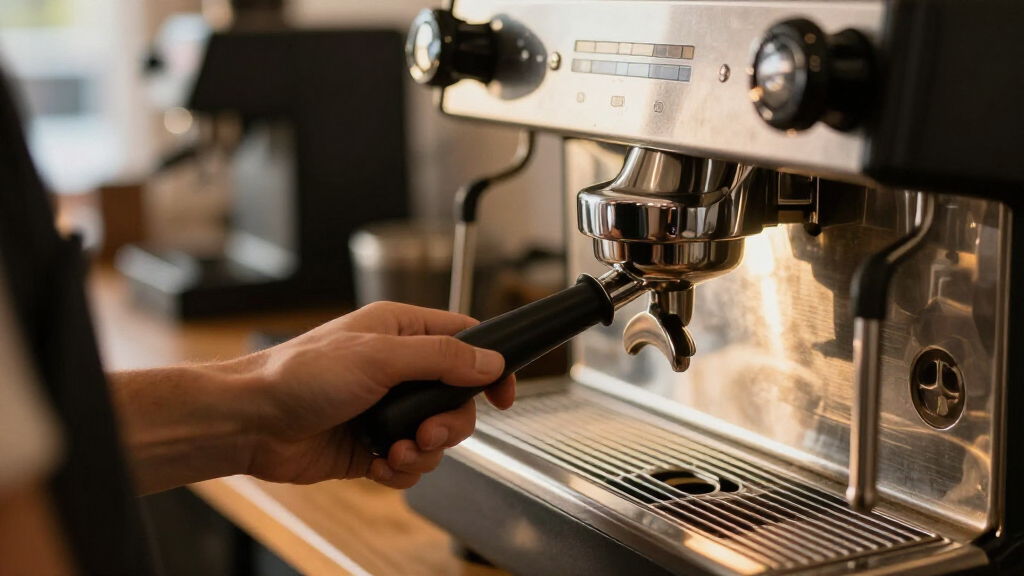
That distinction matters when you shop. A portafilter has a basket, a body, a handle, and locking ears—or lugs—that engage with the machine’s group head. The ears do the mechanical handshake; the basket holds the coffee. A 58mm label tells you something useful about the basket format, but it doesn’t describe the whole handshake.
Imagine buying a 58mm basket online because your machine’s manual says “58mm.” The basket might have the right nominal diameter yet still differ in depth, outer rim, or ridge design from the one your portafilter accepts. Likewise, a complete portafilter can have the expected basket size and still fail to lock because its lug spacing differs. The number is a starting point, not a compatibility promise.
The measurement also isn’t necessarily the basket’s exact internal width at every point. Basket walls taper, and manufacturers can use slightly different dimensions. That’s why a tamper marked 58mm may fit one basket neatly and feel loose—or catch—inside another. For a close fit, compare the tamper specification with your basket’s internal diameter, rather than trusting the label alone.
As an affiliate, we earn on qualifying purchases.
Why did 58mm become the familiar café size?
58mm became common because commercial espresso equipment widely adopted the format, and each machine helped grow a shared supply of compatible-style baskets and tools. The size supported common double-shot preparation, while cafés and manufacturers built routines and equipment around it. As home espresso machines drew on that established ecosystem, the same format became a practical choice for many domestic setups.
Think of the standard as a well-used path through a busy café. When many machines take that path, suppliers have a reason to stock more baskets and tampers for it; when those tools are easy to find, more machine makers can use the format. The path gets busier with every adopter. That doesn’t mean one person or one formal rule declared 58mm the only correct size. It’s better understood as an industry convention that gained momentum through use.
For a home user, the effect is tangible. Say you chip or wear a basket after years of daily espresso. With a widely used size, you’re more likely to find replacement baskets and preparation tools than if you own a machine with an unusual proprietary format. This is one reason why size became part of the buying conversation: it can affect the range and availability of accessories you’ll find.
Still, the familiar size never erased alternatives. Some machines use 54mm baskets or smaller, distinctive formats. Those machines can make excellent espresso. A smaller format may suit a compact design or a maker’s engineering choices; it simply may offer a different accessory selection. Popularity is a supply-chain advantage, not a taste score.
As an affiliate, we earn on qualifying purchases.
What does 58mm change when you make espresso?
A 58mm basket affects which baskets and preparation tools you can buy, but the number alone doesn’t decide your espresso’s quality. Basket depth and design affect capacity, the tamper needs to match the basket’s interior, and the wider coffee bed changes puck geometry. Dose, grind, distribution, and machine performance still do much of the work.
A common 58mm basket can hold a double-shot dose, but its capacity depends on its design and depth. If your recipe uses 18 grams, for example, check that the basket is intended for a dose in that range rather than assuming every 58mm basket holds the same amount. Overfilling can leave too little headroom; underfilling a basket designed for more coffee may also affect puck preparation. Follow the basket maker’s guidance and adjust your recipe to the equipment.
The size can make a practical difference during tamping. A tamper that fits closely supports an even, tidy coffee bed; one that leaves a wide gap leaves more coffee near the edge untouched by the tamper face. But “58mm tamper” is a rounded product label, not a promise of an exact fit. If your tamper rocks or binds, check the actual basket and tamper dimensions before blaming your technique.
Think of the basket as the playing field, not the whole game. A wider surface changes the shape of the puck, just as a broader pan changes how a thin layer of batter spreads. That may affect extraction, but diameter alone can’t tell you whether a shot will taste sweet, sharp, or balanced. Recent gear choices often improve components within the same 58mm format: precision baskets, different hole patterns, high-flow designs, ridgeless baskets, and more closely specified tampers.
As an affiliate, we earn on qualifying purchases.
How do you check whether a 58mm part fits your machine?
To check whether a 58mm accessory fits, identify the exact part you’re replacing and compare its working dimensions with the manufacturer’s specifications. For a portafilter, check the group-head connection and lug geometry; for a basket, check its rim, depth, and shape; for a tamper, check its fit against the basket’s internal diameter. Matching “58mm” alone is not enough.
- Find your machine’s exact model. Check its manual or manufacturer information rather than relying on a broad brand name. A maker may use different group heads across product lines.
- Decide which component you need. A basket, tamper, and complete portafilter have different compatibility checks. Don’t use a basket’s nominal size to infer that the whole portafilter will lock into your machine.
- Check the relevant dimensions. For a complete portafilter, confirm the lug shape and spacing as well as the basket size. For a basket, compare outer dimensions, depth, and rim or ridge design. For a tamper, look for its specified diameter and the basket’s internal measurement.
- Confirm with the manufacturer or a reliable retailer. If the listing doesn’t identify compatible models or measurements, ask before ordering. Keep your old component nearby for a physical comparison.
For example, if your current portafilter locks in smoothly but a replacement marked 58mm stops short, don’t force it. The lugs may be shaped or spaced differently, and forcing a mismatch could damage the machine or the part. Likewise, if a new basket rattles in the portafilter, check its outer rim and basket style before using it. A specific fit check is cheaper than a frustrating return—and safer than leaning hard on a part that doesn’t belong.
As an affiliate, we earn on qualifying purchases.
Is 58mm better than 54mm or a smaller basket?
58mm isn’t inherently better than 54mm; it’s a more widely supported format in many markets, while espresso quality depends on the complete brewing setup. A smaller basket can produce excellent coffee when the machine, basket, dose, grind, and preparation suit one another. The useful question is whether a size fits your needs and equipment, not which number wins.
The clearest difference may show up in shopping. A common 58mm setup often gives you more choice among baskets, tampers, distribution tools, and puck screens. A smaller or proprietary format may narrow those choices, though it can still work perfectly well. If you already own a 54mm machine that makes shots you enjoy, replacing it just to chase a larger number is unlikely to fix a bitter shot or a fast, watery one.
There’s also no universal rule that a wider basket automatically extracts better. Basket design, hole pattern, dose, grind setting, distribution, and the machine’s performance all affect the result. For instance, a café barista might choose a particular 58mm precision basket for its design and workflow; that doesn’t mean a home user with a smaller basket can’t pull a balanced shot. The basket is one piece of the recipe.
Use the same logic when you see claims that a particular diameter guarantees more even extraction. Ask what else changed: the basket geometry, dose, grinder, or preparation method? If you’re choosing between machines, weigh the real tradeoff: 58mm often gives you broad accessory availability, while another size may better suit a compact machine or a specific design. The cup, the fit, and the tools you can readily replace matter more than a bigger-looking number.
Which 58mm accessories can you mix and match?
58mm accessories are not all interchangeable, even when their packaging uses the same nominal size. Baskets, tampers, distribution tools, and puck screens each meet a different surface or part, so each needs its own compatibility check. The label is a useful filter; the actual shape and measurements decide whether a tool works well.
| Accessory | What to check | Common mismatch |
|---|---|---|
| Basket | Outer diameter, depth, rim, ridge style, and portafilter fit | A basket sits too loosely or does not seat correctly |
| Tamper | Fit against the basket’s internal diameter | The tamper rocks, leaves a wide edge gap, or binds |
| Complete portafilter | Group-head fit, lug shape and spacing, plus basket format | The portafilter does not lock into the machine |
| Puck screen or distribution tool | Basket’s usable interior width and depth | The tool catches on the wall or leaves poor coverage |
This is where the size’s popularity pays off. A 58mm label usually opens up a broad accessory market, including precision baskets and varied preparation tools. But a particular 58mm basket may have a ridge that affects fit, or an internal diameter that calls for a slightly different tamper. Check the manufacturer’s listed measurements when you want a close-fitting tool.
Picture replacing a worn basket and ordering a tamper at the same time. If the tamper was chosen from the broad “58mm” category but the basket’s interior is narrower than expected, the two pieces may not work together neatly. Match accessories to the specific basket and machine, not only to each other’s headline labels. This small check can spare you a loose puck, a stuck tool, or a package you have to send back.
How can you get reliable results from a 58mm setup?
Reliable espresso comes from matching your recipe to your basket and preparing the puck consistently, not from the 58mm label on its own. Start with the basket’s recommended dose, use a tamper that fits its interior, and pay attention to grind and distribution. Change one part at a time so you can tell what improved the shot.
For a practical example, suppose your basket is marked for an 18-gram dose and your first shot gushes into the cup. Before buying a different portafilter, check that you weighed the coffee, ground fine enough for your recipe, and distributed it evenly. If the next shot runs too slowly, adjust the grind a little coarser and test again. The basket diameter didn’t change; your control over the recipe did.
A few habits help you get consistent results:
- Use the basket maker’s dose guidance as a starting point; basket depth and shape affect capacity.
- Match the tamper to the basket’s interior, and test for a snug fit without forcing it.
- Keep dose, grind, and distribution steady while you troubleshoot one variable.
- Clean the basket and portafilter after use so coffee oils and old grounds don’t affect flavor or interfere with seating.
Espresso equipment also needs basic care. Let hot metal cool before handling or cleaning it, and follow the machine maker’s instructions for backflushing and descaling. If you use cleaning chemicals, use products intended for espresso equipment and rinse as directed. A clean basket and a repeatable routine give you clearer feedback than a string of random gear changes.
Frequently Asked Questions
Is 58mm the diameter of the whole portafilter?
No. 58mm refers approximately to the basket’s top diameter, not the handle, portafilter body, or locking ears. The complete portafilter is wider, and its connection still needs to match your machine.
Are all 58mm portafilters interchangeable?
No. The basket format may be similar, but lug shape, spacing, and locking geometry can differ between machines. Check compatibility with your exact machine model before buying a complete portafilter.
Why do some espresso machines use 54mm or another size?
Manufacturers choose dimensions to suit a machine’s design, cost, and intended use. Smaller baskets can still make excellent espresso; the main practical difference may be accessory availability and the specific basket capacity.
Does a 58mm portafilter make better espresso?
No diameter guarantees better coffee. Basket design, dose, grind, distribution, and machine performance all affect the result, so a well-prepared shot from a smaller format can taste excellent.
How do I choose a tamper for a 58mm basket?
Choose a tamper specified for the internal diameter of your particular basket. Nominal 58mm labels can cover slightly different fits, so check measurements if you want to avoid a loose tamper or one that binds.
Is 58mm an official standard?
58mm is a widely adopted industry convention, not a universal rule that makes every 58mm component compatible. The number describes the basket format; machine connections and accessory dimensions still vary.
Conclusion
Remember the 58mm label as a useful clue, not a universal guarantee. It points to a popular basket format that grew through commercial use and carries a large accessory ecosystem, but you still need to match the part to your machine and basket.
Before buying, check the measurements that matter for that component. Then let grind, dose, and careful preparation shape the coffee. A good espresso begins with a tool that fits—and ends in a cup that tastes like you meant it.
Fall Picks
fall essentials
As an affiliate, we earn on qualifying purchases.