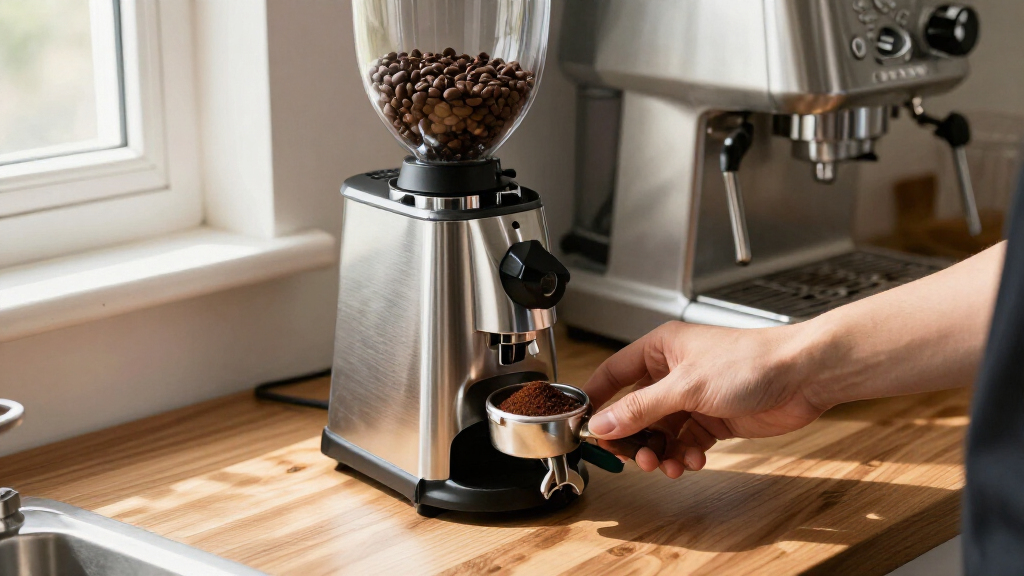

The best electric coffee grinders for espresso pair fine, repeatable adjustment with a workflow that suits your machine and routine. My best overall pick is the Breville Smart Grinder Pro, which offers broad adjustment and timed dosing; the SHARDOR 51-setting model is a feature-rich alternative, while the Aromaster 48-setting grinder gives budget-minded buyers plenty of adjustment options. The tradeoffs are real: more settings do not automatically mean better espresso, and compact or simpler grinders may offer less control over dose and grind consistency. Read on for how these eight options compare, which buyers each suits, and what to check before choosing.

Get coffee and tea gear delivered free with Prime
- Fast, free delivery on millions of items
- Prime Video, Amazon Music and more included
- Member-only deals all year
Complete the kit


Key Takeaways
- The Breville Smart Grinder Pro leads for flexibility. Its combination of adjustment range and timed dosing makes it the strongest all-round choice here for households that switch between espresso and other brew styles.
- SHARDOR’s 51 settings offer fine control on paper, not a guarantee of espresso performance. Buyers should weigh its touchscreen and timer against the importance of grind consistency and their espresso machine’s own adjustment needs.
- Aromaster and AMZCHEF both provide 48 settings, but setting count alone does not distinguish them. Compare their dosing workflow, footprint, and cleanup against the features you will use every day.
- The Cuisinart DBM-8P1 and 16-setting SHARDOR are simpler picks. Their limited adjustment makes them less compelling for dialing in espresso than the more adjustable models, though simplicity can suit less demanding routines.
- The OXO and Ollygrin fill different practical roles. OXO’s 12-ounce capacity favors larger batches, while Ollygrin’s stated 2–12-cup range is aimed at flexible batch brewing; neither specification alone establishes espresso suitability.


| electric coffee grinders for espresso | Grind settings | Dimensions | Burr type | Model |
|---|---|---|---|---|
| Cuisinart Supreme Grind Electr | 18 | — | Flat stainless-steel | DBM-8P1 |
| Aromaster Conical Burr Coffee | 48 | 8 × 5 × 16 in | Conical | — |
| Ollygrin Electric Conical Burr | 30 | 5.4 × 7 × 12 in | 40 mm stainless-steel conical burrs | — |
| SHARDOR Conical Burr Espresso | 51 | 7.4 × 4.9 × 13.5 in | — | CG018B |
| Breville Smart Grinder Pro | 60 | 6.28 × 8.46 × 15.33 in | Conical | BCG820BSS |
| SHARDOR Electric Burr Coffee G | 16 | 7.48 × 5.16 × 9.76 inches | — | CG835B |
| AMZCHEF Burr Coffee Grinder wi | 48 | 7.4 × 5.1 × 13.4 inches | 40 mm stainless steel conical burrs | — |
| OXO Brew Conical Burr Electric | 15 settings plus 43 micro-adjustments | 7.5 × 5.3 × 12.9 inches | 40 mm stainless steel conical burrs | — |
More Details on Our Top Picks
Cuisinart Supreme Grind Electric Burr Coffee Grinder, DBM-8P1
The Cuisinart DBM-8P1 is the broad-brewing pick here: its 18 settings and cup selector suit households that switch between espresso-style fine grounds, drip, and coarser methods. Its flat stainless-steel burrs are a useful step up from blade grinding, but the modest number of adjustments gives less room to fine-tune espresso than the Breville Smart Grinder Pro or the SHARDOR CG018B. The 4–18-cup selector and automatic shutoff make routine batch grinding straightforward, while the removable parts and included brush help with upkeep. The tradeoff is that this is a general-purpose grinder rather than an espresso specialist: its plastic housing feels less substantial than the Breville’s stainless-steel construction, and its 8-ounce hopper is not the largest in this group. I’d choose it for varied daily brewing, not for frequent espresso dialing-in.
Pros:- Flat stainless-steel burrs provide a more consistent grind than blade-style grinding.
- 18 settings cover a range of brewing methods.
- Cup selector, automatic shutoff, and safety interlock support straightforward daily operation.
- Removable hopper and grounds chamber simplify cleaning.
Cons:- Fewer grind settings offer less espresso adjustment than the Breville Smart Grinder Pro or SHARDOR CG018B.
- Plastic housing feels less premium than the stainless-steel Breville.
- The 8-ounce hopper may require frequent refills for heavier use.
Best for: Households that make several coffee styles and want a simple burr grinder with batch-size controls.
Not ideal for: Espresso drinkers who frequently adjust grind size to dial in shots, or high-volume users who want a larger hopper.
- Brand:Cuisinart
- Model:DBM-8P1
- Burr type:Flat stainless-steel
- Grind settings:18
- Cup selector:4–18 cups
- Bean hopper capacity:8 oz
- Grounds chamber capacity:32 cups
- Motor power:500 W
- Warranty:Limited 18-month
Our verdict“Choose the Cuisinart for mixed brewing and easy batch controls, but pick a more adjustable model if espresso is your main focus.”
Aromaster Conical Burr Coffee Grinder, 48 Settings, Anti-Static, Silver
The Aromaster suits espresso drinkers who prefer grinding modest amounts at a time rather than keeping a large hopper filled. Its 48 settings give it finer adjustment options than the Cuisinart DBM-8P1, and the adjustable timer can run for up to 40 seconds, making it easier to repeat a chosen grind duration. Anti-static features are aimed at reducing scattered grounds, while the removable burr and cleaning brush help with maintenance. Its 3.9-ounce capacity is a clear limit beside the Breville Smart Grinder Pro’s 18-ounce hopper, so it is better matched to smaller servings than frequent batch grinding. The supplied details also call for keeping the conical burr dry before reassembly, adding care during cleaning. I’d shortlist it for a compact routine and broad grind adjustment, not for a high-volume kitchen.
Pros:- 48 grind settings offer more adjustment than the Cuisinart DBM-8P1.
- Adjustable timer runs for up to 40 seconds.
- Anti-static design is intended to reduce scattered grounds.
- Removable burr and included brush support cleaning.
Cons:- The 3.9-ounce capacity is much smaller than the Breville Smart Grinder Pro’s 18-ounce hopper.
- The burr must be kept dry before reassembly.
- 120V, 60Hz power specification may limit compatibility in other electrical systems.
Best for: Espresso drinkers making small, fresh batches who want many grind adjustments and a timed operation.
Not ideal for: High-volume households or users who want to load a larger hopper and grind several servings without refilling.
- Burr type:Conical
- Burr material:Stainless steel
- Grind settings:48
- Capacity:3.9 oz
- Timer:Adjustable, up to 40 seconds
- Dimensions:8 × 5 × 16 in
- Power specification:120V, 60Hz
- Warranty:12-month repair service
Our verdict“Pick the Aromaster for small, timed batches and broad grind adjustment, but skip it if you need a large hopper or simple wet-cleaning routines.”
Ollygrin Electric Conical Burr Coffee Grinder, 30 Settings, 2–12 Cups
The Ollygrin stands out for its 10-ounce bean hopper, which holds more than the Cuisinart DBM-8P1’s 8 ounces and far more than the SHARDOR CG018B’s 1.4-ounce capacity. That makes it a better fit for people who want to grind several servings without frequent refills. Its 40 mm stainless-steel conical burrs and 30 settings cover multiple brewing styles, though the lower setting count gives less opportunity to fine-tune espresso than the Breville Smart Grinder Pro with 60. Removable components and a cleaning brush make routine care more manageable. The main buying check is electrical compatibility: the listed 220-volt rating may not match a buyer’s outlet. I’d consider this for capacity and everyday flexibility only where the power specification suits the home.
Pros:- 10-ounce hopper holds more beans than the Cuisinart DBM-8P1.
- 40 mm stainless-steel conical burrs are specified for the grinder.
- 30 settings cover multiple brewing styles.
- Removable parts and an included brush help with cleaning.
Cons:- 220V rating may not match common 110–120V household outlets.
- 30 settings provide fewer adjustment points than the Breville Smart Grinder Pro’s 60.
- The product data does not specify a warranty.
Best for: Multi-cup households that want a larger bean hopper and use several brewing methods on compatible 220-volt power.
Not ideal for: Buyers with 110–120V outlets, or espresso-focused users who want the broadest range of grind adjustments.
- Burr type:40 mm stainless-steel conical burrs
- Grind settings:30
- Cup settings:2–12 cups
- Bean hopper capacity:10 oz
- Wattage:150 W
- Voltage:220 V
- Weight:2 kg
- Dimensions:5.4 × 7 × 12 in
Our verdict“Choose the Ollygrin for larger batch capacity if your outlet supports 220V, but favor the Breville for finer espresso adjustment.”
SHARDOR Conical Burr Espresso Coffee Grinder with Precision Timer 2.0, Touchscreen Adjustable Burr Mill, 51 Settings, Anti-Static, Stainless Steel
The SHARDOR CG018B is the most espresso-specific pick for buyers who want to grind straight into a portafilter. Its included cradle avoids transferring grounds from a separate cup, and the 0.1-second timer increments give more precise time adjustment than the Breville Smart Grinder Pro’s 0.2-second steps. With 51 settings, it also offers more adjustment points than the Ollygrin’s 30, though the Breville’s 60-setting range is broader overall. Anti-static technology is intended to keep the grinding area tidier. The main compromise is capacity: at 1.4 ounces, its listed capacity is small beside the Breville’s 18-ounce hopper, so frequent refills are part of the routine. I’d favor it for direct espresso workflow, but not for grinding larger quantities or moving the grinder often.
Pros:- Portafilter cradle supports direct grinding into the espresso basket.
- Timer adjusts in 0.1-second increments for fine control over grind duration.
- 51 grind settings offer more adjustment points than the Ollygrin’s 30.
- Anti-static technology is designed to reduce mess.
Cons:- The 1.4-ounce capacity is far smaller than the Breville Smart Grinder Pro’s 18-ounce hopper.
- At 4.9 pounds, it may be cumbersome to move frequently.
- The Breville offers more total grind settings.
Best for: Home espresso drinkers who want timed dosing directly into a portafilter and value fine timer increments.
Not ideal for: People grinding several servings at once or buyers who want a large bean hopper and fewer refills.
- Brand:SHARDOR
- Model:CG018B
- Burr:40 mm stainless steel
- Grind settings:51
- Timer increments:0.1 seconds
- Capacity:1.4 oz
- Wattage:165 W
- Voltage:120 V
- Dimensions:7.4 × 4.9 × 13.5 in
Our verdict“Choose the SHARDOR for direct-to-portafilter espresso dosing and fine timer control, but look elsewhere for batch capacity.”
Breville Smart Grinder Pro (BCG820BSS) – Brushed Stainless Steel
The Breville Smart Grinder Pro earns the lead for combining the broadest stated adjustment range in this group with a useful, flexible dosing setup. Its 60 grind settings give espresso drinkers more points to work through than the SHARDOR CG018B’s 51, while the 0.2-second timer supports repeatable grind durations. It can grind into a portafilter or several other containers, making it more adaptable than the SHARDOR’s direct-portafilter-focused setup. The 18-ounce hopper also makes it the strongest option here for keeping beans loaded between sessions, though that capacity comes with a taller, wider counter presence. Its brushed stainless-steel build and two-year limited warranty add practical appeal. The tradeoff is a learning curve: the many settings can take time to sort through, and the footprint is larger than the compact Aromaster. For espresso plus other brew styles, it is the most versatile choice.
Pros:- 60 grind settings provide the widest stated adjustment range in this group.
- Digital timer adjusts in 0.2-second increments.
- Can grind directly into a portafilter, container, filter basket, or paper filter.
- 18-ounce hopper and brushed stainless-steel construction support a substantial daily setup.
Cons:- Larger footprint than the Aromaster and other more compact options.
- The number of settings and programming options may take time for beginners to learn.
- Timer increments are less fine than the SHARDOR CG018B’s 0.1-second adjustments.
Best for: Home coffee drinkers who want broad espresso adjustment, repeatable timed dosing, and one grinder for several brewing methods.
Not ideal for: Small-kitchen owners who need a compact appliance, or beginners who prefer a simpler control set.
- Model:BCG820BSS
- Burr type:Conical
- Grind settings:60
- Digital timer increments:0.2 seconds
- Bean hopper capacity:18 oz (1.1 lb)
- Power:165 W
- Voltage:110–120 V
- Dimensions:6.28 × 8.46 × 15.33 in
- Warranty:2-year limited
Our verdict“Choose the Breville if you want the most adjustable, flexible grinder here for espresso and other brew methods, and have room for its larger footprint.”
SHARDOR Electric Burr Coffee Grinder with 16 Grind Settings
The SHARDOR CG835B is the straightforward pick here for households that want one grinder for espresso-style fine grounds and coarser brews without a long setup routine. Its 16 grind settings cover fewer steps than the AMZCHEF’s 48 or the OXO’s micro-adjustments, so it offers less room to fine-tune espresso shots. In return, the 2–14 cup timer makes batch grinding simple, and the dual safety lock helps prevent operation when the hopper or grounds chamber is unsecured. At 2.6 pounds, it is also lighter than those two alternatives. The tradeoff is limited adjustment granularity and no listed burr details, which makes it a less compelling choice for espresso drinkers who want to dial in a narrow grind range. It suits casual, mixed-brew use better than precision-focused espresso routines.
Pros:- 16 settings span fine espresso-style grounds through coarse French press grounds.
- Automatic 2–14 cup timer supports hands-free batch grinding.
- Dual safety lock helps prevent spills or operation with unsecured parts.
- Removable grounds chamber and included brush make routine cleanup easier.
Cons:- Fewer grind adjustments than the AMZCHEF’s 48 settings and the OXO’s micro-adjustments.
- Product data does not specify burr type, limiting what can be judged about espresso-focused grinding.
- The listed cup-based timer may be less useful for buyers who want precise dose-by-weight control.
Best for: Households that make espresso-style coffee as well as French press or other brews and want simple timed batch grinding.
Not ideal for: Espresso-focused users who regularly adjust grind size to refine shot flow; its 16 settings offer less fine control than the AMZCHEF or OXO.
- Model:CG835B
- Grind settings:16
- Cup settings:2–14 cups
- Capacity:8.5 ounces
- Power:150 watts
- Weight:2.6 pounds
- Dimensions:7.48 × 5.16 × 9.76 inches
- Warranty:Two years
Our verdict“Choose the SHARDOR for uncomplicated, mixed-brew grinding, but pick the AMZCHEF or OXO if espresso grind tuning matters more.”
AMZCHEF Burr Coffee Grinder with 48 Settings, Metallic Silver
The AMZCHEF stands out for buyers who want more room to adjust between espresso and other brew styles: its 48 settings give it a broader adjustment range than the SHARDOR’s 16. For espresso, that flexibility can help narrow in on a grind size, though the listed settings alone do not establish how well it performs at the finest end. Its 40 mm stainless steel conical burrs and half-second timer adjustments offer more detail than the SHARDOR’s cup-based timer. The touchscreen, anti-static design, and hopper trap door also target daily convenience, while the UV-tinted hopper helps limit light exposure. Compared with the OXO, the AMZCHEF has more labeled settings, but the OXO lists micro-adjustments too. The 10.6-ounce hopper and 120-volt power specification may also limit fit for some kitchens or electrical setups.
Pros:- 48 settings provide a wide adjustment range across brewing methods.
- 40 mm stainless steel conical burrs are specified.
- Timer adjusts in 0.5-second increments for more control over grinding time.
- Anti-static design and hopper trap door help reduce mess when handling grounds and beans.
Cons:- The listed 48 settings do not by themselves confirm espresso-level precision or performance.
- The 10.6-ounce hopper may be more capacity than some users need and takes countertop space.
- Specified for 120-volt AC power, limiting suitability for other electrical systems.
Best for: Home brewers who switch among espresso, cold brew, and other methods and want many grind settings plus timed dose adjustments.
Not ideal for: Buyers needing a grinder for non-120-volt power, or espresso users who prioritize proven fine-grind performance over a high setting count.
- Grind settings:48
- Burr type:40 mm stainless steel conical burrs
- Hopper capacity:10.6 ounces
- Timer:Up to 40 seconds, adjustable in 0.5-second increments
- Cup settings:2–12 cups
- Wattage:150 watts
- Weight:5.4 pounds
- Dimensions:7.4 × 5.1 × 13.4 inches
Our verdict“Pick the AMZCHEF if you want broad grind adjustment and timed control for several brew methods, rather than a simpler grinder like the SHARDOR.”
OXO Brew Conical Burr Electric Coffee Bean Grinder – 12 Oz, Matte Black
The OXO is the strongest fit in this group for buyers who value incremental adjustment over a simple preset range. It combines 15 main settings with 43 micro-adjustments, giving more ways to tune grind size than the SHARDOR’s 16 settings and a more granular approach than a setting count alone suggests. Its 40 mm stainless steel conical burrs are a useful specification for espresso-minded shoppers, while one-touch memory start saves the last setting for repeat grinding. A 12-ounce, UV-blocking hopper also holds more beans than the AMZCHEF’s 10.6-ounce hopper. The tradeoffs are practical: the supplied product data does not list a timer or cup-dose control, and the motor is reported as noisy. Its 4.5-pound weight is also less convenient to move than the lighter SHARDOR.
Pros:- 15 main settings plus 43 micro-adjustments offer fine grind-size tuning.
- 40 mm stainless steel conical burrs are specified.
- One-touch memory start recalls the previous setting for repeat grinding.
- 12-ounce UV-blocking hopper holds more beans than the AMZCHEF’s 10.6-ounce hopper.
Cons:- The motor can be noisy during operation.
- At 4.5 pounds, it is heavier than the SHARDOR and less convenient to move.
- Product data does not list a timer or cup-based dose controls.
Best for: Home espresso drinkers who want multiple small grind adjustments and repeatable settings, with occasional use for other brew methods.
Not ideal for: Shoppers who need quiet operation, a lightweight grinder to move often, or a listed timer and cup-based dosing control.
- Burr type:40 mm stainless steel conical burrs
- Grind settings:15 settings plus 43 micro-adjustments
- Capacity:12 ounces
- Hopper feature:UV-blocking tint
- Weight:4.5 pounds
- Dimensions:7.5 × 5.3 × 12.9 inches
- Voltage:120 V
- Color:Matte Black
Our verdict“Choose the OXO if incremental grind adjustment and saved settings matter more than quiet operation or a lightweight design.”
How We Picked
I ranked these grinders around the needs of home espresso, not the number of features on a box. The main criteria were the usefulness of the grind adjustment for dialing in espresso, the degree of control over repeatable dosing, and how easily the grinder can fit into a daily routine. I also weighed build and hopper capacity against maintenance demands and the ability to serve other brew methods.
The Breville Smart Grinder Pro ranks first because its broad adjustment and timed dosing make it the most balanced option in this lineup. The 51-setting SHARDOR and the 48-setting Aromaster and AMZCHEF follow as feature-led alternatives, with their appeal depending on how much buyers value controls and versatility. Simpler grinders rank lower for espresso because fewer adjustments can make dialing in harder; capacity-focused models are useful for batch brewing, but that strength does not automatically make them better espresso grinders. Setting counts and marketing claims are not treated as proof of grind quality, so buyers should match each model to their machine and expectations.
| electric coffee grinders for espresso | Model |
|---|---|
| Cuisinart Supreme Grind Electr | DBM-8P1 |
| Aromaster Conical Burr Coffee | — |
| Ollygrin Electric Conical Burr | — |
| SHARDOR Conical Burr Espresso | CG018B |
| Breville Smart Grinder Pro | BCG820BSS |
| SHARDOR Electric Burr Coffee G | CG835B |
| AMZCHEF Burr Coffee Grinder wi | — |
| OXO Brew Conical Burr Electric | — |
Factors to Consider When Choosing Best Electric Coffee Grinders For Espresso
Choosing an espresso grinder is less about chasing the biggest setting count and more about whether the grinder can make small, useful changes and repeat a dose that works with your machine. I would start with your espresso setup and daily routine, then decide which convenience features justify extra complexity.
Match Adjustment to Your Espresso Machine
Espresso often needs small grind changes because beans, roast level, and age can affect how quickly a shot runs. A grinder with many labeled settings may still have steps too wide for your setup, so ask whether its adjustment gives you practical control near the fine end. Pressurized baskets can be more forgiving than non-pressurized baskets, which usually put more demand on grind consistency. If you plan to move between espresso and pour-over, check whether the grinder can cover both ends without awkward readjustment. Avoid assuming that a higher setting count proves finer control. A modest range can suit occasional espresso use, but it may frustrate buyers who regularly dial in different beans.
Choose a Dosing Routine You Can Repeat
A timer can make daily dosing faster, but it measures time rather than coffee weight, so the amount dispensed can vary as beans and grind settings change. A built-in scale is not part of the listed features for these models, which means weighing beans separately remains the more reliable route to repeatable espresso doses. Hopper dosing suits people who make several drinks in a row, while weighing each dose can help limit stale beans and simplify switching coffees. Before buying, think about whether you want to grind directly into a portafilter, use a container, or transfer grounds by hand. Convenience features only help when they match your counter space and workflow.
Do Not Confuse Setting Count With Grind Quality
Numbers on a dial describe adjustment choices, not particle uniformity or shot quality. Burr alignment, manufacturing tolerances, and how the grinder handles fine settings all affect the result, and those details cannot be inferred from the setting count alone. This matters most for non-pressurized espresso baskets, where uneven grounds can make extraction less predictable. If espresso is your main goal, prioritize a grinder with a credible fine range and a return policy that lets you check compatibility with your machine. If your machine uses a pressurized basket, you may have more flexibility to choose a simpler model. Treat touchscreens and large setting counts as workflow features, not stand-ins for grind performance.
Balance Hopper Capacity Against Freshness
A larger hopper can reduce refills when making coffee for several people, but storing all your beans in the grinder may expose them to air and light between sessions. The OXO’s listed 12-ounce capacity speaks to batch convenience, not a guarantee of fresher espresso or better grinding. Single-dose habits may suit buyers who rotate beans or want to weigh each recipe, while a filled hopper is handy for a steady household routine. Consider how quickly you use a bag and whether the grinder will sit near heat or sunlight. Buying more capacity than you need can make the grinder bulkier without improving the espresso in your cup.
Plan for Cleaning and Counter Space
Fine coffee particles and oils collect around burrs and grounds outlets, so regular cleaning is part of keeping a grinder consistent. Anti-static claims may help limit mess, but they do not remove the need to clean or prevent every stray ground. Check whether the hopper and grounds path are accessible, and leave enough room to operate controls and remove parts safely. Touchscreen controls can make adjustments clear, while simpler dials may be easier to use without menus. Measure the available counter height as well as width, especially if cabinets sit above the grinder. A model that is awkward to clean or reach can make daily espresso prep less pleasant.
Pay for Features You Will Actually Use
More controls make sense if you switch brew methods, share the grinder, or want preset timing to speed up a regular routine. They add less value if you make one espresso recipe and prefer weighing every dose yourself. A beginner using a pressurized basket may get more from a straightforward setup than from a touchscreen full of options. For a non-pressurized machine, spending more on a grinder with useful fine adjustment may matter more than paying for a larger hopper or extra cup presets. Compare the cost of complexity against the control you need, rather than treating premium styling or extra settings as automatic upgrades. The right choice is the one that supports your brewing method without adding unused features.
Frequently Asked Questions
Can these grinders make espresso for a non-pressurized basket?
Some may suit that use, but the product names and setting counts alone do not establish whether a grinder can produce consistent espresso-fine grounds. Non-pressurized baskets tend to expose limitations in adjustment and grind consistency more than pressurized baskets do. Among this lineup, the Breville Smart Grinder Pro and the higher-setting SHARDOR, Aromaster, and AMZCHEF models offer more adjustment choices on paper than the 16-setting SHARDOR or Cuisinart. Check the manufacturer’s fine-grind guidance and your machine’s requirements before buying. If possible, choose a seller with a return window that lets you test shot adjustment at home.
Is a grinder with 48 or 51 settings automatically better for espresso?
No. A higher number of settings can provide more labeled adjustment points, but it does not reveal how far apart those points are or how consistent the grounds will be. The 48-setting Aromaster and AMZCHEF and 51-setting SHARDOR offer broad adjustment on paper, while the Breville stands out for combining flexibility with timed dosing. Your espresso machine, basket type, beans, and preferred workflow all affect which grinder feels usable. Look for evidence of fine adjustment and repeatable results rather than choosing by the largest number on the dial.
Should I use a timer or weigh each espresso dose?
A timer is convenient for repeating a familiar routine, but it dispenses by duration rather than weight. Bean size, roast, and grind setting can change how much coffee falls during the same time interval. Weighing beans before grinding is generally a more direct way to repeat a dose, especially when changing coffees or dialing in a shot. Buyers who value speed may still appreciate timed dosing, as offered by the Breville and SHARDOR feature-led models. You do not have to choose one method forever: a timer can handle routine mornings, while a scale helps when precision matters.
Is a large hopper a good choice if I make espresso for one person?
Not necessarily. A large hopper is useful when several people make coffee throughout the day, but it can take more counter space and encourage keeping beans in the grinder between sessions. A single coffee drinker may prefer to weigh each dose and store the remaining beans in an airtight container. The OXO’s 12-ounce capacity is more relevant to batch convenience than to espresso performance. Think about how many doses you make daily and how often you change beans before prioritizing hopper size.
Which type of grinder is least likely to frustrate a new espresso owner?
A new owner should first check whether the espresso machine has a pressurized basket, since that can make grind requirements more forgiving. For a flexible starting point, the Breville Smart Grinder Pro offers broad adjustment and timed dosing without relying only on a simple low-setting-count design. The Cuisinart DBM-8P1 and 16-setting SHARDOR may be easier to approach, but their more limited adjustment can restrict fine tuning as skills develop. If you are unsure how committed you will be to espresso, choose a model that can also serve your other brewing methods. Prioritize clear controls and a workable fine range over a long list of presets.
Conclusion
For the strongest balance of espresso adjustment and everyday convenience, I recommend the Breville Smart Grinder Pro as best overall. The best value direction is the Aromaster or AMZCHEF if you want a broad set of adjustment choices without needing Breville’s timed-dosing focus; compare their size and workflow before choosing. For a best premium-style feature pick, the 51-setting SHARDOR’s touchscreen and timer suit buyers who want hands-on controls, though its setting count is not proof of better grind quality. The best beginner choice depends on the basket: the Breville gives more room to learn, while the simpler Cuisinart or 16-setting SHARDOR may suit pressurized-basket users who value straightforward operation. For larger-batch brewing, consider the OXO’s 12-ounce capacity; for flexible cup-size routines, the Ollygrin lists a 2–12-cup range. Match the grinder to your machine and routine first, then treat extra settings and capacity as deciding factors.