
TL;DR

Get coffee and tea gear delivered free with Prime
- Fast, free delivery on millions of items
- Prime Video, Amazon Music and more included
- Member-only deals all year
A flat white is usually espresso topped with steamed milk textured into smooth microfoam, often served in a smaller cup than a latte. Australia and New Zealand both claim a role in its disputed history, and no universally enforced recipe fixes its size, milk ratio, or foam—so café versions can vary.
You order a flat white in one city and get a small, strong coffee with silky milk. Somewhere else, it arrives looking almost exactly like a latte. Both cafés may call it a flat white, because the name never came with one internationally enforced recipe.
The drink is closely tied to Australia and New Zealand, where its history is still disputed. As it spread to other countries, cafés added it to menus already crowded with lattes and cappuccinos, but they did not agree on a single definition. The result is a coffee order that can confuse even people who drink espresso every day.
Here, you’ll learn what a flat white usually means, why its borders blur with other milk drinks, and how to order one to suit your taste. Think of the name as a helpful style clue—not a guarantee printed on a recipe card.
A flat white usually combines espresso with smooth microfoam and a relatively thin layer of foam.
Australia and New Zealand both claim a role in the drink’s history, and its exact origin remains disputed.
No universally enforced recipe sets a flat white’s cup size, milk ratio, or shot count.
Caffeine depends mainly on the espresso used, so ask how many shots the café includes.
For a stronger or milkier result, describe your preference and ask about size, shots, and milk.
What a flat white usually tastes and feels like
A flat white is usually espresso combined with steamed milk that has been textured into smooth, glossy microfoam, with a thin layer of foam rather than a tall cap. It is often served in a smaller cup than a latte, which can make the coffee taste more prominent. Those are common features, not rules every café follows.
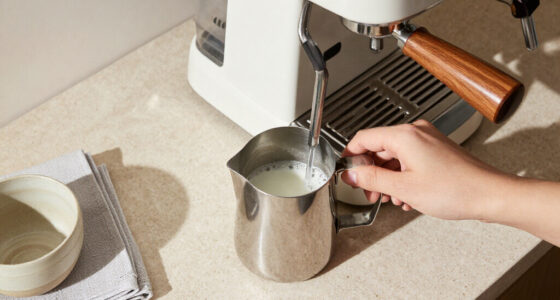
The word flat does not mean foam-free. It points to the drink’s relatively level, fine-textured surface compared with a cappuccino’s more noticeable foam cap. Properly steamed milk looks shiny, pours smoothly, and blends into the espresso instead of sitting on top like a stiff cloud. The texture can feel almost like wet paint—silky, not bubbly.
Imagine ordering one at a busy café before work. The barista pulls espresso into a small cup, steams milk until it has a fine, even texture, and pours it so the coffee and milk meet in a smooth, unified drink. You get a rounded coffee flavor without a thick layer of dry foam. But if another café uses a larger cup or more milk, the same name can produce a gentler, milkier result.
That variation is why it helps to think of a flat white as a style built around espresso and finely textured milk—not a guaranteed set of measurements. If you like the taste, ask the café how large its version is and how many shots it uses. A quick question can tell you more than the menu label.
Products Worth Considering

De'Longhi Magnifica Evo Fully Automatic Espresso Machine with Manual Milk Frother, Silver

Breville Bambino Espresso Machine, Brushed Stainless Steel (BES450BSS)

Le Creuset Enamemed Cast Iron Oval Dutch Oven, 5 qt., White/Crucible
As an affiliate, we earn on qualifying purchases.
Why the flat white became hard to define
Why flat whites confuse everyone outside Australia and New Zealand comes down to one simple fact: the drink travelled widely without a single recipe that cafés had to follow. The name became familiar faster than its boundaries became clear, so each market inherited a coffee label that baristas could interpret in their own way.
Australia and New Zealand both claim a role in developing the drink, and stories often place its emergence in the 1980s. The exact origin remains disputed, with no definitive account accepted by both countries. That unresolved story gives the flat white a strong regional identity, but it does not give the world one agreed recipe.
When the drink spread, it landed in cafés where customers already understood “latte” and “cappuccino.” Cafés needed to explain what the newcomer offered, so they emphasized different features: a smaller cup, a stronger coffee-to-milk impression, or smooth microfoam. Large coffee chains later introduced flat whites to wider audiences in markets such as the United States and the United Kingdom. That raised awareness, but a chain’s recipe could also make customers think the name had one official meaning.
Think of it like a familiar local dish that travels abroad: the name stays put, while the ingredients and serving style shift to suit local tastes. The flat white now appears on menus around the world, but no universally enforced standard dictates exactly how much milk it contains or how large the cup should be. Its international popularity brought more choices—and more room for disagreement.
See how a flat white compares with a latte and cappuccino
A flat white usually sits in the territory between a latte and a cappuccino: it tends to have less milk and less visible foam than a latte or a more foamy surface than a cappuccino. That comparison can point you in the right direction, but it cannot predict every café’s recipe. Cup sizes, espresso shots, and milk texture all affect the final drink.
The easiest way to understand the differences is to compare their usual styles side by side. Treat the table as a guide, not a rulebook; a café may serve drinks that blur these lines.
| Drink | Typical milk texture | Common impression | What may vary |
|---|---|---|---|
| Flat white | Fine, glossy microfoam with a thin layer | Often smaller and more coffee-forward than a latte | Cup size, milk volume, and shot count |
| Latte | Steamed milk with a relatively light foam layer | Often larger and milkier | Size and the strength of the espresso |
| Cappuccino | A more prominent foam layer | Often feels airier and more foam-forward | Foam depth, serving size, and milk-to-coffee balance |
For example, if you like a latte’s creamy texture but want a more noticeable espresso flavor, a smaller flat white may suit you. If you enjoy a light, foamy top, a cappuccino may feel more familiar. Still, one café’s flat white could overlap with another café’s small latte. The texture and proportions matter more than the name alone.
That overlap is not a failure of coffee knowledge. It reflects a menu category without fixed boundaries. Use the comparison to describe what you enjoy, then ask how that café makes its drinks.
Order a flat white that matches the coffee you want
To order a flat white that tastes the way you expect, ask about the café’s size and espresso shots, then describe whether you want a stronger or milkier drink. Those details are more dependable than the name because cafés use different recipes. A short, specific question can save you from ordering a drink that is too mild or too small.
- Ask what size the flat white comes in. A small cup often means a stronger coffee impression, but serving sizes vary. If the menu lists ounces or millilitres, compare those numbers with the café’s latte size.
- Find out how many espresso shots it includes. Caffeine depends mainly on the espresso used, including shot count and beans—not on whether the drink is called a flat white. A smaller drink can taste stronger without containing more caffeine.
- Say what you like about the drink. Try “I’d like a coffee-forward drink with silky milk” or “Could you make it a little milkier?” That gives the barista a useful target.
- Choose your milk and mention any preference. Dairy, oat, soy, and other alternatives can steam differently. If you have an allergy, name it clearly and ask about cross-contact practices.
Picture a café queue moving quickly. Instead of asking, “Is this a real flat white?” you can ask, “What size is yours, and how many shots does it have?” You’ll get practical information without making the barista defend a disputed coffee definition.
If you want the coffee to stand out, ask whether the drink can be made with an extra shot; if you want a softer cup, ask about a larger size or more milk. The café may not be able to change every part of its recipe, but describing your preference makes a useful result more likely. Order the cup you want, not the label you assume.
Understand why two flat whites can taste different
Two flat whites can taste different because the café controls several moving parts: espresso, milk quantity, cup size, and foam texture. Even when two baristas use the same name, a change in any one of those choices can shift the drink from bold and compact to mild and creamy. The label alone cannot tell you which version you will receive.
Espresso sets the drink’s foundation. The coffee blend, roast, dose, and number of shots affect how intense or sweet it tastes. Milk softens espresso’s sharper notes, so a smaller serving may leave the coffee more obvious, while a larger pour can make the cup feel rounder and gentler. That is why a flat white’s strength is not simply a matter of “less milk.”
Milk texture matters too. A barista who steams milk into tiny, even bubbles can create a glossy surface that blends smoothly with espresso. Coarser bubbles make the drink feel airier, even if the cup looks similar from across the counter. Plant-based milks add another layer: oat or soy alternatives can produce a different texture from dairy, and results vary by product and steaming technique.
For instance, you might order a flat white at a neighbourhood café and taste chocolatey espresso under dense, silky milk. The next day, a chain version could seem sweeter or milkier because its size and recipe differ. Neither cup proves that the other is wrong. They are different interpretations of the same flexible style—a bit like two cooks making the same soup with different amounts of broth.
If you find a version you love, remember the café, cup size, and milk choice. Those details will help you recreate the experience far better than relying on the drink name alone.
Get the foam, caffeine, and milk details right
A flat white usually contains a thin layer of fine microfoam, but its caffeine and milk content depend on the café’s recipe. “Flat” describes the comparatively smooth, lightly foamed surface; it does not mean the drink has no foam. And a compact cup does not automatically contain more caffeine than a larger latte.
For caffeine, focus on espresso shots and the coffee itself. If one flat white uses a single shot and another uses two, their caffeine levels can differ even if both cups look nearly identical. Bean choice and preparation also matter. If you are limiting caffeine, ask directly about shot count rather than assuming that a smaller drink will be weaker—or stronger.
Milk volume has no universal amount either. A café might serve its flat white in a smaller cup than its latte, while another café uses similar sizes for both. If you count calories, manage a dietary need, or simply dislike a very milky coffee, ask what size the drink is and what milk it uses. Those practical details give you a more useful answer than arguing over whether it qualifies as a “true” flat white.
Milk choice can affect both taste and texture. Dairy, oat, soy, and other alternatives may foam differently, and café recipes vary. If you have a milk allergy or another food allergy, tell staff clearly and ask how they handle shared steam wands, pitchers, and equipment. A plant-based option is not automatically suitable for someone with an allergy, since cross-contact can happen in a busy café.
Remember: the name describes a common style, not a promise about exact caffeine, cup size, milk volume, or allergens. Ask for the details that matter to you.
That small check is useful whether you’re ordering a first flat white or choosing a daily coffee. You get the taste you want, and you avoid relying on assumptions that the menu cannot guarantee.
Frequently Asked Questions
Is a flat white just a small latte?
Not exactly, though a smaller, more coffee-forward latte is a useful shortcut. A flat white usually has finely textured milk and a thin layer of microfoam, but recipes overlap and café sizes vary. Ask how that café makes its version if the distinction matters to you.
Does a flat white have foam?
Yes. It usually has a thin layer of fine microfoam, not a thick, airy cap. “Flat” refers to the comparatively smooth surface; it does not mean foam-free.
Does a flat white contain more caffeine than a latte?
Not inherently. Caffeine depends mainly on the espresso, including the number of shots and the beans, rather than the drink’s name or size. Ask the café how many shots its flat white contains if caffeine is a concern.
Where was the flat white invented?
Australia and New Zealand both claim a role in its development, and stories often place its emergence in the 1980s. The origin remains disputed, with no definitive account accepted by both countries. It is more accurate to describe it as a drink strongly associated with both places than to declare one settled birthplace.
Can I order a flat white with oat or soy milk?
Many cafés offer oat, soy, or other plant-based milks, though each can steam and taste differently from dairy. Ask what options are available and tell staff about any allergy. If you have an allergy, also ask how the café manages cross-contact with shared equipment.
Conclusion
Remember the flat white as a style, not a fixed formula: espresso, finely textured milk, and usually a thinner foam layer than a cappuccino. Its Australian and New Zealand roots are part of its story, while its worldwide variations explain why the same menu word can bring different cups.
Next time, ask about size and shots, then order for the taste you want. That way, you can leave the coffee-definition debate at the counter—and enjoy the silky cup in your hands.