TL;DR

Get coffee and tea gear delivered free with Prime
- Fast, free delivery on millions of items
- Prime Video, Amazon Music and more included
- Member-only deals all year
A level tamp matters more than tamping force because a tilted puck can give water an easier path through one side, while extra pressure does not reliably correct unevenness. Distribute the grounds evenly, press straight with firm and repeatable pressure, and troubleshoot grind, dose, basket fit, and puck preparation if a shot still runs unevenly.
You can press down hard enough to make your wrist ache and still pull an uneven espresso. If your tamper tilts, one side of the coffee bed may sit lower than the other, giving water an easier route through the puck. A straight, level tamp often matters more than adding pressure once the grounds feel firmly compressed.
This guide explains why tamping level matters more than tamping force, what each part of the tamp actually does, and how to build a repeatable routine at home. You’ll also learn what to check when espresso sprays, gushes, or tastes different from one shot to the next, since tamping is only one piece of puck preparation.
Think of the puck like a packed garden bed. Pressing it down helps settle the soil, but packing one side lower does not make the surface even. You want a coffee bed that starts as evenly as you can make it, followed by a firm, straight press.
A level tamp helps avoid a sloped puck that can encourage uneven water flow.
Tamping force compresses the grounds; it does not reliably correct a crooked tamp or uneven distribution.
Distribute the coffee evenly before tamping, then use a firm, straight, repeatable press.
Check tamper and basket fit, grind, dose, puck preparation, and machine behavior when shots remain uneven.
A calibrated tamper is optional; a standard tamper can work well when you use it consistently.
Espresso technique / Puck preparation
Why Tamping Level Matters More Than Tamping Force
A straight, level tamp helps create an even coffee bed. Pressing harder cannot reliably correct a tilted puck or unevenly distributed grounds.
TL;DR Distribute the grounds evenly, press straight with firm and repeatable pressure, then troubleshoot grind, dose, basket fit, puck preparation, and machine behavior if a shot still runs unevenly.
At a glance / Different jobs
Why a level tamp gives water a fairer route
Espresso water passes through a bed that resists flow. An uneven or sloped puck can encourage water to favor easier paths, so removing a preventable slope makes shots easier to compare.
Evenness
Level tamp
A straight press helps leave the compressed bed more even from side to side. That reduces one source of variation and supports repeatable troubleshooting.
Compression
Tamping force
A firm press compresses and stabilizes the grounds. Once the bed is compressed, extra effort does not reliably fix a crooked tamp, clumps, or gaps.
Flow logic / A useful model
From uneven bed to less predictable shot
Water may favor regions with less resistance. Channeling is one possible result, but tamp angle is only one influence on how water moves through coffee.
Uneven grounds
Clumps, gaps, or a lopsided dose can remain beneath the tamper.
Sloped puck
A tilted press can leave one side lower than the other.
Uneven resistance
Some areas may offer water an easier route through the bed.
Variable flow
Concentrated flow may erode a narrow path through the puck.
Harder to compare
Shot patterns and taste can vary, with several possible causes.
These bars show relative practical emphasis, not measured extraction effects. A crooked tamp will not always produce a visibly bad shot, and tamp angle alone does not explain every sour or bitter cup.
Repeatable routine / Five steps
Distribute first. Tamp without guesswork.
A level press cannot repair clumps, gaps, or an uneven bed underneath it. Build a simple baseline you can repeat while dialing in a coffee.
Settle the dose
Break up obvious clumps and spread grounds across the basket instead of leaving a mound on one side.
Start square
Hold the tamper straight over the basket and check that it sits evenly against the coffee bed.
Press once
Use firm, comfortable pressure you can repeat. Stop when the grounds are compressed and stable.
Check the surface
When visible, look for a puck that appears level. A close-fitting tamper can make this easier to judge.
Pull and compare
If the result is uneven, review your routine and adjust one variable at a time.
No strength test
Do not strain or lean into the counter. A twist or polishing motion is not needed for a good tamp.
Troubleshooting / Look beyond the tamp
Uneven shot? Check the whole setup.
A fast-running side, spray, or pale patch can prompt an inspection, but a visual pattern does not prove the tamp caused it. Similar signs can come from several parts of preparation and equipment.
A standard tamper can work well when it fits the basket and you use it consistently. No tool guarantees better extraction when distribution or basket fit is poor.
- Were the grounds distributed evenly, without obvious clumps or gaps?
- Was the tamper a close fit for the basket and held square?
- Did the grind or dose change between shots?
- Could another part of puck preparation be contributing?
- Is machine behavior affecting the flow?
- Did you change only one variable before comparing the next shot?
The takeaway / Make comparisons useful
Control the parts you can repeat.
Strength and taste depend on several variables, including dose, yield, grind, and extraction. Pressing harder does not directly make espresso stronger.
Why a level tamp gives water a fairer route
Why tamping level matters more than tamping force: a level tamp leaves the compressed coffee bed more even from side to side, while extra pressure mainly adds compression. Espresso water passes through a bed that resists flow; if one region offers less resistance, more water can pass there. That concentration of flow may erode a narrow route through the puck, so the rest of the coffee contributes less evenly. A forceful press cannot reliably straighten a puck that you tamped at an angle.
Imagine filling two sides of a sloped path with rain. Water tends to run downhill, and espresso water under pressure can also favor easier routes through the coffee. The analogy is useful for understanding why unevenness matters, but it is not a precise prediction of flow: coffee is porous, and tamp angle is only one part of how resistance varies across the puck. A crooked tamp will not always produce a visibly bad shot, and tamp angle alone does not explain every sour or bitter cup. Still, removing a preventable slope makes the next shot easier to compare with the last.
Say your morning shot runs quickly on the left and leaves a pale patch on the puck. A level tamp is a sensible thing to check, but the pattern alone doesn’t prove the angle caused it. Clumps, uneven grounds, a grind that is too coarse, or other preparation issues can create similar problems. Treat the visual pattern as a prompt to inspect the routine, not as proof of a single cause.
The practical win is repeatability. When you tamp straight in the same way each time, you reduce one source of variation and can judge whether a grind or dose change helped. Think of level as evenness and force as compression: they work together, but they solve different problems. Pressing harder may make a puck denser overall, yet it does not make resistance uniform if the grounds began unevenly distributed.
As an affiliate, we earn on qualifying purchases.
Why more pressure stops helping after the bed is compressed
Firm and repeatable pressure is enough to compress and stabilize the coffee bed; pushing as hard as possible does not reliably fix a tilted tamp or uneven grounds. There is no single precise tamping pressure presented here as settled science. Instead, focus on a controlled press that feels consistent from shot to shot. Consistency matters because it lets you interpret other changes; a pressure target that is hard to reproduce can add effort without giving you useful information.
What happens when you press harder? You may feel the tamper stop moving much as the grounds compress. At that point, extra effort offers little practical help if the coffee beneath the tamper remains poorly distributed. It can also make the press harder to keep straight, especially if you lean or tense your wrist. A crooked press stays crooked, much like pressing a book harder against a slanted table will not level the table.
For example, if you pull one shot after a light, straight tamp and the next after a hard, angled tamp, you have changed two things at once. If the second tastes different, you won’t know whether pressure, angle, or another part of preparation mattered. A comfortable, repeatable press makes comparisons more useful, even if it does not guarantee identical extraction.
Keep the goal modest: compress the grounds so they hold together, then stop. Don’t strain, lean your whole body into the counter, or expect force to compensate for gaps in the basket. Espresso strength depends on several variables, including dose, yield, grind, and extraction; a harder tamp does not directly make the drink stronger. The tradeoff is simple: spend attention on a straight press and consistent distribution, where small adjustments are easier to assess, rather than on force that cannot repair an uneven bed.
As an affiliate, we earn on qualifying purchases.
How to distribute and tamp without adding guesswork
To tamp consistently, distribute first, then press straight with controlled pressure. A level tamp cannot repair clumps, gaps, or an uneven bed underneath it, so your routine should begin before the tamper touches the coffee. Distribution matters because pressing compresses what is already in the basket; it does not move coffee reliably from a mound into a bare area. These steps give you a simple baseline you can repeat when you dial in a new coffee.
- Settle the dose evenly. Break up obvious clumps and distribute the grounds across the basket so one side is not heaped while the other is bare. This reduces large differences in density that could otherwise remain after tamping.
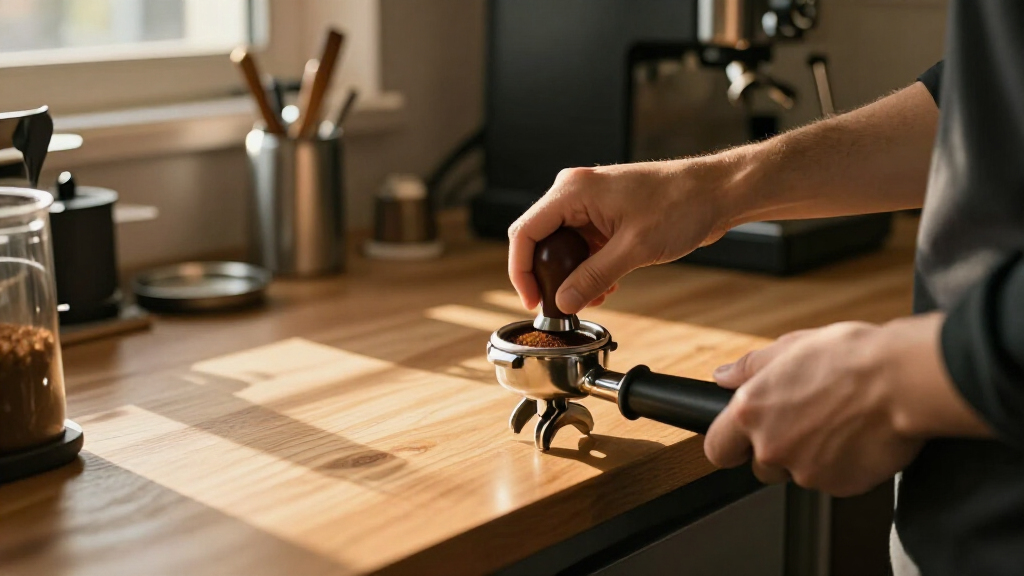
- Position the tamper squarely. Hold it straight over the basket and check that it sits evenly against the coffee bed. A square starting position makes it less likely that your press will leave one side lower.
- Press once with controlled pressure. Use a firm, comfortable motion that you can repeat. Avoid turning a simple press into a test of strength; extra effort cannot compensate for uneven distribution.
- Check the surface. If it is easy to see, look for a puck that appears level across the basket. A well-fitting tamper can make this check easier, although a level-looking surface does not confirm that the grounds are perfectly uniform throughout.
- Pull the shot and change one variable at a time. If the result is uneven, review distribution, grind, dose, basket fit, and machine behavior instead of immediately pressing harder. Isolating changes helps you learn which adjustment is useful.
Picture a rushed weekday morning: coffee grounds cling in a clump to one side of your basket, so you tamp before spreading them. Even a neat, level press leaves that uneven bed in place. Taking a moment to distribute first gives the tamp a fair chance to do its job, though it cannot remove every source of variation in the grinder, basket, or machine.
A twist or polishing motion is not needed to make a good tamp. Prioritize an even bed and a straight press. Consistency beats drama: a calm routine may feel slower by a second, but it gives you clearer feedback from each shot than repeatedly changing pressure and preparation together.
As an affiliate, we earn on qualifying purchases.
What an even tamp can and cannot fix
A level tamp can remove one possible source of uneven flow, but it cannot fix every channeling problem. Channeling is uneven water flow through the puck; distribution, grind, dose, basket fit, puck preparation, and machine behavior can all play a part. These factors matter because they affect how easily water can move through different parts of the bed. Treat tamp angle as one clue to inspect, not a diagnosis on its own.
Consider a shot that spurts from the spouts and tastes both sharp and hollow. You might suspect channeling, but a sloped puck is only one possibility. Clumps left after grinding or an unsuitable grind can also contribute to uneven extraction, and changing the tamp pressure alone may leave the real problem untouched. Even a clean-looking puck after tamping cannot reveal every difference in density inside it.
Use this comparison to decide what to inspect next:
| What you notice | What tamping may explain | What else to check |
|---|---|---|
| One side of the puck looks lower | A tilted or uneven tamp may have left a slope. | Check your grip and whether the tamper sits squarely. |
| Clumps or gaps are visible before tamping | A straight tamp will compress the bed, but not even out distribution by itself. | Spread the grounds more evenly before pressing. |
| Shots still run unevenly after a level tamp | Tamp angle may not be the main cause. | Review grind, dose, basket fit, puck preparation, and machine behavior. |
One morning, you might level the tamp and still get a fast shot. That is not proof that the tamp made no difference; the other sources of resistance may still be unchanged or dominant. Keep your recipe steady while you inspect one factor at a time. This takes more than one shot, but it avoids treating a coincidental improvement as a reliable fix.
As an affiliate, we earn on qualifying purchases.
Why basket fit and distribution deserve a quick check
An even tamp starts with an even bed and a tamper that fits the basket. A level top surface cannot make up for a ring of loose grounds around the edge or a heap concentrated in the middle. If the tamper is too small, it may leave coffee near the basket wall untouched; if it scrapes, it may be awkward to press straight. In either case, you may struggle to prepare the whole bed consistently.
Before tamping, look around the basket rim. A small mound on one side or a visible gap can tell you the grounds need more even distribution. For instance, if you dose into a basket and most of the coffee lands at the back, a careful press may still leave a denser area there than at the front. The quick visual check helps catch a preparation problem before tamping compresses it into place.
Check that the tamper fits closely enough to compress most of the bed without scraping the basket. That practical fit makes it easier to hold the handle upright and inspect whether the puck sits level. A close fit supports consistency, but it does not guarantee even density if the dose was clumped or concentrated to begin with. You do not need a special leveling tool to start; careful placement and a repeatable motion are useful basics.
Tools can support a routine, but they do not guarantee a better shot. A calibrated tamper may help some people repeat their pressure, while a leveling tamper may help with surface preparation. Neither can rescue poor distribution or a poor basket fit. The tradeoff is convenience: a tool may make one step easier to repeat, but it adds cost and another variable to your routine. If you use one, judge it by whether your preparation becomes easier to repeat, not by the label on the box.
How to troubleshoot a shot without blaming the tamp
If a shot tastes off or flows unevenly, check the whole preparation routine before blaming tamping force. Start with the puck you made: was the dose spread evenly, did you press straight, and did the tamper fit the basket? Then consider grind, dose, yield, and whether the machine behaved consistently. This order starts with what you can observe directly, then moves to recipe and equipment factors that can change how water moves through the puck.
For example, your espresso may suddenly gush after you switch to a new bag of beans. Pressing harder can feel like an easy adjustment, but the change in coffee may call for a grind adjustment instead. Keep your tamp firm and level, then test the grind while holding the other parts of your recipe as steady as you can. Otherwise, the next shot may improve or worsen without showing you which change mattered.
A simple troubleshooting order keeps you from changing everything at once:
- Look at the bed before tamping: address clumps, gaps, and uneven distribution.
- Check the tamp: keep the tamper upright, use controlled pressure, and inspect the surface if visible.
- Review the basket and dose: confirm the tamper fits and your dose is appropriate for your setup.
- Adjust the recipe: consider grind and yield if the shot still runs too fast, too slow, or tastes unbalanced.
- Compare one change at a time: note what you changed and what the next shot does.
This approach turns a frustrating sink full of failed shots into a useful experiment. You don’t need to record every detail in a spreadsheet; even a note like “same dose, finer grind, level tamp” can help you see what changed. The point is to make each shot informative, not to guarantee that every adjustment works on the first try.
What a repeatable tamp looks like in a real morning routine
A repeatable tamp is one you can perform the same way without strain. The point is not to hit a perfect pressure number or create a polished puck. It is to distribute your grounds, tamp squarely, and make the next shot comparable to the last one. That comparison is useful because it narrows the likely explanation when taste or flow changes, even though it cannot remove every variable.
Say you are making two coffees before work. For the first basket, the grounds look fluffy and even; you tamp straight with a comfortable press. For the second, you rush, leave a mound at one edge, and lean heavily on the tamper. If the drinks taste different, the extra force on the second shot will not tell you much because the bed and angle changed too. A steady routine gives you a better starting point for deciding whether the beans, grind, or recipe need attention.
Build a small pause into the routine. After dosing, glance around the basket, even out obvious high spots, then set the tamper upright. Press once, lift it cleanly, and inspect the puck if the basket makes that visible. That calm sequence is easier to repeat than trying to fix a rushed preparation with a final hard push. The pause costs little time and can prevent you from using force to compensate for a problem that started earlier.
Over several shots, look for a pattern rather than judging one cup in isolation. If a level, evenly distributed puck still produces a fast or uneven shot, the clue may lie in grind, dose, or the equipment. The goal is not to make tamping responsible for everything; it is to make tamping predictable enough that the other clues become easier to read.
Frequently Asked Questions
How hard should you tamp espresso?
Press firmly enough to compress and stabilize the coffee bed, using pressure you can repeat comfortably. Extreme force is generally unnecessary and will not reliably correct an uneven tamp or poorly distributed grounds.
Does tamping harder make espresso stronger?
No, tamping harder does not directly make espresso stronger. Strength and taste depend on several variables, including dose, yield, grind, and extraction; keep your tamp consistent while you adjust those variables.
Can a level tamp fix channeling?
A level tamp may remove one possible cause of uneven flow, but it cannot fix every channeling problem. Clumps, gaps, grind, dose, basket fit, puck preparation, and machine behavior can also matter.
Do you need a calibrated tamper?
No. A calibrated tamper may help you repeat your pressure, but a standard tamper can work well if you hold it straight and use a consistent press. Even distribution and basket fit still matter.
Should you twist the tamper after pressing?
A twist or polishing motion is not necessary for a good tamp. Focus on an even bed and a straight, controlled press rather than using a twist to compensate for poor distribution.
How can you tell if your tamp is level?
Check whether the tamper sits squarely in the basket and, when visible, whether the puck surface looks even from side to side. A tamper that fits the basket closely can make the surface easier to inspect.
Conclusion
Tamp straight, press firmly, and stop chasing maximum force. A level tamp helps create an even coffee bed, so water is less likely to find an easy path through one side of the puck. If your shot still runs unevenly, look at distribution, grind, dose, basket fit, and the rest of your setup.
Tomorrow morning, take one extra second to level the grounds before the press. That small pause can make your next cup—and the one after it—easier to understand.
Halloween Picks
halloween
As an affiliate, we earn on qualifying purchases.