TL;DR
A single shot uses about 7g of ground coffee yielding roughly 1 oz of espresso; a double uses 18–20g yielding about 2 oz in 25–30 seconds. A double is not two singles — modern doubles are stronger than the old Italian standard because specialty cafés pushed doses from 14g up to 18–22g, and most shops now use the double as their default base. Weighing your dose and yield (a 1:2 ratio) beats measuring volume every time.
Order a double shot in Rome, then order one in Portland, and you’ll drink two very different espressos. Same word. Same menu. Up to 40% more coffee in the glass on one side of the ocean.
The problem is that single and double were born as volume measurements — one ounce or two — back when everyone pulled shots from the same 7-gram basket. Coffee got better, doses got bigger, and the words never caught up. Today a “double” can mean 14g in an old-school Italian bar or 20g in a third-wave café, and neither is wrong.
In this guide, you’ll learn exactly what each shot size means in grams and ounces, why single shots taste worse on most machines, how much caffeine you’re actually drinking, and how to decode any café menu in seconds.
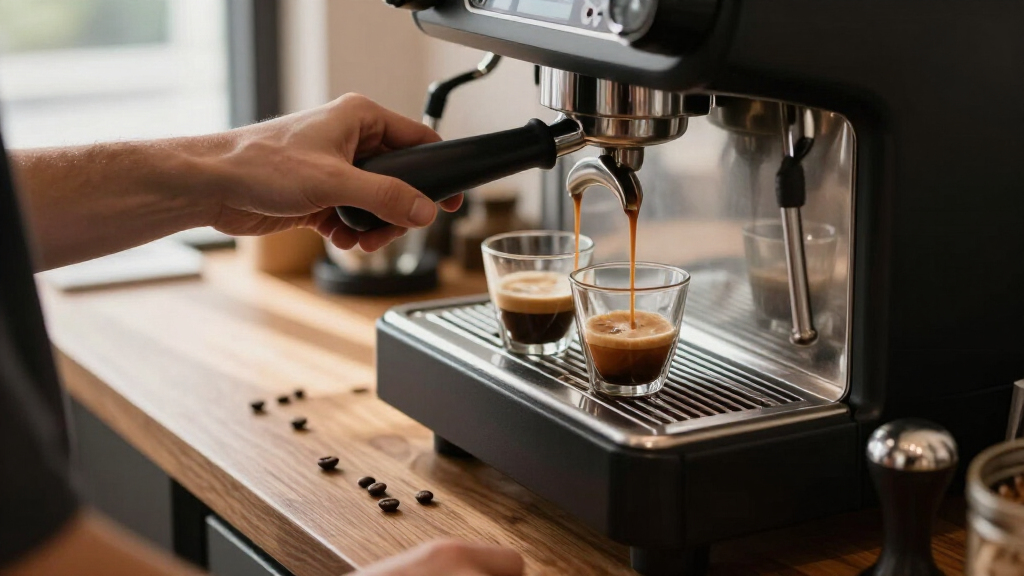
A modern double shot is 18–20g of coffee yielding 36–40g of espresso in 25–30 seconds — not two 7g singles combined.
Most cafés use the double as their default base for all milk drinks; your "single" order is often half of a split double.
Single shots taste worse on most equipment because 7g doses channel unevenly — the basket geometry, not your technique, is usually the problem.
Caffeine in a double ranges 60–150mg depending on dose, bean, and extraction; a 12oz drip coffee often contains more.
Weigh dose and yield (1:2 ratio) instead of measuring volume — crema makes volume measurements unreliable by up to 100%.
Ristretto and lungo change the water, not the coffee amount: same dose, less or more yield.
Single Shot vs Double Shot: The Confusing Standard Explained
Order a double shot in Rome, then order one in Portland, and you’ll drink two very different espressos. Same word. Same menu. Up to 40% more coffee in the glass on one side of the ocean — because “single” and “double” were born as volume measures, and coffee outgrew them.
What a Single and Double Shot Actually Are (In Grams, Not Guesses)
Notice what’s missing: cups. Serious baristas think in terms of dose in, yield out — grams of coffee going into the basket, grams of liquid coming out of the spout. If your recipe reads 18g in, 36g out, you’re pulling a double no matter what cup catches it.
| Shot Type | Dose (Coffee In) | Yield (Espresso Out) | Approx. Time |
|---|---|---|---|
| Single (traditional) | ~7g | 25–30ml (~1 oz) | 20–28 sec |
| Double (traditional Italian) | ~14g | ~60ml (2 oz) | 25–30 sec |
| Double (modern specialty) | 18–20g | 36–40g (~2 oz) | 25–30 sec |
| Split double (two singles) | 18–20g | 18–20g per cup | 25–30 sec |
// Highlighted row = the convention worth committing to memory.
No, a Double Shot Is Not Two Singles
Two singles use ~14g of coffee total; one modern double uses 18–20g. The double is the bigger drink by a wide margin. It isn’t the single’s twin — it’s the single’s older sibling who hit a growth spurt.
The old Italian arithmetic: 7g + 7g. Clean doubling on paper — but almost nobody pulls it this way anymore.
Third-wave cafés scaled up doses for better flavor balance and easier extraction. Up to 40% more coffee than two singles.
Why Your Single Shot Tastes Worse (It’s the Basket, Not You)
Water always finds the easiest path through the coffee puck. With only 7g spread across a full basket, channeling happens far more often — producing a shot that’s simultaneously sour and bitter, thin-bodied and harsh. A double’s deeper puck acts like a thicker filter.
Thin Puck, Wild Flow
Water bores narrow rivers through a shallow 7g puck instead of flowing evenly. Precision baskets and bottomless portafilters made singles infamous — you can literally watch the espresso squirt sideways.
The Workarounds
A well-made 7–9g single basket, a very careful distribution routine, and a slightly finer grind can produce a lovely single — but it demands precision most setups and most mornings can’t deliver.
Hence the Double
Baristas who chase a good single for weeks pull a double with the same coffee and it’s clean on the first try. The equipment isn’t broken — the dose is just too small to behave.
How Much Caffeine Is Really in Your Cup
The range is enormous because caffeine depends on dose, bean variety, roast, and contact time. Robusta beans carry nearly double the caffeine of arabica — which is why old-school Italian blends deliver a genuine jolt.
Your “small” double espresso is not the caffeine bomb its reputation suggests — a 12oz drip coffee often contains more.
Decode Any Café Menu in 10 Seconds
Most milk drinks at a specialty café are built on a double shot as the default base, regardless of cup size. Chains standardize; independent cafés improvise — the only number that transfers between shops is grams of coffee.
☕ Dose
Weigh coffee into the basket — 18–20g for a modern double.
⚖️ Ratio
Target a 1:2 brew ratio: 18g in → 36g out.
⏱️ Time
Pull in 25–30 seconds; adjust grind to hit both targets.
🥛 Build
Use the double as your base for milk drinks — or split it for “singles.”
The Standard Nobody Standardized — Summed Up
A modern double shot is 18–20g of coffee yielding 36–40g in 25–30 seconds — not two 7g singles combined.
Most cafés use the double as their default base for milk drinks; your “single” order is often half of a split double.
Single shots taste worse on most equipment because 7g doses channel unevenly — basket geometry, not your technique.
Caffeine in a double ranges 60–150mg; a 12oz drip coffee often contains more.
Weigh dose and yield at a 1:2 ratio — crema makes volume measurements unreliable by up to 100%.
Ristretto and lungo change the water, not the coffee amount: same dose, less or more yield.
What a Single and Double Shot Actually Are (In Grams, Not Guesses)
A single shot is about 7g of ground coffee yielding roughly 25–30ml (1 oz) of espresso. A double shot is 18–20g of ground coffee yielding 36–40g (about 2 oz) in 25–30 seconds. That’s the modern specialty-coffee convention, and it’s the one you should commit to memory.
Notice what’s missing: cups. The old idea that a double means “two little cups” is fading fast. Serious baristas think in terms of dose in, yield out — grams of coffee going into the basket, grams of liquid coming out of the spout. If your recipe reads 18g in, 36g out, you’re pulling a double no matter what cup catches it.
Here’s the historical wrinkle that confuses everyone. The classic Italian standard was 7g for a single and 14g for a double — a clean doubling. Third-wave coffee pushed double doses up to 17–22g for better flavor balance and easier extraction. So a double today is often stronger than a double from 30 years ago, even though the name never changed.
| Shot Type | Dose (Coffee In) | Yield (Espresso Out) | Approx. Time |
|---|---|---|---|
| Single (traditional) | ~7g | 25–30ml (~1 oz) | 20–28 sec |
| Double (traditional Italian) | ~14g | ~60ml (2 oz) | 25–30 sec |
| Double (modern specialty) | 18–20g | 36–40g (~2 oz) | 25–30 sec |
| Split double (two singles) | 18–20g | 18–20g per cup | 25–30 sec |
No, a Double Shot Is Not Two Singles (Here’s the Math)
A double shot is not two singles poured into one cup — at least not in a modern café. Two singles use ~14g of coffee total; one modern double uses 18–20g. The double is actually the bigger drink by a wide margin, which surprises almost everyone the first time they hear it.
Think of it this way: the double isn’t the single’s twin — it’s the single’s older sibling who hit a growth spurt. When baristas increased doses to improve extraction, they scaled up the double basket, because that’s where most of their drinks start. The single basket stayed stuck at 7g, a relic of a different era.
And here’s the kicker: most cafés don’t even pull true singles anymore. When you order a single shot, you’ll often get a split shot — a full double (18–20g) brewed into one basket and divided between two cups, or halved into one. You get roughly half of a double, which is still more coffee than a traditional single. One drink, two workflows, three possible amounts of coffee. That’s the standard nobody standardized.
The double shot became the industry default not because anyone decreed it, but because bigger doses extract more evenly and taste better. The single became the exception baristas tolerate rather than the building block they use.
Why Your Single Shot Tastes Worse (It’s the Basket, Not You)
Single shots taste worse than doubles on most equipment because small doses extract unevenly. Water always finds the easiest path through the coffee puck, and with only 7g spread across a full basket, channeling — water boring narrow rivers through the grounds — happens far more often. The result is a shot that’s simultaneously sour and bitter, thin-bodied and harsh.
A double’s deeper puck acts like a thicker filter. Water has to work harder, the flow distributes more evenly, and the extraction balances out. This is why precision baskets and bottomless portafilters — those naked-handled portafilters that expose the bottom of the basket — have made singles infamous: you can literally watch the espresso squirt sideways instead of flowing straight down.
I’ve watched home baristas chase a good single shot for weeks, adjusting grind, redistributing grounds, swearing at the machine. Then they pull a double with the same coffee and it’s clean on the first try. The equipment isn’t broken. The dose is just too small to behave.
There are workarounds. A well-made 7–9g single basket, a very careful distribution routine, and a slightly finer grind can produce a lovely single. But it demands precision that most setups and most mornings can’t deliver. Hence the double default.
How Much Caffeine Is Really in Your Cup
A double shot contains roughly 60–150mg of caffeine, with most landing around 80–120mg. A single runs about half that — 30–75mg. That range is enormous because caffeine depends on the dose, the bean variety, the roast, and how long the water contacts the coffee.
Counterintuitively, a shot made with light-roast, finely-ground coffee at a heavy dose can out-caffeine a dark-roast lungo pulled long. And robusta beans carry nearly double the caffeine of arabica, which is why old-school Italian blends — often 10–20% robusta — deliver a genuine jolt that a delicate single-origin ethiopian can’t match.
For context: a 12oz drip coffee typically contains 120–180mg of caffeine. Your “small” double espresso is not the caffeine bomb its reputation suggests. The reputation comes from how fast you drink it — a 2oz shot hits your bloodstream quicker than a mug you sip for twenty minutes.
Most milk drinks at a typical specialty café are built on a double shot as the default base, regardless of cup size. Here’s the general pattern you’ll find across most modern coffee shops:
- Small latte / flat white (8–12oz): usually one double shot.
- Medium (16oz): double, or double plus a single — shops differ.
- Large (20oz+): often two doubles, sometimes more milk instead of more coffee.
- Cappuccino: traditionally one double in a 5–6oz cup.
- Traditional macchiato: a double shot “stained” with a spoonful of milk — not the 16oz caramel dessert drink.
The honest answer to “how many shots are in my latte?” is ask. Chains standardize; independent cafés improvise. A barista who tells you “our medium is a triple split from two doubles” is speaking a dialect you now understand.
If you’re comparing cafés, the only number that transfers is grams of coffee — not shot counts, not cup sizes, not the words on the menu.
Ristretto, Lungo, and the Family of Shot Variations
Ristretto and lungo are variations on the same dose, not different amounts of coffee. A ristretto is “restricted”: the same 18–20g dose stopped early, yielding maybe 18–25g of thick, syrupy, intense espresso. A lungo runs long: the same dose pushed with more water to 50–60g, producing a larger, more dilute, more bitter cup.
So the shot family works like this: the dose is the person, and the yield is how much you let them speak. Ristretto cuts them off mid-sentence. Lungo lets them ramble. The double is the natural conversational middle.
One newer variation worth knowing: the turbo shot, a higher-ratio, coarser-grind, faster pull that some cafés now use for filter-like clarity in a small cup. Espresso is a living craft, and the definitions keep moving — which is exactly why weight-based recipes have become the anchor. Ratios don’t lie, and they don’t drift with fashion.
Pull a Great Shot at Home: Weigh Everything, Trust Nothing Volume-Based
Stop measuring espresso in ounces and start weighing it. Volume lies — crema foam can double the apparent size of a shot while the actual liquid weight stays the same. A scale accurate to 0.1g costs less than two bags of good coffee and transforms your consistency overnight.
- Dose 18g of finely ground coffee into a double basket, level and tamp evenly.
- Start the shot and a timer together; aim for first drips around 5–8 seconds.
- Stop the shot at 36g yield — that’s your 1:2 ratio for a balanced double.
- Check the clock: 25–30 seconds is your target window. Too fast? Grind finer. Too slow? Grind coarser.
- For a single: use a proper 7–9g single basket, grind slightly finer, and target ~14–18g out in the same time. Accept that it will take practice.
One safety note for your beans: store them airtight at room temperature, away from light and heat — not in the fridge, where condensation degrades the grounds. Fresh beans (roasted within the last 2–4 weeks) are the single biggest upgrade to any shot, bigger than any technique on this list.
Frequently Asked Questions
Is a double shot just two singles?
No. Two traditional singles use about 14g of coffee total, while a modern double uses 18–20g. What you’ll usually get when ordering a single is half of a split double — a full double brewed into one basket and divided — which still contains more coffee than a true 7g single.
Does “double shot” mean double the water or double the coffee?
Both, technically — a double uses roughly double the coffee dose and produces roughly double the liquid volume of a single. The cleaner way to think about it: a double keeps the same 1:2 coffee-to-liquid ratio as a good single, just scaled up. The defining feature is the 18–20g dose, not the water alone.
How much caffeine is in a single vs double shot?
A single contains roughly 30–75mg of caffeine; a double contains 60–150mg, with most landing around 80–120mg. The exact amount depends on the dose, the bean (robusta has nearly double the caffeine of arabica), and extraction time. For comparison, a 12oz drip coffee typically has 120–180mg.
Why do single shots often taste sour or thin?
Small doses extract unevenly. With only 7g of coffee spread across the basket, water channels through narrow paths instead of flowing evenly, producing a shot that’s simultaneously sour and bitter. Precision single baskets, careful distribution, and a slightly finer grind help, but most equipment pulls doubles far more reliably.
How do I pull a proper single shot at home?
Use a genuine 7–9g single basket (not a double basket underfilled), grind slightly finer than your double setting, dose 7–8g, and target roughly 14–18g of yield in 25–30 seconds. Weigh everything — at this small dose, a half-gram error noticeably changes the flavor, and volume measurements are unreliable because crema varies.
Conclusion
Forget the words on the menu. The only definition of a shot that travels — between countries, cafés, and decades — is grams in, grams out, seconds on the clock. Learn the 1:2 ratio, weigh your shots, and you can reproduce (or deliberately break) any espresso anyone hands you.
Next time a menu asks single or double, you’ll know the question is really asking: how much coffee do you want, and how much do you trust the barista’s 7-gram basket? Order accordingly.