TL;DR

Get coffee and tea gear delivered free with Prime
- Fast, free delivery on millions of items
- Prime Video, Amazon Music and more included
- Member-only deals all year
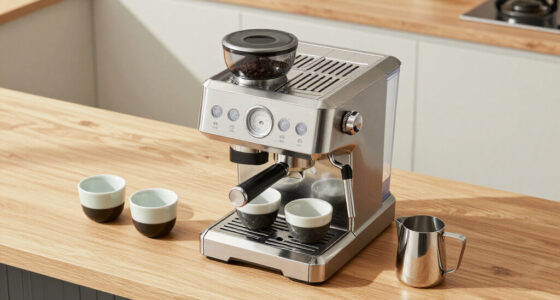
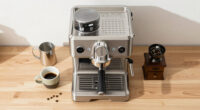
Built-in grinder espresso machines combine a coffee grinder and espresso machine in one appliance, saving counter space and simplifying daily use. They can make excellent sense for a compact kitchen or a newer home barista, but the grinder is harder to upgrade or service separately, so check its adjustment range, cleaning instructions, warranty, and repair support before you buy.
A single machine can turn a cluttered coffee corner into one neat setup—but it also ties your grinder’s future to your espresso machine’s. That trade-off is the heart of choosing a built-in grinder espresso machine.
This guide helps you weigh space and convenience against grind control, cleaning, repairs, and upgrades. You’ll come away knowing which details to check before you commit, whether you’re pulling your first shot or refining a morning routine.
A built-in grinder can save counter space and simplify your espresso workflow, but the machine itself may still be large.
Judge grinder performance by adjustment range, dosing, and cleaning access; the built-in label is not a quality rating.
With integrated equipment, a grinder fault may require specialist service and can affect the whole setup.
Touchscreens and guided steps can make routine use clearer, but they do not guarantee a better shot.
Check the warranty, local repair support, cleaning instructions, and bypass-chute availability before you buy.
Built-In Grinder Espresso Machines: Smart Shortcut or Long-Term Limitation?
One appliance that grinds and brews saves counter space and simplifies your morning routine—but it also ties your grinder’s future to your espresso machine’s. This guide weighs space and convenience against grind control, cleaning, repairs, and upgrades.
A built-in grinder espresso machine combines grinding and brewing in one appliance, usually with a bean hopper attached. Fewer separate steps make it easier to repeat the same routine each morning—especially while you’re still learning. But convenience comes with a footprint trade-off: the combined unit may be tall and heavy, and hopper lids often need more overhead clearance than the listed height suggests.
Clearer Counter
Replacing a separate grinder and machine clears a patch of counter, keeping the grinder and brewer close so grounds go directly where you need them.
Gentler Learning Curve
Guided grinding, dosing, and brewing prompts reduce setup friction while you learn how grind size and dose affect a shot—no juggling two appliances’ settings.
Repeatable Routine
Displays and assisted dosing make daily steps easier to repeat. Treat these as model-specific tools, not proof of better espresso.
How to Tell Whether the Grinder Can Keep Up
Espresso needs a suitably fine, consistent grind, and small changes alter how quickly water passes through the coffee. The “built-in” label alone tells you nothing about grinder quality. Pressure ratings can’t rescue a poorly suited grind, dose, or puck—evaluate the grinder and brewer as one working system.
Built-In vs. Separate Grinder and Machine
An integrated machine saves you from buying and placing two appliances; separate equipment gives you more freedom to change or service the grinder independently. The difference matters most as your needs change.
| What matters to you | Built-in grinder | Separate grinder + machine |
|---|---|---|
| Counter setup | Fewer separate appliances | More pieces to place |
| Future upgrades | Grinder may be tied to the machine | Replace or upgrade the grinder separately |
| Service & repair | Grinder access may require specialist repair | Grinder and machine assessed independently |
| Routine use | Controls and workflow consolidated | More choice in how each step works |
| If the grinder fails | Whole setup affected; brewing on depends on bypass chute | Keep brewing while repairing the grinder |
The Five-Point Pre-Purchase Check
Compare the grinder, the cleaning routine, and the repair path before deciding an all-in-one machine suits you.
Grinder specs
Read the manual: adjustment type, step fineness, and dosing method.
Cleaning access
Burr area, grinder chute, brew group, milk system — what can you realistically do at home?
Repair path
Check local service options and how grinder access is handled.
Warranty terms
Confirm coverage for both grinding and brewing components.
Bypass chute
Can it accept pre-ground coffee if the grinder fails?
The central tension: one compact purchase now can mean fewer independent choices later. If you expect to experiment with beans or equipment, that constraint grows more noticeable over time. If your routine is stable and counter space is scarce, the trade-off may be worthwhile.
Five Things to Remember
Judge each machine on its own merits—the layout label is not a quality rating.
A built-in grinder can save counter space and simplify your workflow, but the machine itself may still be large.
Judge grinder performance by adjustment range, dosing, and cleaning access; the built-in label is not a quality rating.
With integrated equipment, a grinder fault may require specialist service and can affect the whole setup.
Touchscreens and guided steps can make routine use clearer, but they do not guarantee a better shot.
Check the warranty, local repair support, cleaning instructions, and bypass-chute availability before you buy.
Integration reduces clutter—but it does not reduce cleaning or maintenance. Budget for servicing the whole appliance.
What You Gain When the Grinder and Machine Share One Body
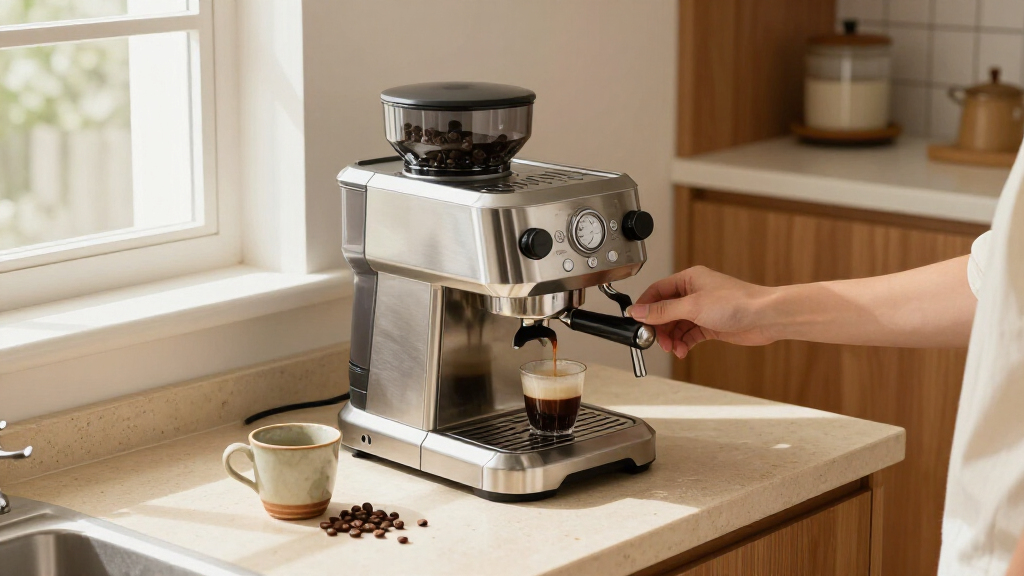
A built-in grinder espresso machine combines grinding and espresso brewing in one appliance, usually with a bean hopper attached to the machine. That can free counter space and reduce the number of separate controls. The practical benefit is not just a neater counter: fewer separate steps can make it easier to repeat the same routine each morning, especially when you are still learning the equipment. [1]
For instance, in a small apartment kitchen, you might otherwise fit a grinder, machine, tamper, and knock box around a toaster and kettle. Combining two appliances clears a patch of counter and may keep the grinder and brewer close together, so grounds go directly where you need them. Some machines also guide you through grinding, dosing, or brewing, which can reduce the number of settings you have to coordinate.
That convenience comes with a footprint tradeoff. The combined appliance may be tall, heavy, or awkward to move, and a hopper lid can need more overhead clearance than the machine’s listed height suggests. Measure the space it occupies in use, including room to open the lid and reach controls. You may gain counter area by removing a second appliance while losing flexibility in where the larger machine can sit.
Why a Built-In Grinder Can Make Espresso Easier to Learn
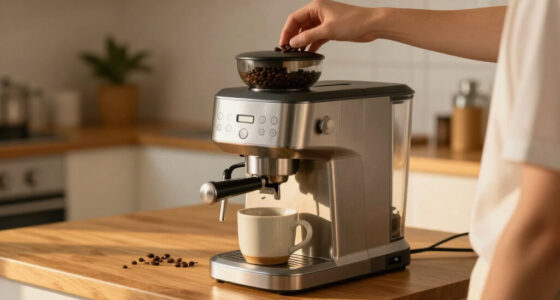
A built-in grinder can simplify your first espresso routine by keeping the grinder and brewer close together and, on some models, guiding you through a few basic steps. That reduces setup friction when you’re learning how grind size and dose affect a shot. [1]
Imagine making coffee before work: you add fresh beans, follow the machine’s prompts, and pull a shot without juggling a separate grinder’s settings and a second appliance’s instructions. A display or assisted dosing feature can make those steps easier to repeat. That does not mean the machine automatically knows which grind suits your beans.
New beans, age, and storage can change how coffee flows. You may need to adjust the grind or dose when a shot runs too fast or drips slowly. A guided workflow helps you start; it does not remove the value of learning what a good adjustment looks like.
Recent models increasingly offer electronic controls, touchscreens, connected features, and assisted tamping. Treat these as model-specific tools, not proof of better espresso: look for features that make everyday adjustments clearer and more repeatable.
How to Tell Whether the Grinder Can Keep Up
A built-in grinder is a good fit only if it offers the adjustments and repeatability you need for your coffee. Espresso needs a suitably fine, consistent grind, and small changes can affect how quickly water passes through the coffee. The built-in label alone tells you nothing about grinder quality. [1]
Before buying, open the manufacturer’s specifications and manual. Check how the grinder adjusts, whether the steps are fine enough for espresso, how dosing works, and what the maker says about cleaning. If you switch between beans, consider how easy it is to return to a previous setting.
For instance, one bag of beans may produce a balanced shot at one setting, while a different roast pours too quickly at the same setting. A grinder with useful adjustment gives you room to respond. The machine’s pressure rating cannot make up for a grind, dose, or puck that is poorly suited to the coffee.
Evaluate the grinder and brewer as one working system. Temperature stability, dose, puck preparation, and extraction all play a role in the cup. Freshly ground coffee helps when you can adjust it appropriately and the machine can brew consistently.
Compare the Convenience With the Long-Term Trade-Offs
An integrated machine saves you from buying and placing two separate appliances, while separate equipment gives you more freedom to change or service the grinder independently. The difference matters most as your needs change: a beginner may value one coordinated workflow now, while someone who later wants a different grind range may prefer to replace only the grinder. [1]
| What matters to you | Built-in grinder | Separate grinder and machine |
|---|---|---|
| Counter setup | Fewer separate appliances | More pieces to place |
| Future upgrades | Grinder may be tied to the machine | Replace or upgrade the grinder separately |
| Service | Grinder access may require specialist repair | Grinder and machine can be assessed independently |
| Routine use | Controls and workflow may be consolidated | More choice in how each step works |
Say your grinder stops working. With separate equipment, you may be able to keep using the espresso machine while arranging a grinder repair or replacement. With an integrated design, a grinder fault can affect the whole setup, and access may be more involved. A machine might still brew if the grinder fails, but that depends on whether it accepts pre-ground coffee and how the failure is handled. Check the design and local service options rather than assuming either outcome.
That is the central tension: one compact purchase now can mean fewer independent choices later. If you expect to experiment with beans or equipment, that constraint may become more noticeable over time. If your routine is stable and counter space is scarce, the tradeoff may be worthwhile. Consider not only the purchase price but also the cost and inconvenience of servicing the combined appliance.
Check Cleaning and Repairs Before You Fall for the Touchscreen
Built-in grinder espresso machines still need regular cleaning, and integration does not necessarily reduce maintenance. Coffee oils and fine grounds can collect in the grinder and chute, where residue can affect dosing or contribute stale flavors. The brew group and, on milk models, the milk system need separate care; neglecting one area can undermine the benefit of keeping the rest of the machine clean. [1]
Before purchase, find the cleaning instructions for the burr area, grinder chute, brew group, and milk system. Look for steps you can realistically follow at home and note which tasks require a technician. Access matters because cleaning that is difficult to reach is more likely to be postponed. If the manual does not make grinder cleaning clear, ask the manufacturer or seller how it is serviced and whether routine cleaning affects warranty coverage.
Picture your Sunday reset: you brush loose grounds from the accessible parts, rinse removable components as directed, and wipe down the steam wand after use. That routine is manageable when the parts are easy to reach and the instructions are clear. If cleaning requires tools or a service visit, the added effort and cost can outweigh some of the convenience you gained by combining appliances.
Check the warranty length and coverage, how to request service, and whether a local repair provider works on the machine. Ask whether the grinder can be replaced or repaired as a component, and how long common parts are available. Warranty and service details shape the machine’s long-term value: a low purchase price may be less appealing if a grinder fault sends the whole appliance away for repair.
Use This Five-Point Check Before You Buy
Compare the grinder, the cleaning routine, and the repair path before you decide that an all-in-one machine suits you. A quick checklist can expose gaps that a polished touchscreen demo will not answer. [1]
- Check grind adjustment. Find out how many settings the grinder offers and whether the manufacturer describes its range as suitable for espresso.
- Check dosing and workflow. See how you set or repeat a dose, and whether prompts make daily use simpler.
- Check cleaning access. Read how to clean the grinder area, chute, brew group, and milk system if the machine has one.
- Check support. Confirm the warranty, repair route, parts availability, and whether the grinder can be serviced separately.
- Check the footprint and flexibility. Measure the machine and look for a bypass chute if you want to use pre-ground coffee, such as for decaf.
For example, if you drink regular espresso in the morning and decaf after dinner, a bypass chute may matter more than app connectivity. If you rarely change beans and prize a tidy counter, the space savings may matter more. Let your routine decide which features earn their place.
Match the Machine to the Way You Make Coffee
Built-in grinder espresso machines tend to suit people who value a compact, straightforward routine; separate equipment tends to suit people who want to change components independently. Neither setup guarantees better coffee, and the right fit depends on your kitchen, interest, and budget. [1]
If you’re new to espresso, a consolidated setup and guided steps may help you build a routine without comparing several separate appliances. You still need to learn the basics: a shot that gushes may need a finer grind, while one that crawls may call for a coarser setting. Make one small change at a time so you can tell what affected the cup.
If you like to try different grinders, burr sets, or brewing approaches, a separate grinder gives you room to change one part while keeping the other. That flexibility may matter more to you over time than a cleaner counter today. If you mostly want a dependable morning cappuccino, the integrated workflow may feel like a smart shortcut.
When you compare current models, verify their grinder design, adjustment range, cleaning instructions, service options, and warranty with up-to-date manufacturer information. Specifications and features differ between machines, even when they share the same built-in-grinder label. A guide to espresso machines with grinders can help you frame the options, but confirm current details before you buy.
Remember the One Question That Makes the Choice Clear
The most useful question is not whether an integrated grinder is automatically better or worse; it is whether its convenience is worth tying the grinder to the rest of your machine. That answer depends on your space, your appetite for experimentation, and how you would handle a repair. [1]
- Choose integrated when fewer appliances, a simpler routine, and compact storage matter most.
- Favor separate equipment when independent upgrades, grinder choice, and service flexibility matter more.
- Either way, compare grind adjustment, dosing, cleaning, warranty, and repair support for the exact model.
A sleek display can be pleasant, but the quiet daily details matter more: can you adjust the grind for new beans, clean the parts that collect coffee, and get help if the grinder fails? Answer those questions, and your morning setup is more likely to suit you well beyond the first week.
Frequently Asked Questions
Are built-in grinder espresso machines worth buying?
They can be worth buying if you value a compact setup and a simpler workflow. Compare the grinder’s adjustment and dosing, the machine’s cleaning needs, and its repair support before weighing the price.
Is a built-in grinder as good as a separate grinder?
It depends on the specific grinder and machine. Compare grind adjustment, dose consistency, and cleaning access rather than assuming the built-in version is better or worse.
Can you upgrade the grinder later?
Usually, an integrated grinder is not upgraded independently as easily as a separate unit. Check with the manufacturer whether the grinder can be replaced or serviced as a component before you buy.
What happens if the built-in grinder breaks?
The machine may need specialist service, and the grinder may not be user-replaceable. Check the warranty, local repair support, and parts availability so you know what service would involve.
Can a built-in grinder espresso machine use pre-ground coffee?
Some models have a bypass chute for pre-ground coffee; others do not. Confirm the feature if you want to brew decaf or keep a small amount of ground coffee on hand.
Conclusion
Choose a built-in grinder espresso machine when its compact routine fits your kitchen and its grinder, cleaning, and repair details stand up to scrutiny. If you want to upgrade or service the grinder on its own, separate equipment gives you more room to change your mind.
Pick the setup that still makes sense after the beans are ground, the counter is wiped, and the first repair question comes up.
Halloween Picks
halloween
As an affiliate, we earn on qualifying purchases.