
TL;DR
Coffee roasting continues briefly after the beans leave the roaster because they retain heat. Coffee cooling trays use airflow and agitation to remove that heat more evenly, helping limit carryover and improve batch-to-batch consistency. There is no universal cooling time: batch size, bed depth, equipment, and airflow all affect how quickly beans reach near room temperature.
A roast can be over before the beans are cool enough to touch, but the beans themselves are still hot and changing. That short stretch after discharge is where a slow, crowded pile can drift farther from the profile you worked to create.

Get coffee and tea gear delivered free with Prime
- Fast, free delivery on millions of items
- Prime Video, Amazon Music and more included
- Member-only deals all year
Coffee cooling trays move air through a batch and usually agitate the beans, helping them shed stored heat more quickly and evenly. You’ll learn why cooling speed matters, what tray features do, and how to cool a small home batch without treating one exact time as a universal rule.
Cooling is a finishing step, not a flavor fix. Think of it as closing the oven door on a recipe: it can help you stop at the point you chose, but it cannot undo what happened earlier.
Roasted beans retain heat after discharge, so post-roast development can continue briefly.
A shallow layer, even airflow, and agitation help reduce uneven cooling.
Use the same batch size, cooling routine, and thermometer placement when comparing roast logs.
A tray can improve consistency, but it cannot repair roast defects or guarantee specific flavors.
Cool beans near room temperature before storing them in a clean, dry, food-safe container.
Coffee Cooling Trays Why Cooling Speed Changes Roast Development
Roasted beans keep exchanging heat after leaving the roaster. Even airflow and agitation help limit carryover and make batches easier to compare.
How a tray cools beans
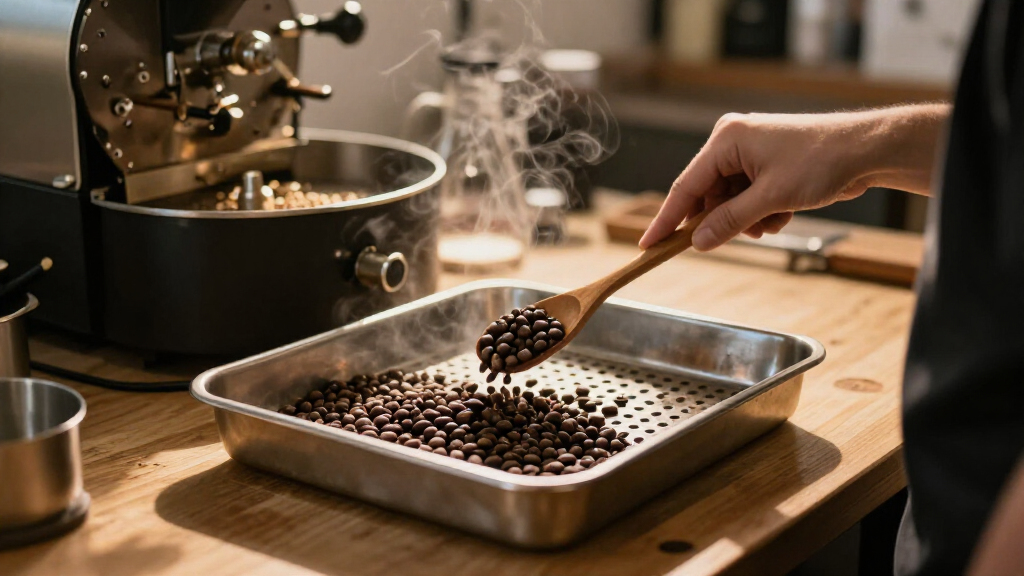
A shallow, moving layer exposes more beans to air and helps reduce hot spots.
Keep beans in a shallow layer so the center does not hold heat beneath a deep pile.
A screened base and fan bring air into contact with more of the batch.
Turn the beans and use the same thermometer placement when comparing batches.
Choose a setup that fits
Match cooling equipment and routine to your batch size and workspace.
| Setup | Works well when | Keep in mind |
|---|---|---|
| Colander or screen | Cooling a small home batch | Spread beans out and stir |
| Purpose-built tray | Cooling repeat batches | Use even airflow and avoid overfilling |
| Commercial system | Handling larger batches | Match capacity to batch mass and bed depth |
What cooling can change
- Limit extra development from stored heat
- Reduce uneven cooling with airflow and agitation
- Make batch comparisons more repeatable
- Repair scorching, tipping, or underdevelopment
- Guarantee a particular flavor or freshness
- Make one cooling time right for every roaster
Why Beans Keep Developing After They Leave the Roaster
Coffee cooling trays matter because roasting does not stop the instant beans leave the drum. The beans hold heat, and that heat keeps moving through the batch during the first moments of cooling. Removing it promptly limits carryover and helps the coffee land closer to the roast profile you intended.
The surface of a bean and its center do not cool at the same rate. Beans piled together also hold warmth where they touch, especially in the middle of a deep heap. A tray spreads the beans across a perforated or screened base so air can reach more of the batch; an agitator turns them so one side does not sit against a hot neighbor for the whole cooling period.
Imagine you roast a small batch and dump it into a deep metal bowl. The top layer may feel cooler while the beans underneath remain warm. If you instead spread the same batch thinly and stir it, the warmer beans take turns meeting the air. That simple difference can make cooling more even, even though it does not guarantee any particular flavor.
In that sense, cooling is a handoff between the roaster and the room. The roast creates the profile; moving air helps keep stored heat from carrying it farther. Green-coffee condition, roast profile, batch size, airflow, and roaster design still shape the result, so no tray can compensate for a roast defect.
Products Worth Considering

Instant Pot Pro 6-Quart 10-in-1 Electric Pressure Cooker

Breville Barista Express Espresso Machine with Built-In Grinder, Black Truffle

Le Creuset Signature Enameled Cast Iron Round Dutch Oven, 9 qt, Marseille
As an affiliate, we earn on qualifying purchases.
How Cooling Speed Affects Consistency From Batch to Batch
Coffee cooling trays support repeatability by helping batches lose heat in a similar way after discharge. Faster, evenly distributed cooling generally reduces the extra development caused by stored heat. If you use a different cooling method each time, that handoff can become another variable in your roast log.
Picture two Saturday batches of the same coffee. You spread the first batch across a wide screen and stir it; the next sits in a bowl while you measure the following charge. Even if both batches leave the roaster at the same moment in the profile, the bowl’s center may stay hot longer. A tasting difference could come from several parts of roasting, but inconsistent cooling makes the comparison harder to interpret.
Why cooling speed matters is not that one fast time creates a magic cup. Rather, a repeatable cooling routine reduces variation you do not want. Keep the discharge point, batch size, cooling surface, stirring pattern, and temperature-check method as similar as you can. When you adjust airflow or batch depth, note the change alongside your roast data.
There is a tradeoff: the fastest possible airflow is not automatically the best setup if it scatters chaff, makes the work unsafe, or cools only the center of the tray well. Aim for strong, even airflow and consistent agitation. A shallow layer in a small colander may suit a home sample; a commercial batch needs equipment designed for its mass and bed depth.
What a Cooling Tray Does—and What It Cannot Fix
A coffee cooling tray removes heat from roasted beans by exposing them to moving air, often while an agitator turns the batch. The screened or perforated base lets air pass through more beans than a solid bowl does. Its job is to bring the coffee toward room temperature quickly and evenly, not to roast it further on purpose.
A tray also helps separate some loose chaff as air moves through the beans. That material needs regular cleanup, especially if you roast indoors or in a compact workspace. Think of the tray as a sieve with a breeze underneath: it moves heat and loose debris, while the beans keep tumbling into fresh contact with the air.
It cannot reverse scorching, tipping, underdevelopment, or another problem created earlier in the roast. Nor does cooling alone create a named flavor or guarantee freshness. Storage, packaging, degassing, and time all influence how coffee changes after roasting; the cooling stage is only one part of that chain.
For example, if a roast tastes sharp because you stopped development too early, cooling faster will not finish it in the way a controlled roast profile would. But if you are trying to reproduce a successful roast and one batch sits warm in a deep pile, a tray can make the cooling step easier to repeat. That is a useful gain, just a more modest one than “better coffee every time.”
How to Cool a Home Roast More Evenly
To cool a home roast evenly, spread the beans in a shallow layer, move air through them, and stir until the batch is near room temperature. A dedicated tray can do this with a fan and agitator, but a small batch can also cool on a heat-safe screen or in a colander if you keep it moving.
- Prepare the cooling area before you discharge the beans. Choose a stable, heat-safe surface with enough space to spread the batch.
- Keep the bed shallow. Avoid stacking beans into a deep mound, where the center can hold heat longer than the exposed top.
- Move the beans and air. Use a tray’s agitator, or stir by hand at regular intervals. A household fan may help with a small spread-out batch, but keep beans and loose chaff away from hot surfaces and moving parts.
- Check the batch consistently. If you use a thermometer, measure in a similar place and mix the beans before checking. Probe placement and stirring change readings.
- Let the beans approach room temperature before storage. Judge the mixed batch, not only the surface beans.
For instance, a roaster working with a small sample can use a wide metal colander over a safe, clear area and stir while the beans release their warm, toasted aroma. The same technique becomes awkward with a much larger charge: the layer gets deeper, stirring takes longer, and the batch may cool unevenly. Match your method to the amount you roast rather than copying a cooling time from someone else’s equipment.
Choose Airflow, Agitation, and Batch Depth That Fit Your Roast
The most useful cooling setup is one that moves air evenly through your typical batch without overfilling the tray. A strong fan cannot compensate if beans block the screen or pile too deep, and agitation cannot help much if the airflow reaches only one side. Size, airflow distribution, and bed depth work together.
Consider a shallow home batch spread across a perforated tray: air can pass through much of the bed, and a stir exposes fresh surfaces. Put the same amount in a narrow, crowded vessel and the airflow may skim the top while the center stays warmer. This is why a tray that works well for one batch size may feel slow with a larger one.
When comparing setups, focus on how they handle the coffee you actually roast. If you roast indoors, also think about ventilation and where chaff collects. A screen that is easy to clean may be more useful day to day than a more powerful fan that leaves debris scattered around your work area.
| Factor | What helps | What can get in the way |
|---|---|---|
| Airflow | Air reaches the batch evenly | Air passes over only one area |
| Agitation | Beans keep turning and exposing new surfaces | Beans sit in a still, compact pile |
| Batch depth | A shallow layer suited to the tray | Overfilling blocks air and traps heat |
| Chaff handling | Collection is accessible and easy to empty | Debris builds up in the workspace |
These factors matter more than a single advertised cooling time. If you want to compare formats and capacities before buying, use a guide to coffee cooling trays for home roasting as a starting point, then check that a tray’s size suits your batch and space.
Measure Cooling Without Chasing One Magic Number
There is no one cooling time or temperature target that applies to every coffee batch and tray. Batch mass, bean size, airflow, agitation, room conditions, and probe placement all affect readings. Use measurement to compare your own process consistently, then aim to reach near room temperature as soon as your equipment can manage safely and evenly.
A thermometer is most helpful as a repeatability tool. For example, you might check a mixed batch in the same part of the tray each time and write down when it approaches room temperature. If you check one batch in the center and another at the edge, the numbers can tell a misleading story because those spots may cool differently.
Keep a simple roast note with the discharge time, batch size, cooling setup, and when the beans reach your chosen endpoint. If a later cup tastes different, these details help you compare cooling alongside the roast profile instead of blaming the tray by default. Changes roast development describes a possible effect of lingering heat, not a guarantee that each difference in taste came from cooling.
Do not make your setup unsafe just to chase a quicker reading. Keep hot beans, electrical fans, loose chaff, and work surfaces under control. A repeatable, even routine is more useful than one impressive number produced by a measurement you cannot reproduce.
Keep Cooling, Storage, and Freshness in Their Proper Places
Cooling brings hot beans toward room temperature; it does not replace proper storage or the resting time coffee may need before brewing. The beans begin releasing carbon dioxide after roasting, and they continue to degas during storage. A cooling tray cannot remove that need or guarantee a longer shelf life.
Once the beans have cooled, store them in a clean, dry, food-safe container and protect them from moisture, excess heat, and strong odors. Avoid sealing very warm beans into a container, where trapped warmth and condensation can undermine careful handling. Cool first, then store; keep the container closed between uses.
Say you roast a batch in the morning and plan to brew it that evening. A tray helps the beans cool before storage, but the resulting cup still depends on the coffee, roast, and how long it has rested. The smell may be fragrant and the beans may look beautiful, yet freshness is shaped by the whole journey after discharge.
That distinction keeps expectations realistic: roasting does not end every change in the bean at the moment it leaves the roaster, and cooling does not settle every question about flavor or freshness. It simply manages the heat that remains. Once the beans are near room temperature, clean storage and a sensible rest take over.
Frequently Asked Questions
How quickly should roasted coffee cool?
Cool it as quickly and evenly as your setup can manage safely, bringing the beans toward room temperature. There is no universal time because batch size, tray design, airflow, and room conditions vary.
Can I cool roasted beans in a bowl?
You can cool a small batch in a bowl, but a deep, still pile can hold heat in the center. Spread the beans thinly and stir them, or use a perforated surface that lets air reach more of the batch.
Does faster cooling make coffee taste better?
Even, prompt cooling can help limit carryover development and make batches more consistent. Taste still depends on the coffee and the full roast process, so faster cooling alone does not guarantee a better cup.
Do I need a dedicated cooling tray at home?
Not always. A shallow heat-safe surface and frequent stirring may work for small batches, while a dedicated tray becomes more useful as batch size or roasting frequency grows.
Should I stir beans while they cool?
Yes, if your setup does not agitate them automatically. Stirring exposes different beans and surfaces to moving air and helps reduce hot spots in the pile.
Can a cooling tray fix an underdeveloped or scorched roast?
No. A tray manages heat after discharge; it cannot reverse defects created during roasting. Adjust the roast profile to address the cause, then use consistent cooling to help reproduce your results.
How do I know when beans are cool enough to store?
They should be near room temperature before you store them. Mix the batch before checking, since beans at the surface may feel cooler than those underneath.
Conclusion
Treat cooling as the last controlled handoff in your roast. Spread the beans, move air evenly through them, and keep the batch turning until it approaches room temperature; then store it cleanly and track the routine you used.
The best cooling method is one you can repeat safely with your batch size. Let the beans leave the roaster with their heat behind them, not trapped in a warm little mountain.