Choosing an espresso machine for a small cafe means balancing drinks per hour, staff skill, counter space, and how much of the menu one machine needs to cover. The Breville Barista Express is my strongest fit for a compact espresso-focused setup because it combines grinding and brewing in one machine. The Ninja Luxe Café Premier suits a cafe that also needs drip coffee and cold brew, while the De’Longhi Linea Classic offers a simpler preset-led workflow with an adjustable steam wand. Those strengths come with real tradeoffs: these are compact consumer-oriented machines, and none of the supplied product details establish commercial-duty capacity or sustained high-volume performance. I rank them by how well their described features support a small cafe’s actual service needs, while calling out where a busy counter may need a different class of equipment.

Get coffee and tea gear delivered free with Prime
- Fast, free delivery on millions of items
- Prime Video, Amazon Music and more included
- Member-only deals all year
Complete the kit


Key Takeaways
- The Breville Barista Express is my best espresso-led pick here: its integrated grinder saves counter space, but staff still need to grind, dose, extract, and texture milk manually.
- The Ninja Luxe Café Premier is the most versatile menu machine, combining espresso, drip coffee, and cold brew with guided dosing and hands-free frothing; its learning curve and unspecified dimensions complicate cafe planning.
- The De’Longhi Linea Classic emphasizes repeatable single- and double-shot presets, a pressure gauge, and two steam settings, though the product details do not specify tank size, power, or warranty.
- The Breville Bambino heats quickly and takes little space, but requires a separate grinder and hands-on preparation, so its compact footprint can shift work elsewhere on the counter.
- The Neretva is a compact ground-coffee option with a removable 1.3-liter tank, but it lacks an integrated grinder and its 17-pound weight makes repositioning less convenient. None of the supplied descriptions confirms commercial certification or volume capacity.
| Breville Barista Express Espresso Machine, Brushed Stainless Steel (BES870XL) |  | Best Overall for an Espresso-Focused Small Cafe | Model: BES870XL | Material: Brushed stainless steel | Grinder: Integrated precision conical burr grinder | VIEW LATEST PRICE | See Our Full Breakdown |
| Ninja Luxe Café Premier 3-in-1 Espresso, Drip Coffee, and Cold Brew Machine |  | Best for a Cafe With a Mixed Coffee Menu | Drink types: Espresso, drip coffee, and cold brew | Espresso styles: Double shot and quad shot | Grinder: Built-in conical burr grinder with 25 settings | VIEW LATEST PRICE | See Our Full Breakdown |
| Breville Bambino Espresso Machine, Brushed Stainless Steel | 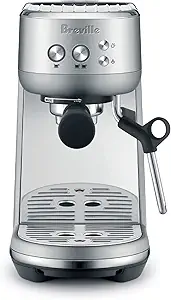 | Best Compact Machine for a Tight Counter | Heating system: ThermoJet | Heat-up time: 3 seconds | Temperature control: Digital PID | VIEW LATEST PRICE | See Our Full Breakdown |
| De’Longhi Linea Classic Espresso Machine with Adjustable Milk Frother |  | Best for a Preset-Led Espresso Workflow | Pump pressure: 15 bar | Heating technology: Thermoblock | Milk frother: Adjustable steam wand with 2 settings | VIEW LATEST PRICE | See Our Full Breakdown |
| Neretva 20-Bar Compact Espresso Machine |  | Best Ground-Coffee Entry Pick | Machine type: Semi-automatic espresso machine | Pressure: 20 bar | Power and voltage: 1350 W; 120 V | VIEW LATEST PRICE | See Our Full Breakdown |
| espresso machines for small cafe | Power and voltage |
|---|---|
| Breville Barista Express Espre | 1600 W; 120 V |
| Ninja Luxe Café Premier 3-in-1 | — |
| Breville Bambino Espresso Mach | 1560 W; 110–120 V |
| De’Longhi Linea Classic Espres | — |
| Neretva 20-Bar Compact Espress | 1350 W; 120 V |
More Details on Our Top Picks
Breville Barista Express Espresso Machine, Brushed Stainless Steel (BES870XL)
The Barista Express earns the top spot because its integrated conical burr grinder keeps grinding and espresso preparation on one station. In a small cafe, that can free counter space and reduce the need to move grounds between appliances. Its PID temperature control and low-pressure pre-infusion give an operator useful extraction controls, while the manual steam wand preserves the ability to texture milk for cafe-style drinks. Compared with the Bambino, it is the more self-contained espresso setup; the Bambino is smaller, but needs a separate grinder.
This is still a hands-on machine. Staff must manage the grind, dose, tamp, shot, and milk themselves, so the built-in grinder does not make service automatic. The 67-ounce tank and half-pound hopper are concrete capacity details for planning refills, but the supplied specs do not establish rush-hour throughput. By contrast, the Ninja adds guided dosing and hands-free frothing, and covers other brew styles; the Barista Express keeps its focus on espresso. Its one-year limited warranty is also a consideration for a business relying on daily use. I would choose it for a low-volume cafe with an espresso-led menu and trained staff, not as a proven high-throughput commercial machine.
Pros:- Integrated conical burr grinder doses coffee directly into the portafilter.
- PID temperature control and low-pressure pre-infusion support control over extraction.
- Manual steam wand can texture milk for lattes and cappuccinos.
- 67-ounce water tank and half-pound bean hopper provide specified refill capacities.
Cons:- Milk texturing and espresso preparation require operator technique.
- One-year limited warranty offers a short stated coverage period for a business machine.
- Supplied details do not establish commercial certification or sustained service capacity.
Best for: A small, espresso-centered counter with staff who can handle manual grinding, extraction, and milk texturing.
Not ideal for: A high-volume cafe that needs documented commercial duty capacity, minimal training, or automated milk preparation.
- Model:BES870XL
- Material:Brushed stainless steel
- Grinder:Integrated precision conical burr grinder
- Water tank:67 oz
- Bean hopper:1/2 lb
- Power and voltage:1600 W; 120 V
- Shot settings:Single or double
- Warranty:1-year limited
Our verdict“I would make the Barista Express my first choice for a small, espresso-led cafe that values an integrated grinder and can staff a hands-on workflow.”
Ninja Luxe Café Premier 3-in-1 Espresso, Drip Coffee, and Cold Brew Machine
The Luxe Café Premier stands apart from the espresso-only machines by combining espresso, drip coffee, and cold brew. That makes it the most adaptable pick for a small operation where customers want different brew styles but space for separate machines is limited. Its 25-setting conical burr grinder, weight-based dosing, assisted tamping, and guided settings can take some repetitive decisions off the barista’s hands. Compared with the Barista Express, it trades a narrower espresso focus for more menu coverage and assistance; compared with the Bambino, it includes a grinder and a much wider range of drink types.
The expanded menu brings setup and training demands. The supplied description itself flags that the many drinks and settings can take time to learn, and a team may need to standardize recipes so each shift prepares the same drinks. Hands-free frothing with four presets may help when several milk drinks are on the menu, though the unit also offers manual control. Its 70-ounce removable reservoir is the largest stated capacity in this lineup, but product dimensions and weight are missing, which makes counter fit and service access harder to assess. I would select it for a compact cafe that genuinely sells drip and cold brew alongside espresso. If espresso consistency and a simple station matter more than menu breadth, the Barista Express is a more focused match.
Pros:- Makes espresso, drip coffee, and cold brew on one machine.
- 25-setting conical burr grinder with weight-based dosing and assisted tamping.
- Hands-free frothing offers four preset programs plus manual control.
- 70-ounce removable water reservoir and built-in accessory storage.
Cons:- The range of drink options and settings may require staff training and recipe standardization.
- Dimensions and weight are not supplied, making counter planning difficult.
- Description does not establish commercial certification or sustained duty capacity.
Best for: A small cafe serving espresso alongside drip coffee and cold brew, with staff willing to learn a guided multi-drink workflow.
Not ideal for: An espresso-only bar that needs known machine dimensions, a minimal interface, or documented commercial-volume performance.
- Drink types:Espresso, drip coffee, and cold brew
- Espresso styles:Double shot and quad shot
- Grinder:Built-in conical burr grinder with 25 settings
- Dosing and tamping:Weight-based dosing and assisted tamping
- Water reservoir:70 oz, removable
- Frothing:Dual froth system with 4 preset programs and manual frothing
- Included accessories:Portafilter, milk jug, baskets, assisted tamper, cleaning tools, and descaling supplies
- Dimensions and weight:Not provided
Our verdict“I would choose the Luxe Café Premier when menu breadth matters more than keeping the espresso station simple.”
Breville Bambino Espresso Machine, Brushed Stainless Steel
The Bambino is the space-conscious pick. Its ThermoJet system reaches extraction temperature in three seconds, so staff do not have to wait through a long warm-up between service periods. PID temperature control and low-pressure pre-infusion give it core espresso controls, and a steam wand keeps milk drinks possible. Compared with the Barista Express, it gives up the integrated grinder and hopper, making the machine itself more compact but requiring another appliance and another workflow step. It is also less menu-flexible than the Ninja, which can brew drip coffee and cold brew.
The Bambino makes most sense when a small cafe has a quality grinder already, or when it needs a secondary espresso station with a small footprint. The 54 mm portafilter and 19 g dose are useful details for matching baskets and setting recipes, while included single- and dual-wall baskets give some flexibility in preparation. Still, manual espresso work and milk texturing remain the operator’s responsibility. The 1-year limited warranty matches the Barista Express’s stated coverage, and the supplied description does not include reservoir capacity or dimensions. I would not treat a fast heat-up as evidence of high-volume readiness; this is a compact, quick-start choice whose value depends on the grinder and workflow around it.
Pros:- ThermoJet heating system reaches extraction temperature in 3 seconds.
- PID temperature control and low-pressure pre-infusion are specified.
- Compact design helps where counter area is constrained.
- Includes 54 mm portafilter, milk jug, baskets, tamper, and cleaning tools.
Cons:- Requires a separate grinder and adds a separate dosing step.
- Espresso preparation and milk texturing remain manual.
- One-year limited warranty; reservoir capacity and dimensions are not supplied.
Best for: A cafe with a separate grinder that needs a compact espresso machine or a secondary station for lower-volume service.
Not ideal for: A shop that needs an all-in-one grinder-and-machine station, less manual work, or confirmed sustained throughput.
- Heating system:ThermoJet
- Heat-up time:3 seconds
- Temperature control:Digital PID
- Pre-infusion:Low-pressure
- Portafilter:54 mm; 19 g dose
- Power and voltage:1560 W; 110–120 V
- Settings:1 cup, 2 cups, hot water, steam
- Warranty:1-year limited
Our verdict“I would pick the Bambino for a tight secondary station when a capable grinder is already part of the cafe setup.”
De’Longhi Linea Classic Espresso Machine with Adjustable Milk Frother
The Linea Classic is the clearest choice here for a team that wants customizable single- and double-shot presets rather than a grinder integrated into the machine. Its pressure gauge gives the operator a visible brewing cue, while Thermoblock heating is described as providing fast, stable temperature control. The adjustable steam wand has two settings for steamed milk or microfoam, offering more defined options than the fully manual descriptions for the Bambino and Barista Express. Compared with those Breville machines, this De’Longhi places more emphasis on repeatable presets and milk settings; compared with the Ninja, it avoids the extra drip and cold brew modes.
The tradeoff is that key planning information is missing. No grinder, tank capacity, power, dimensions, weight, or warranty is listed in the supplied product details, so I cannot judge how often the team will refill it or how readily it will fit a particular counter. A pressure gauge and presets can support a consistent routine, but they do not replace a good grinder or prove that extraction will remain consistent through a rush. I would consider it for a small cafe looking for a straightforward espresso and milk station with adjustable drink settings, after confirming the missing specifications with the seller. The Barista Express is the stronger self-contained package if integrated grinding is the priority.
Pros:- Customizable single- and double-shot presets support a repeatable routine.
- Two steam-wand settings accommodate steamed milk or microfoam.
- Pressure gauge provides a visible brewing indicator.
- Adjustable-height drip tray can fit different glass sizes.
Cons:- Supplied product details do not specify a grinder or coffee input method.
- Water capacity, dimensions, power, weight, and warranty are not provided.
- Presets and a pressure gauge do not establish commercial throughput.
Best for: A small espresso bar that values customizable shot presets, a visible pressure gauge, and two steam-wand settings.
Not ideal for: A buyer who needs a confirmed integrated grinder, documented tank capacity, or complete dimensional and warranty details before planning a station.
- Pump pressure:15 bar
- Heating technology:Thermoblock
- Milk frother:Adjustable steam wand with 2 settings
- Preset recipes:Customizable single or double espresso
- Pressure gauge:Chrome-detailed, real-time display
- Drip tray:Adjustable double-height
- Design:Compact stainless steel
- Tank, power, and warranty:Not provided
Our verdict“I would shortlist the Linea Classic for preset-led espresso service, but confirm its missing operating specifications before fitting it into a cafe.”
Neretva 20-Bar Compact Espresso Machine
The Neretva is a compact, semi-automatic option for a cafe that already buys or prepares ground coffee and wants a simple espresso machine with a steam wand. Its 1.3-liter removable tank, 11 × 12 × 9.1-inch dimensions, and 17-pound weight give more concrete placement information than several other entries. Pre-infusion and temperature monitoring are included in the description, and the reusable filter setup accepts ground coffee. Compared with the Barista Express, it lacks an integrated grinder; compared with the Bambino, its dimensions are specified, but it is heavier and its 1350-watt boiler is not described as having a rapid heat-up system.
The stated 20-bar pressure may sound like a standout, but pump pressure alone does not tell a cafe how the espresso will taste or how reliably the machine will perform through repeated orders. The most relevant day-to-day tradeoff is the need to supply correctly ground coffee, which can mean purchasing pre-ground coffee, using a separate grinder, or managing grounds from another station. Its manual milk frothing also requires staff practice. I rank it fifth because it offers fewer workflow advantages for a cafe than the integrated-grinder, guided, or preset-led alternatives. It may still fit a low-volume counter with limited space and a ground-coffee routine, but I would not select it for a busy espresso bar on these details alone.
Pros:- Compact stainless steel body with dimensions listed as 11 × 12 × 9.1 inches.
- Removable 1.3-liter water tank and cup warmer.
- Pre-infusion and temperature monitoring are specified.
- Steam wand supports manual milk frothing.
Cons:- Uses ground coffee rather than whole beans and has no integrated grinder.
- 17-pound weight may make it less convenient to move.
- The 20-bar rating does not provide evidence of extraction consistency or cafe throughput.
Best for: A low-volume counter that uses ground coffee, wants specified compact dimensions, and can handle manual espresso and milk preparation.
Not ideal for: A cafe seeking an integrated grinder, frequent repositioning, or evidence of performance under sustained commercial demand.
- Machine type:Semi-automatic espresso machine
- Pressure:20 bar
- Power and voltage:1350 W; 120 V
- Water tank:1.3 liters, removable
- Temperature:198°F
- Dimensions:11 × 12 × 9.1 inches
- Weight:17 lb
- Coffee input:Ground coffee
Our verdict“I would consider the Neretva only for a low-volume setup already organized around ground coffee and manual preparation.”
How We Picked
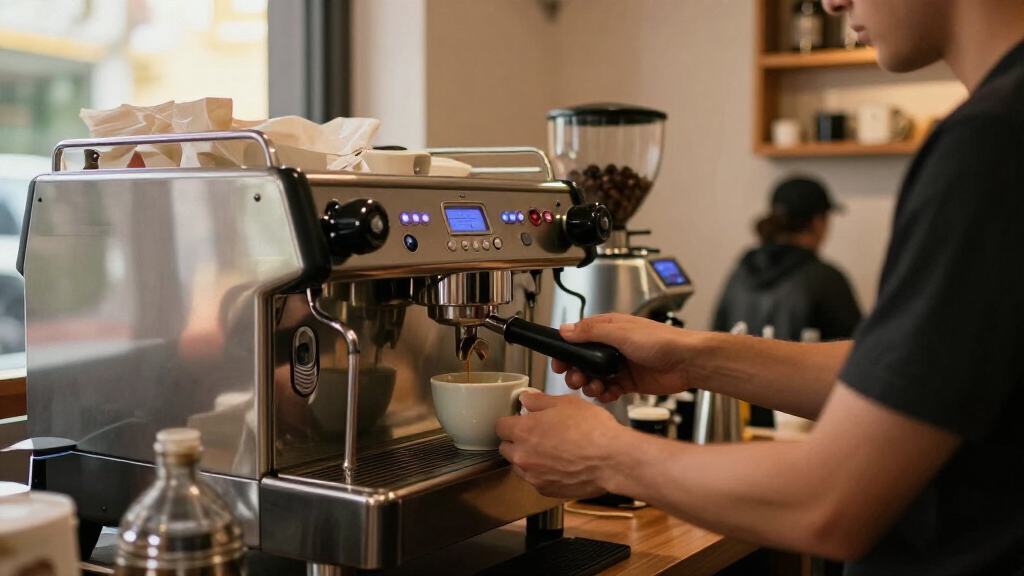
I ranked these machines around the needs implied by small cafe service: making espresso and milk drinks within a limited footprint, supporting a repeatable workflow, and fitting the menu without creating avoidable prep steps. I gave weight to features that can change the work at the counter: an integrated grinder, dose or shot guidance, heat-up and temperature controls, steam-wand design, reservoir capacity, and whether the unit can serve drinks beyond espresso.
The ranking also reflects the limits of the information supplied. A feature such as a 20-bar pump rating does not by itself tell me how consistently a machine extracts during a rush, and compact dimensions do not establish how durable it will be under daily commercial use. The product descriptions do not provide comparable throughput, duty-cycle, serviceability, or commercial certification data. I therefore treat these as candidates for a small, lower-volume operation or a supplementary station, rather than assuming they can support sustained cafe volume. I also consider workflow complexity: manual control can help a skilled operator, while presets and guided steps may be easier to hand off across a small team.
My order favors a well-rounded espresso workflow first, then distinct use cases: menu versatility, compactness, preset-led operation, and a ground-coffee entry point. That makes the Barista Express my overall pick from this lineup, not a blanket recommendation for every cafe. A shop expecting continuous orders should compare commercial machines with documented service support and capacity before buying.
Factors to Consider When Choosing Best Espresso Machines For Small Cafes
I would choose a small-cafe espresso machine by mapping the equipment to the menu and service pattern first. These five products vary more in workflow than in their stainless-steel styling: one includes a grinder, one covers three brew categories, some depend on manual preparation, and one emphasizes shot presets. The following questions help me separate a machine that fits a compact counter from one that can actually support the work planned for it.
Start with the expected drink mix
If most orders are espresso, americanos, cappuccinos, and lattes, a focused station is easier to organize than a machine with modes the team rarely uses. The Barista Express is the most self-contained espresso option in this group because its grinder sits in the same unit. For a mixed menu with drip and cold brew, the Ninja Luxe Café Premier may save room by combining brew types, though its larger feature set also asks for more staff familiarity. A compact machine is not automatically the best use of space if it requires extra appliances to complete the menu.
Count the workflow steps, not just the machine
Grinding, dosing, tamping, pulling a shot, and texturing milk all take time and attention. The Barista Express combines grinding and espresso preparation, but still leaves most tasks manual. The Bambino occupies less space as a machine but needs a separate grinder. The Ninja includes guided grinding, weight-based dosing, assisted tamping, and preset frothing, which may reduce some steps while adding interface choices that the team needs to learn. The Linea Classic’s customizable shot presets offer a different kind of assistance. I would write down who performs each step during a typical order before comparing models.
Plan milk service realistically
Milk drinks can shape the pace of a small cafe. The Barista Express and Bambino provide manual steam wands, so results depend on operator skill and practice. The Linea Classic provides two steam settings, and the Ninja offers preset frothing programs as well as manual control. Those differences matter if several staff members rotate through a shift or if the menu includes both dairy and alternatives. The supplied descriptions do not quantify simultaneous drink capacity or steaming recovery, so I would ask for operating guidance and observe whether the workflow suits the expected order pattern.
Check counter fit and refill cadence
Do not rely on “compact” alone. The Neretva lists its dimensions and weight, while the Ninja does not provide either; that makes it harder to plan clearance, storage, and cleaning access for the Ninja. Tank sizes are specified for the Barista Express, Neretva, and Ninja, which helps estimate refill frequency, though actual use depends on menu and volume. The Bambino and Linea Classic details supplied here omit tank capacity. I would check the footprint alongside space for cups, grinder access, milk, knock box, and cleaning before settling on a machine.
Ask for commercial-use evidence
These product details describe compact machines but do not establish commercial certification, expected drinks per hour, duty cycle, parts availability, or repair response. For a cafe, those facts can matter more than headline pump pressure or a short heat-up time. Before committing to daily service, I would confirm warranty terms for business use, maintenance requirements, access to replacement parts, and the manufacturer’s guidance on sustained operation. If the machine will be responsible for the main bar during a busy period, compare it with commercial equipment that publishes capacity and support information.
Match training needs to your team
A skilled barista may prefer manual control and a grinder integrated into the station; a new or rotating team may value presets or guided steps. Those conveniences are not interchangeable: the Ninja’s guided multi-drink menu needs familiarization, while the Linea Classic simplifies shot selection but the supplied details do not show a grinder. The Bambino is simple in footprint but leaves preparation fully manual. I would choose the workflow the staff can repeat, then document grind, dose, shot, and milk routines so service does not depend on one person’s memory.
Frequently Asked Questions
Can these machines serve as the main espresso machine in a small cafe?
Possibly for a low-volume operation, but the supplied descriptions do not establish commercial certification, drinks-per-hour capacity, duty cycle, or service support. The Barista Express has the most self-contained espresso workflow here, while the Ninja covers more drink types and guided steps. Before using any of them as the main bar machine, I would confirm the manufacturer’s business-use terms and whether the machine can handle the cafe’s expected order pattern.
Which machine has a built-in grinder?
The Breville Barista Express and Ninja Luxe Café Premier both include conical burr grinders. The Barista Express integrates grinding into a focused espresso workflow, while the Ninja combines its 25-setting grinder with guided dosing and other brew methods. The Bambino’s supplied description does not include a grinder, and the Neretva is specified for ground coffee; the Linea Classic details do not state whether a grinder is included.
Which pick is best when counter space is limited?
The Bambino is explicitly described as compact and is designed around espresso preparation, but it requires a separate grinder. The Neretva has listed dimensions of 11 × 12 × 9.1 inches, giving a buyer a concrete footprint, though it weighs 17 pounds. The Ninja could consolidate espresso, drip, and cold brew equipment, but its dimensions are not supplied. I would measure the whole station, including grinder and cleaning access, before deciding which option saves the most usable space.
Do higher bar ratings mean better espresso for cafe service?
A pump pressure figure alone does not predict taste, consistency, or service capacity. The Neretva lists 20 bar and the De’Longhi Linea Classic lists a 15-bar pump, but the supplied information does not provide comparable extraction testing or sustained-use data. I would weigh temperature control, pre-infusion, grinder quality, repeatable recipes, and staff workflow alongside the pump specification, then seek commercial-use information for the service volume planned.
Which machine is easiest for a team with mixed experience?
The Ninja’s guided brewing, weight-based dosing, assisted tamping, and preset frothing can give less experienced staff more prompts, although the range of settings takes time to learn. The Linea Classic’s customizable shot presets and two steam settings may suit a narrower espresso routine. By comparison, the Barista Express and Bambino depend more on manual technique. I would choose based on the team’s training time and standardize recipes regardless of the model.
Conclusion
For an espresso-focused, lower-volume cafe with staff comfortable with manual preparation, I would start with the Breville Barista Express because its integrated grinder makes the station more self-contained. If the menu spans espresso, drip, and cold brew, I would look at the Ninja Luxe Café Premier, after measuring its footprint and allowing time for staff training. A cafe with an existing grinder and very limited counter space may prefer the Bambino; a team that values shot presets and defined steam settings should investigate the De’Longhi Linea Classic, while confirming its missing specifications. The Neretva makes sense for a ground-coffee workflow with modest demands. For any of these as the main machine in a busy cafe, I would first confirm commercial-use support and capacity directly with the manufacturer.
Fall Picks
fall essentials
As an affiliate, we earn on qualifying purchases.