Choosing among grind-by-time espresso grinders means weighing convenience against dose consistency. My leading pick for broad brewing flexibility is the Fellow Opus 2, with stepless adjustment and two catch cups; the SHARDOR CG018B is the more direct portafilter option, thanks to its cradle and fine timer increments; and the AMZCHEF offers touchscreen timed grinding across a broad range of brew styles. Each answers a different need, and none makes timed grinding a substitute for checking your dose.

Get coffee and tea gear delivered free with Prime
- Fast, free delivery on millions of items
- Prime Video, Amazon Music and more included
- Member-only deals all year
The rankings prioritize how well each grinder supports a repeatable espresso routine: adjustment precision, timer control where specified, grounds handling, and practical fit. The main tradeoff is between finer control and simpler preset operation. I also include the battery-powered TIMEMORE WhirlY for portability, while noting that its small bean capacity changes how easily it fits a daily home setup.
Complete the kit


Key Takeaways
- The Fellow Opus 2 ranks first for espresso buyers who want stepless adjustment and the flexibility to switch among several brewing methods.
- The SHARDOR combines a portafilter cradle with 0.1-second timer increments, making it the most directly geared toward timed espresso dosing at the grinder.
- The AMZCHEF has a touchscreen timer adjustable in 0.5-second steps and 48 settings, but its cup-selection control is capped at 12 cups.
- The TIMEMORE WhirlY is the only battery-powered option here; its recommended 30-gram espresso capacity favors small batches over repeated household dosing.
- Timed grinding is convenient, but bean density and grind setting affect output, so I would verify the delivered dose rather than treating seconds as a fixed weight.
| Fellow Opus 2 Electric Conical Burr Coffee Grinder, Black |  | Best overall for flexible espresso grinding | Burr type: 48 mm conical burrs | Grind adjustment: Stepless | Recommended use: Espresso, pour-over, drip, French press, and cold brew | VIEW LATEST PRICE | See Our Full Breakdown |
| SHARDOR Conical Burr Electric Coffee Grinder with Touchscreen and 51 Grind Settings |  | Best for direct portafilter timed grinding | Burr type: 40 mm stainless steel conical burr | Grind settings: 51 | Timer: Up to 60 seconds in 0.1-second increments | VIEW LATEST PRICE | See Our Full Breakdown |
| AMZCHEF Burr Coffee Grinder with 48 Settings, Metallic Silver |  | Best value-style pick for multi-brew timed grinding | Grind settings: 48 | Burr type: 40 mm stainless steel conical burrs | Hopper capacity: 10.6 ounces | VIEW LATEST PRICE | See Our Full Breakdown |
| TIMEMORE WhirlY Portable Electric Burr Coffee Grinder – Black |  | Best cordless option for small espresso batches | Model: WhirlY 01S | Battery capacity: 1000 mAh | Charge time: 3 hours | VIEW LATEST PRICE | See Our Full Breakdown |
| grind by time espresso grinder | Burr type | Included components | Dimensions | Grind settings |
|---|---|---|---|---|
| Fellow Opus 2 Electric Conical | 48 mm conical burrs | Coffee grinder and two magnetic catch cups | 7.95 × 5.12 × 10.49 inches | — |
| SHARDOR Conical Burr Electric | 40 mm stainless steel conical burr | Cleaning brush, residual grounds cleaner, dosing ring, and portafilter cradle | 7.4 × 4.9 × 13.5 inches | 51 |
| AMZCHEF Burr Coffee Grinder wi | 40 mm stainless steel conical burrs | — | 7.4 × 5.1 × 13.4 inches | 48 |
| TIMEMORE WhirlY Portable Elect | Stainless steel octagonal S2C-420-EI | Grinder, cleaning brush, Type-C cable, and user manual | — | 30 |
More Details on Our Top Picks
Fellow Opus 2 Electric Conical Burr Coffee Grinder, Black
The Fellow Opus 2 is my best overall pick for someone whose espresso grinder also needs to cover other brew methods. Its stepless adjustment gives the user room to make small grind changes instead of choosing among a fixed set of numbered steps. That can be useful when dialing in espresso, where a small adjustment may change how quickly a shot flows. The grinder also covers pour-over, drip, French press, and cold brew, giving it broader range than the more countertop- and timer-focused SHARDOR and AMZCHEF.
For grind-by-time buyers, there is an important qualification: the supplied details list automatic shutoff, but do not specify a timed dose control or adjustment increments. I would not interpret that shutoff as proof that the Opus 2 can dispense a repeatable amount by setting seconds. It earns the top overall position because its adjustment, stated low-retention design, and two magnetic catch cups support a useful espresso routine, not because it has the most explicit timer among these four.
The near-zero-retention design claim and anti-static features aim to limit leftover grounds and mess, while tool-free burr access makes cleaning and calibration less of a chore. Two catch cups give the workflow more flexibility when switching between coffee tasks. Compared with SHARDOR, however, the Opus 2 lacks a listed portafilter cradle and a stated 0.1-second timer. Buyers who want to grind directly into a portafilter with a specified timer should look at SHARDOR instead. Its two-year standard warranty is a useful ownership detail, though it does not change that workflow distinction.
I would choose this model when espresso adjustment and brew-method range matter more than a clearly documented timed-dose interface. The tradeoff is that key timer details are absent, and buyers who want one fixed, simple setting for each dose may prefer a grinder with explicit time controls. Its 48 mm conical burrs and compact countertop footprint round out a versatile package, but the product information does not specify hopper capacity or a dosing timer, so I would not assume either.
Pros:- Stepless grind adjustment supports incremental espresso dialing.
- Designed for espresso and four other common brew methods.
- Anti-static features and near-zero-retention design aim to reduce mess and leftover grounds.
- Includes two magnetic catch cups, automatic shutoff, and tool-free burr access.
Cons:- The supplied product details do not specify a timed-grind control or time increments.
- No portafilter cradle is listed, unlike the SHARDOR.
- Hopper capacity is not stated in the provided specifications.
Best for: Espresso drinkers who want stepless grind adjustment and regularly switch among espresso, pour-over, drip, French press, and cold brew.
Not ideal for: Buyers who require a clearly specified adjustable grind timer or a portafilter cradle for direct dosing.
- Burr type:48 mm conical burrs
- Grind adjustment:Stepless
- Recommended use:Espresso, pour-over, drip, French press, and cold brew
- Features:Anti-static technology, near-zero grind retention design, automatic shutoff, built-in grind guide, tool-free burr access
- Included components:Coffee grinder and two magnetic catch cups
- Dimensions:7.95 × 5.12 × 10.49 inches
- Warranty:2-year standard warranty
- Color:Black
Our verdict“I rank the Opus 2 first for its flexible, stepless espresso-capable workflow, but buyers who specifically need an adjustable grind timer should choose a model with timer controls explicitly listed.”
SHARDOR Conical Burr Electric Coffee Grinder with Touchscreen and 51 Grind Settings
The SHARDOR CG018B is the clearest match here for a buyer who wants time-based control to connect directly to an espresso workflow. Its timer adjusts in 0.1-second increments, and the included portafilter cradle lets grounds fall directly into the basket instead of requiring a separate catch cup. Compared with the AMZCHEF, whose timer moves in 0.5-second increments, SHARDOR gives finer stated timing steps. That does not guarantee more accurate dosing by itself, but it gives the user smaller adjustments while calibrating a preferred grind time.
Its 51 grind settings span espresso-fine through French press-coarse, and the touchscreen also offers 1–12 cup selection. Anti-static design, a cleaning brush, a residual-grounds cleaner, and a dosing ring are practical workflow additions. These details make SHARDOR more purpose-built for direct basket dosing than the Fellow Opus 2, which has flexible stepless adjustment but no listed portafilter cradle or specified timer.
The tradeoff is capacity: the stated 1.4-ounce capacity is small, so frequent refilling may become part of the routine for people grinding several drinks or larger batches. It is also specified for 120-volt power, which limits suitability in places with a different electrical standard. The product details describe the timer and cup selection, but timed output still needs calibration against a scale; the same number of seconds can yield a different dose when beans or settings change.
I place SHARDOR ahead of AMZCHEF for espresso-focused timed dosing because its cradle and finer listed timer increments align more closely with direct portafilter use. AMZCHEF has a larger stated 10.6-ounce hopper and a 0.5-second timer, making it a better fit for someone who values a larger bean supply and broad household use. SHARDOR’s strengths are therefore specific: fine timer adjustment and direct-to-portafilter convenience, with small capacity and 120-volt-only specifications as meaningful limits.
Pros:- Timer adjusts in 0.1-second increments for fine calibration.
- Portafilter cradle supports direct grinding into an espresso basket.
- 51 settings cover espresso through coarse French press grinding.
- Includes a dosing ring, cleaning brush, and residual-grounds cleaner.
Cons:- The stated 1.4-ounce capacity is small for repeated or larger batches.
- Listed for 120-volt power.
- Timer settings still need dose checks when beans or grind settings change.
Best for: Home espresso drinkers who want adjustable timed grinding into a portafilter and value fine timer increments over a large bean capacity.
Not ideal for: People who grind large batches, want a large hopper, or need a grinder specified for power standards other than 120 volts.
- Burr type:40 mm stainless steel conical burr
- Grind settings:51
- Timer:Up to 60 seconds in 0.1-second increments
- Cup selection:1–12 cups
- Capacity:1.4 ounces
- Included components:Cleaning brush, residual grounds cleaner, dosing ring, and portafilter cradle
- Dimensions:7.4 × 4.9 × 13.5 inches
- Power:165 watts; 120 volts
Our verdict“For a timed espresso workflow that starts and ends at the portafilter, I would pick SHARDOR over the broader-brew AMZCHEF, provided its small capacity suits my routine.”
AMZCHEF Burr Coffee Grinder with 48 Settings, Metallic Silver
The AMZCHEF is a practical choice for a household that wants timed grinding and one grinder for several brewing styles. Its touchscreen timer runs for up to 40 seconds and adjusts in 0.5-second increments; the separate cup selection covers 2–12 cups. That interface is more explicit about timed grinding than the supplied Opus 2 details, while its 48 grind settings span espresso-fine to French press-coarse. It is a more natural multi-brew countertop pick than the espresso-workflow-focused SHARDOR, though SHARDOR provides finer timer increments and a portafilter cradle.
The 10.6-ounce removable hopper is the largest clearly stated bean capacity among these options, making the AMZCHEF easier to keep filled for a household that alternates between espresso and larger brewed batches. Its UV-blocking tint, anti-static design, and stainless steel grounds container also address storage and cleanup. The touchscreen’s cup quantity and timer provide convenient controls, but they do not automatically confirm the mass of ground coffee in the basket.
For espresso, the key limitation is 40 mm conical burrs with 48 stepped settings, rather than the Opus 2’s stepless adjustment. Numbered steps can make a setting easy to repeat, but they offer less freedom for tiny adjustments between points. Compared with SHARDOR, AMZCHEF also has coarser stated timer increments and no listed portafilter cradle. Those differences matter most to espresso drinkers who regularly fine-tune shot flow or want grounds delivered straight into the basket.
The other constraints are straightforward: cup selection stops at 12, and the grinder is specified for 120-volt power. I would rank it behind SHARDOR for espresso-first timed dosing, but ahead for a mixed-use kitchen that wants a larger removable hopper and straightforward touchscreen operation. Its role is not precision-first espresso adjustment; it is a broadly useful grinder whose explicit timer brings time-based convenience to several brew methods.
Pros:- Timer adjusts in 0.5-second increments for up to 40 seconds.
- 48 settings span espresso-fine through coarse brewing methods.
- Removable 10.6-ounce hopper supports a larger supply of beans.
- Anti-static design and stainless steel grounds container support tidier cleanup.
Cons:- Timer increments are less fine than SHARDOR’s 0.1-second steps.
- No portafilter cradle is listed.
- Cup selection is capped at 12 and the unit is specified for 120-volt power.
Best for: Households that want a touchscreen timed grinder for espresso and other brew methods, with a larger removable hopper for routine use.
Not ideal for: Espresso-focused buyers who want stepless adjustment, direct portafilter grinding, or timer increments as fine as SHARDOR’s.
- Grind settings:48
- Burr type:40 mm stainless steel conical burrs
- Hopper capacity:10.6 ounces
- Grinding timer:Up to 40 seconds, adjustable in 0.5-second increments
- Cup selection:2–12 cups
- Grounds container:Stainless steel
- Dimensions:7.4 × 5.1 × 13.4 inches
- Power:150 watts; 120 volts
Our verdict“I would choose AMZCHEF over SHARDOR for a larger-hopper, multi-brew touchscreen routine, but not when direct portafilter dosing and finer timer adjustment lead the brief.”
TIMEMORE WhirlY Portable Electric Burr Coffee Grinder – Black
The TIMEMORE WhirlY serves a different buyer from the three countertop machines: someone who wants electric grinding away from a fixed outlet. Its rechargeable 1000 mAh battery, Type-C charging, and claimed capacity of up to 20 espresso shots per charge make it the lineup’s portable, cordless pick. For a camper, traveler, or person who wants to move a compact grinder between locations, that freedom is a real distinction from the 120-volt SHARDOR and AMZCHEF.
The WhirlY has 30 grind settings and stainless-steel octagonal burrs, with low-noise operation, auto shutoff, and clog protection listed among its features. It is described for espresso through French press, but its recommended espresso dose is 30 grams despite a 50-gram bean capacity. That favors one or a few small servings rather than a household that grinds multiple drinks back-to-back. At 760 grams, it is portable without being especially light for a bag where every gram counts.
Its place in a guide to grind-by-time espresso grinders comes with a clear caveat: the supplied details do not specify an adjustable grind timer. Auto shutoff is not the same as timed dose selection, so I would not pick it to set a repeatable number of seconds at home. Compared with SHARDOR, it gives up the stated 0.1-second timer and portafilter cradle; compared with AMZCHEF, it gives up the touchscreen timer and larger hopper. In return, it offers battery operation that neither countertop model provides.
I would choose WhirlY when power access and small-batch portability matter more than timer-based dosing or batch size. Its 30 settings offer less granularity on paper than the 48- and 51-setting countertop choices, and the provided information does not state how the controls map to timed operation. This is a useful specialist option, not the strongest match for a fixed home espresso setup built around setting a grinder timer and dosing directly into a portafilter.
Pros:- Battery-powered design supports grinding away from a fixed outlet.
- 30 settings and stainless-steel octagonal burrs cover multiple brew styles.
- Low-noise operation, auto shutoff, and clog protection are listed features.
- USB Type-C charging and stated capacity of up to 20 espresso shots per charge support portable use.
Cons:- No adjustable grind timer is specified in the supplied product details.
- The recommended espresso capacity is 30 grams, so larger routines can require refilling.
- At 760 grams, it may feel heavy for buyers focused on ultra-light travel.
Best for: Travelers and outdoor coffee drinkers who want battery-powered burr grinding for small espresso servings without relying on a wall outlet.
Not ideal for: Home users who require a stated adjustable grind timer, direct portafilter workflow, or enough capacity for frequent multi-person batches.
- Model:WhirlY 01S
- Battery capacity:1000 mAh
- Charge time:3 hours
- Bean capacity:50 grams; 30 grams recommended for espresso
- Grind settings:30
- Burr type:Stainless steel octagonal S2C-420-EI
- Weight:760 grams
- Included components:Grinder, cleaning brush, Type-C cable, and user manual
Our verdict“I would take the WhirlY for cordless, small-batch espresso away from home, but not as my first choice for a timer-led countertop dosing routine.”
How We Picked
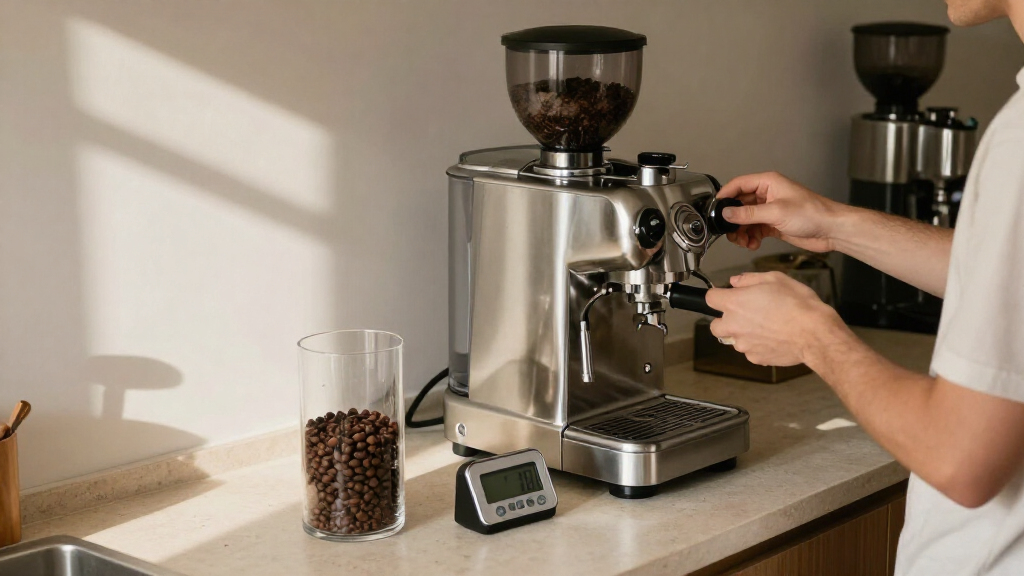
I ranked these four products around the promise of grind-by-time espresso grinding, rather than treating all-purpose coffee features as equally important. I looked for the controls and workflow details that matter when a buyer wants a repeatable grind routine: whether the grind adjustment can be fine-tuned, how explicitly the timer is described, whether grounds can go directly into a portafilter or catch cup, and how much the design supports cleanup between sessions.
The supplied product information does not state an electronic timed-dose feature for every model. The AMZCHEF and SHARDOR list specific adjustable timers, while the Fellow Opus 2 description highlights stepless adjustment and automatic shutoff without giving a timed-grind duration or dose program. I do not treat automatic shutoff as a timer-based dosing feature. The TIMEMORE WhirlY description gives battery and grind-setting details, but no grind timer. That distinction matters: a grinder can be useful for espresso without matching a buyer who specifically wants to set grind time.
Within that constraint, I gave credit for espresso-relevant adjustment and practical grounds handling, then weighed stated limitations such as capacity, power format, and batch size. The ranking is not a claim that seconds deliver identical doses across beans. Timed grinding is a convenience control; changes in coffee, grind setting, and the grinder itself can change how much ground coffee exits in a given interval. I would calibrate a preferred time against a scale and recheck when conditions change.
Finally, I separated the recommendations by buyer and routine. The Opus 2 leads as the most flexible espresso-capable option, not as the clearest timer-first machine. SHARDOR ranks ahead of AMZCHEF for direct portafilter workflow and finer timer increments; AMZCHEF follows as a capable multi-brew touchscreen pick. TIMEMORE earns a distinct place for cordless use, but is last for a fixed countertop grind-by-time workflow because its supplied description does not specify timed dosing.
| grind by time espresso grinder | Included components |
|---|---|
| Fellow Opus 2 Electric Conical | Coffee grinder and two magnetic catch cups |
| SHARDOR Conical Burr Electric | Cleaning brush, residual grounds cleaner, dosing ring, and portafilter cradle |
| AMZCHEF Burr Coffee Grinder wi | — |
| TIMEMORE WhirlY Portable Elect | Grinder, cleaning brush, Type-C cable, and user manual |
Factors to Consider When Choosing Best Grind By Time Espresso Grinders
For this comparison, I separate timed control from the broader question of whether a grinder can make espresso-fine coffee. A grinder may offer fine adjustment without a specified timer, or a timer without the finest grind control. Decide which part of the routine matters most before choosing by the number of settings alone.
What grind-by-time actually controls
A timed grinder runs for a selected duration, then stops or completes the programmed cycle. That makes the operation repeatable by seconds, but it does not directly measure the weight of the ground coffee. Different beans, roast levels, grind settings, and conditions can change how quickly coffee moves through the burrs. For that reason, I treat the timer as a way to repeat a starting point, not as a guaranteed dose measurement.
To calibrate it, I would grind into the portafilter or a catch cup, weigh the result, then adjust the time until the output suits my recipe. I would recheck when changing beans or making a substantial grind adjustment. This is especially relevant when comparing SHARDOR’s 0.1-second increments with AMZCHEF’s 0.5-second increments: finer steps give more control over the selected duration, but do not remove the need to verify the dose.
Timer precision versus grind adjustment
Timer increments and grind increments solve different problems. A timer controls how long the motor runs; grind adjustment changes the particle size. For espresso, the second control affects how water passes through the coffee, while timed output affects how much ground coffee the grinder dispenses. A user may need to tune both, so I would not choose solely by the largest grind-setting count.
The Opus 2’s stepless adjustment is its differentiator for incremental grind changes, but the supplied description does not specify a grind timer. SHARDOR lists 51 settings plus a 0.1-second timer, while AMZCHEF lists 48 settings plus 0.5-second timer steps. The WhirlY lists 30 settings but no timer control in the provided details. These specifications point to different strengths rather than a simple count-based winner.
Direct portafilter dosing or a catch cup
If I want the grounds to fall into an espresso basket, the SHARDOR’s portafilter cradle is a practical advantage. It can reduce an extra transfer step and includes a dosing ring in the listed components. The supplied details for the Fellow mention two magnetic catch cups instead, which suit a more flexible routine across brew methods but do not provide the same direct-to-portafilter setup.
AMZCHEF includes a stainless steel grounds container, while TIMEMORE is designed around a portable, small-batch workflow. Think about where the coffee should land, how often you change brew methods, and whether a separate cup is convenient. A direct cradle can simplify espresso prep, while catch cups offer more flexibility when grinding for several kinds of brewer.
Capacity, batch size, and daily routine
Capacity shapes how often a grinder needs attention. AMZCHEF lists a 10.6-ounce removable hopper, which is a useful fit for a shared kitchen or someone switching between brewing methods. SHARDOR’s stated capacity is 1.4 ounces, so it is better suited to smaller runs than repeated large batches. TIMEMORE recommends 30 grams for espresso, making its scale and battery design a natural fit for individual servings.
The Fellow’s supplied specifications do not state hopper capacity, so I would not assume it matches the larger AMZCHEF hopper. If you usually grind one espresso at a time, a compact capacity may be perfectly workable. For several drinks in a row, batch size, refill frequency, and where beans are stored can matter more than a small difference in timer increments.
Cleaning and retention
Static and retained grounds can leave mess around a grinder and make the amount dispensed less predictable from one run to another. The Fellow describes anti-static features, near-zero grind retention, and tool-free burr access; AMZCHEF lists anti-static design and a stainless steel grounds container; SHARDOR includes a residual-grounds cleaner and cleaning brush. These features address related but different parts of upkeep, so I would compare what is supplied with how I like to clean.
TIMEMORE lists a cleaning brush and clog protection. All grinders still need routine care, especially when switching among beans or when oily grounds build up. Easier access and a clear cleaning routine can help reduce stale residue, but none of these features means maintenance can be skipped.
Power and portability
For a fixed kitchen counter, a corded grinder with a touchscreen or catch cup may suit a repeatable setup. Both SHARDOR and AMZCHEF are listed for 120-volt power, a limitation for buyers outside compatible electrical systems. The Fellow’s supplied details do not list voltage, so check the product information for the intended market before purchase rather than inferring compatibility.
The WhirlY is the only battery-powered grinder in this group. Its 1000 mAh battery, three-hour charge time, and stated capacity of up to 20 espresso shots per charge make it the obvious option when a wall outlet is inconvenient. That portability comes with a small recommended espresso batch and no specified timer, so it is a specialist choice rather than a direct replacement for a timer-equipped countertop unit.
How I would rank the tradeoffs
For a flexible grinder that supports multiple brew styles and offers stepless espresso adjustment, I would start with Fellow Opus 2, while accepting that its supplied details do not document a timed dose control. For direct timed grinding into a portafilter, I would select SHARDOR because it lists both a cradle and 0.1-second timer steps. If a larger hopper and touchscreen control matter more than direct basket dosing, AMZCHEF is the better fit. For cordless use and small batches, TIMEMORE WhirlY has a unique role, but it is not the strongest match for grind-by-time specifically.
My final check would be to confirm the power specification, capacity, and controls against the manufacturer’s current listing. Then I would choose based on the routine I actually follow, not just the number of grind settings or the word “timer.”
Frequently Asked Questions
What does grind-by-time mean on an espresso grinder?
A grind-by-time control runs the grinder for a selected number of seconds rather than stopping at a measured coffee weight. It can make a routine easier to repeat, but it does not promise the same dose every time because bean type, grind setting, and other conditions affect how much coffee exits during that interval. I would use a scale to calibrate the timer and recheck the output when changing beans or settings.
Which grinder in this comparison has the finest specified timer increments?
The SHARDOR CG018B has the finest stated timer increments here: 0.1 seconds, compared with AMZCHEF’s 0.5-second increments. The smaller step size lets a user adjust the selected running time more gradually, but it does not by itself prove more accurate dose weight. The supplied details for Fellow Opus 2 and TIMEMORE WhirlY do not specify adjustable grind timers.
Is the Fellow Opus 2 a timed-dose grinder?
The supplied product details list automatic shutoff for the Fellow Opus 2, but do not state a grind timer, timer increments, or a timed-dose program. Automatic shutoff should not be treated as equivalent to a selectable grind time. I would choose it for its stepless adjustment, broad brew-method range, and catch cups, and pick SHARDOR or AMZCHEF if an explicitly described timer is a priority.
Which option is best for grinding directly into a portafilter?
The SHARDOR is the clearest fit because its listed components include a portafilter cradle and dosing ring, and its timer adjusts in 0.1-second increments. The Fellow Opus 2 includes two magnetic catch cups instead, while the AMZCHEF lists a stainless steel grounds container. If direct basket dosing is central to your routine, SHARDOR’s included cradle gives it an advantage over those alternatives.
Can I use the TIMEMORE WhirlY as my main home espresso grinder?
You can use the WhirlY for small espresso servings, and its battery-powered design suits locations where a wall outlet is not convenient. However, the supplied information recommends 30 grams for espresso and does not specify an adjustable grind timer. For a countertop routine built around timed dosing or grinding several drinks in succession, SHARDOR or AMZCHEF offers more explicitly documented timer controls, while the WhirlY makes the most sense when portability is the main requirement.
Conclusion
For a flexible home setup, I would start with the Fellow Opus 2 if stepless grind adjustment and several brew methods matter more than a documented timer. For an espresso routine centered on a timed run straight into the portafilter, my pick is the SHARDOR CG018B; its 0.1-second increments and cradle make its role clear, provided the small capacity works for you. Choose AMZCHEF if a larger removable hopper and touchscreen timed grinding suit a mixed-brew household better than fine timer steps.
If you need to grind away from an outlet or make small servings on the move, the TIMEMORE WhirlY is the specialist option, not the timer-first choice. Whichever grinder matches your routine, I would treat time as a repeatable starting point, weigh the result, and recalibrate when beans or grind settings change. That simple check is what makes timed grinding more useful for espresso.